






Stepping out of the post-war transition, India’s Finance Minister Mr. C.D. Deshmukh’s Union Budget 1955-56 laid the foundation for the country’s industrialisation. Closing out the First Five-Year Plan, the Budget reflected an increasing tempo of Government expenditure, reported The Hindu on February 28, 1955. Delivering his seventh budget speech, Mr. Deshmukh presented the document in Hindi as well as English – a first since Independence.
Also Read: Nehruvian budget in the corporate age
Prevailing economic conditions
In 1954, both agriculture and industrial production had increased. Production of some commodities exceeded the Five-Year Plan’s targets, reported The Hindu. Restrictions on movement and distribution of foodgrains had been lifted, industrial development had gained pace and cost of living had declined by 7% by December 1954. Inspite of a surplus in the first two quarters, the country’s balance of payments exhibited a deficit of ₹15 crores in the third quarter. Increase in import of raw materials and sugar, decline in indigenous sugar production contributed to a sizeable deficit in the second half of the year. However, the finance minister expressed satisfaction about the country’s external payments position but warned about continued relative shortage of foreign exchange in the long-term.
Saving of ₹11.01 crores in expenditure due to decrease in share of Union Excise Duties payable to States and less defence procurement, led to the revised estimates exhibiting a reduction in revenue deficit to ₹5 crores form the ₹ 15.36 crores as envisaged in the original Budget.
“From now on, unless very marked deterioration took place in the international situation or a natural calamity like the failure or maldistribution of the monsoon occurred in a big way, the determining factor in economic situation, would be the rate pf planned economic development in the country,” he was quoted as saying.
Focus areas of Budget 1955-56
Taxation and duties
Income tax structure was readjusted. With a focus on families, married persons earning upto ₹2000 were exempt from taxes, while unmarried persons earning above ₹1000 were taxed.
“This is the first move in the direction of evolving a suitable scheme of family allowances which the (Finance) Commission have suggested for implementation. The net loss of revenue is estimated at Rs. 90 lakh,” explained Mr. Deshmukh.
Also Read: The Budget pipeline and India’s foreign policy ambitions
The super-tax slab expanded to include an annual income(s) of ₹20,000. Concession to income above ₹45,000 was abolished and concessions for income above ₹25,000 was reduced. Anyone earning above ₹18,000 in salaries, directors of companies and entertainment allowances were all to be taxed. Super-tax of four annas in the rupee was levied on undistributed profits of companies. These changes were expected to yield ₹8.7 crores in additional revenue of which the States’ share would be ₹4.2 crores.
Furthermore, urging larger co-operation towards the Small Savings Movement, the finance minister was hopeful that its targeted collection of ₹45 crore would be achieved for the first time. Small savings for 1955-56 was pegged at ₹52 crores.
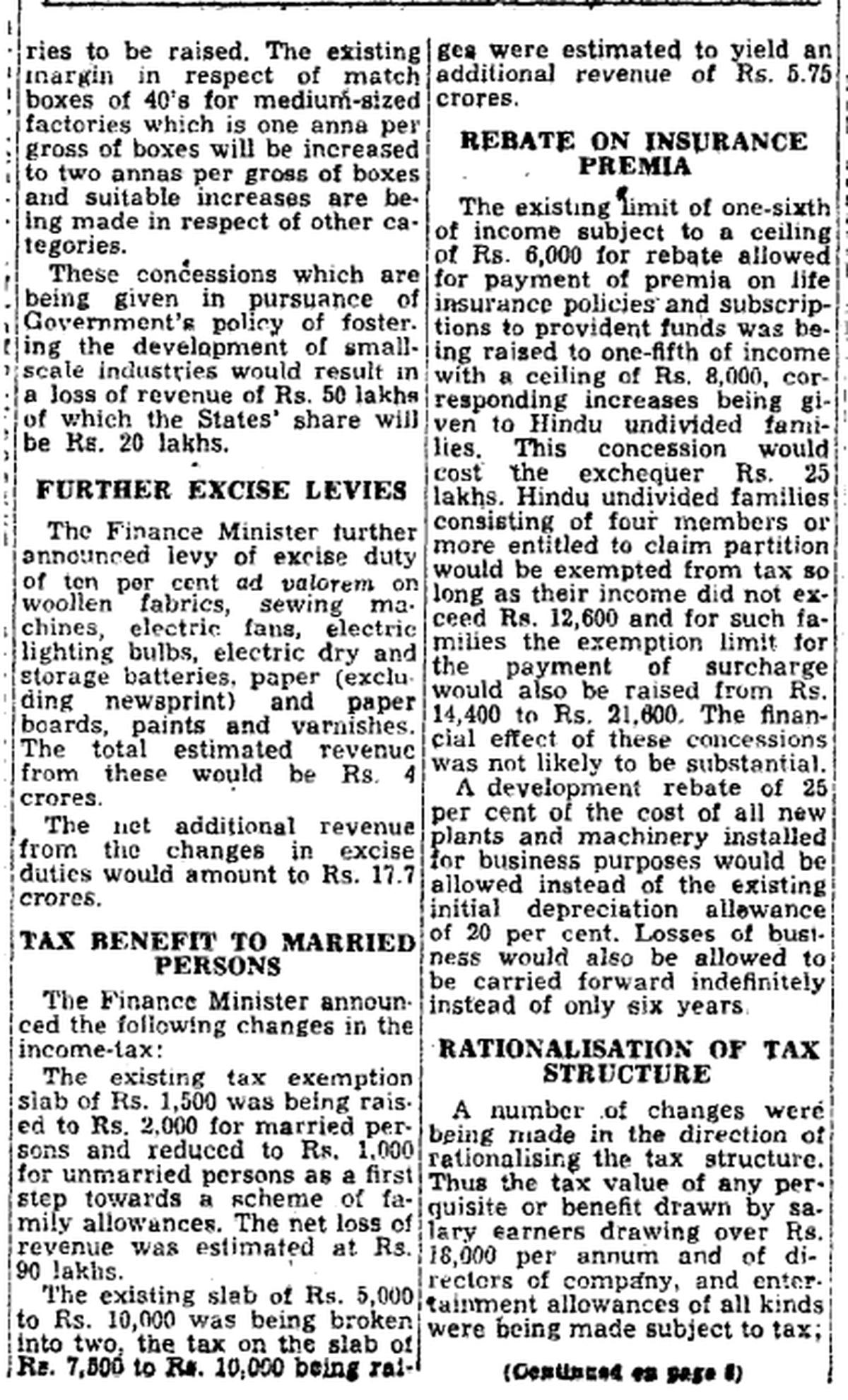
Taxation, custom and excise levies were increased to further reduce India’s revenue deficit in 1955-56. Sugar, textile duties were increased to get an additional revenue of ₹9 crores. Ten percent excise duty was also levied to woollen fabrics, electric home equipment, batteries, paper, paints, adding ₹4 crore to the Centre’s revenue kitty. As a whole, excise duties were pegged to add ₹17.7 crores in revenue.
Industrialisation push
The Centre was ready to take a revenue hit.
Cottage industries were exempt from taxation. Duties on dyeing and tanning substances, gums, resin, plumbago and graphite was abolished altogether while export duty on cotton cloth was reduced to 6.5% to maintain India’s dominant position in the global market. Even match-box industries were strengthened as their existing margin was increased from one to two annas per gross of boxes. The loss of revenue was pegged at ₹50 lakhs.

Bolstering establishment of new factories and machinery, Centre offered a development rebate of 25% of the cost instead of the existing initial depreciation allowance of 20%. Losses of business were allowed to be carried forward indefinitely instead for a maximum of six years.
Education, Defence and Health
Allocation for Education was enhanced by ₹7.3 crores to ₹18.3 crores which included a provision of ₹10 crores to States for Basic, Social and Secondary Education, ₹₹3.5 crores for the University Grants Commission and ₹1.29 crores for scholarships to students of Scheduled Castes, Scheduled Tribes and Other Backward classes. Budgetary allocation for public health was hiked by ₹1.96 crores and by ₹2 crores for science and research.
Defence manufacturing began taking foundation in India as factory to produce electronic equipment was proposed in the Union Budget, while organization, procedure and methods of production in Ordnance Factories were reviewed to expand their activities. However, Defence services were allocated the largest chunk as promulgation of a New Pension Code and pensionary benefits to short-term personnel had increased expenditure of the Navy and Air Force.
“While in present conditions it is not realistic to expect any reduction in the strengths of the Defence Forces, we are trying to effect as many economies as possible by better conservation and utilization of staff, reduction in scale of consumption and avoidance of wastes,” said Mr. Deshmukh, citing the examples of some global economies.
Exhorting citizens to focus on contributing to the economy, Mr. Deshmukh concluded, “All over the country people of small means are making a contribution towards the (Five-Year) Plan by the offer of their resources and sometimes their labour. It is, to me, personally a sustaining and heartening experience and if the spirit behind this continues to animate the people as a whole, we can look forward with confidence to the successful implementation of this and of future Plans”.
Effect of Budget on economy
The Union Budget 1955-56 set favourable conditions for the implementation of the Second Five-Year Plan. Agricultural production remained stable inspite of the floods in North India and cyclones in South India. Commercial crops like oilseeds, raw cotton, sugar, jute exceeded estimated production levels. With the development rebates offered, industrial production saw a 11% increase from the preceding year – mainly in steel, mill cloth, handloom cloth, cement, jute, chemicals and paper.
The National Industrial Development Corporation took up projects of heavy foundries, forges and gear cutting and structural fabrication shops, laying the foundation of heavy machine-making industries in India. Subsequently, the Ministry of Iron and Steel was set up to establish steel plants in the public sector to relieve the steel shortage expected in the Second Five-Year Plan.
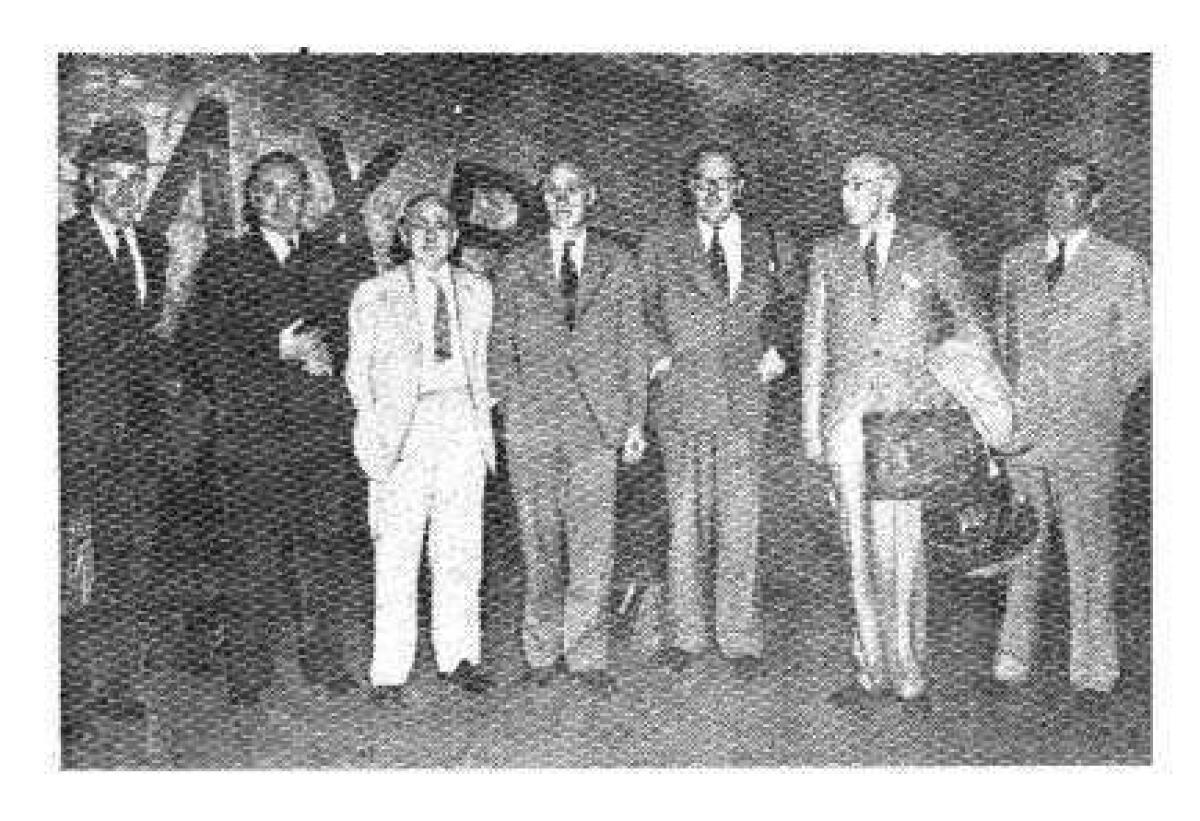
The delegation of the British Steel Consortium which arrived in Delhi on October 25, 1955 for talks with the Government of India for setting up a steel plant in the public sector at Durgapur. Sir Cyril Jones, Leader of the delegation is seen In the centre of the picture.
Wholesale prices which fell in 1953 and 1954 due to revocation of food controls were arrested in 1955 as the Centre stepped up its purchase of wheat and coarse grains while export of several agricultural commodities were permitted. Keeping prices in check, the government periodically released stocks of wheat for sale. On the other hand, prices of food articles and industrial raw materials increased through the year, while prices of manufactured articles remained unchanged. This, in turn, led to rise in cost of living in tandem with the industrial progress.
Despite the progress on multiple fronts, industrialisation had not kicked in enough to tackle India’s job crisis. Unemployment increased by 13% that year with 6.92 lakh people registering at the various Employment Exchanges.
The country’s balance of payment showed a surplus of ₹35 crores and the sterling reserves rose to ₹735 crores by end of 1955. Imports too had risen by ₹28 crores and exports too increased to ₹41 crores.
However, the Centre anticipated a heavy strain on India’s payments position due to the pace of industrialisation. India had already withdrawn $64 million of the $125 million loan sanctioned by the International Bank for Reconstruction and Development and expected further foreign capital for implementing the Second Five-year Plan. Over the period of five years, India’s total income had increased by 18% against the expected 11% and inflation had remained in check by 1955.
(With Inputs from The Hindu Archives)
Published – January 29, 2025 05:35 pm IST