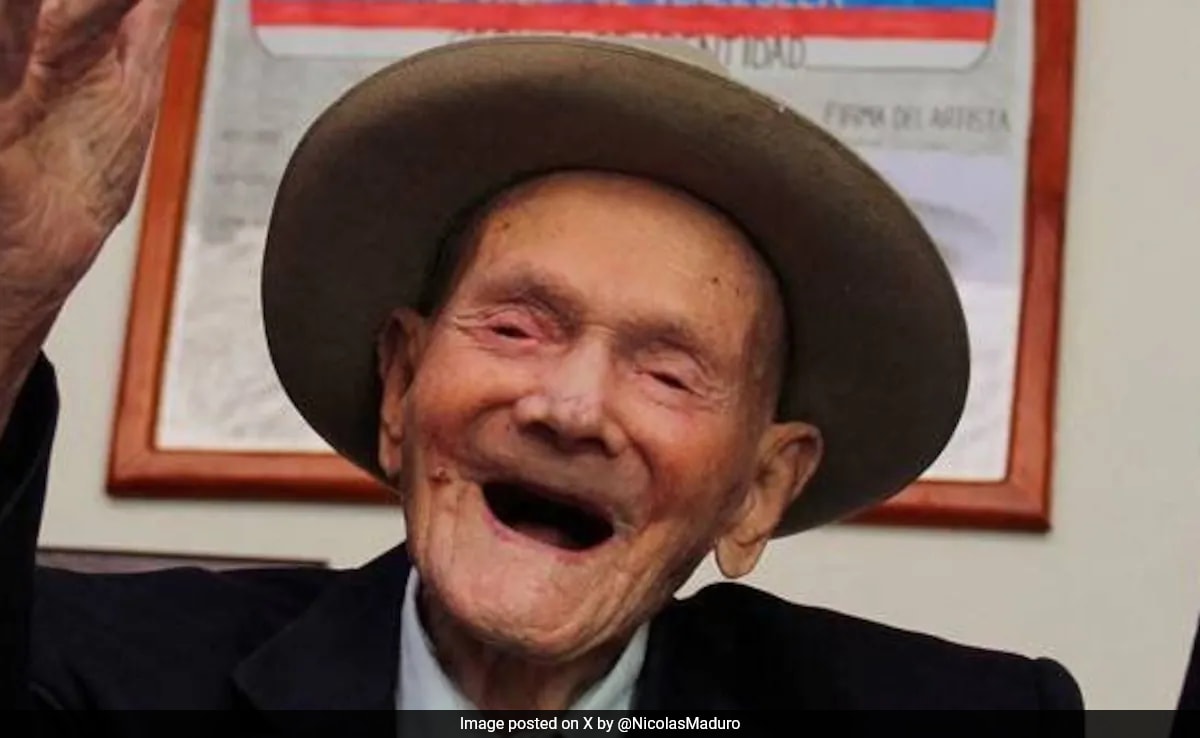
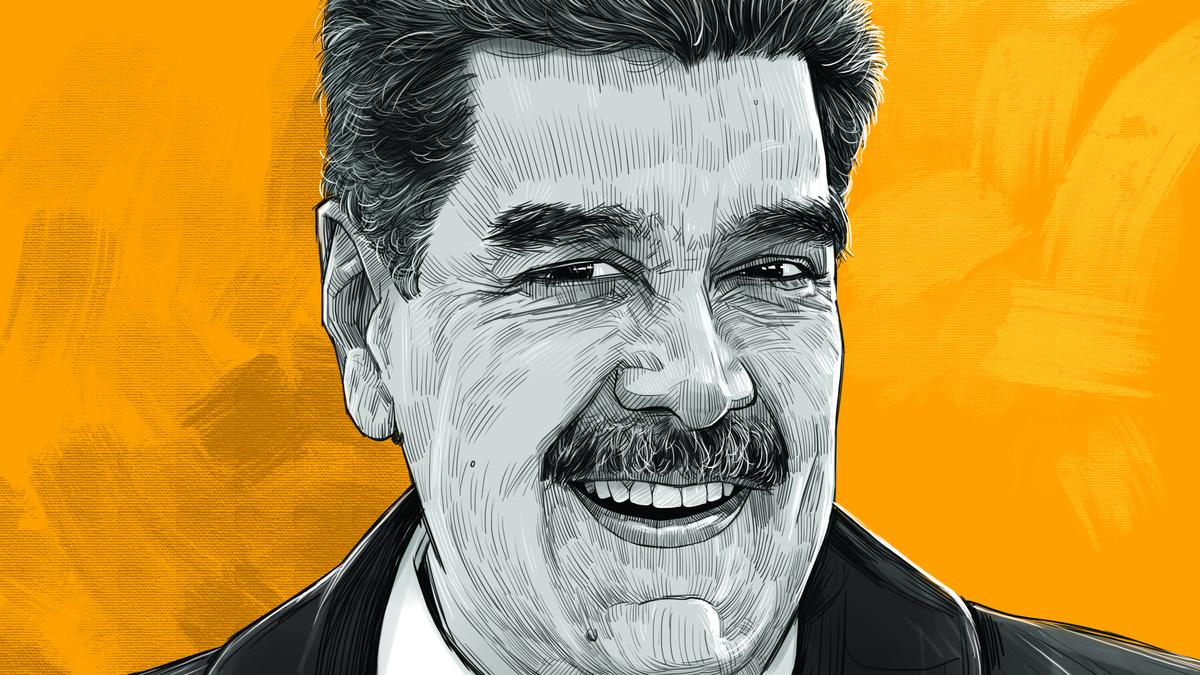
More than 11 years after assuming power as Venezuela’s interim President following the death of popular leader Hugo Chavez, Nicolas Maduro has yet again been sworn in as the President of the Latin American country. The circumstances of the retention of his post and the reactions to the ceremony from international actors provide a sense of deja vu.
In 2019, when Mr. Maduro was sworn in for the second time as President, nearly 40 countries including the U.S., neighbouring Colombia and Brazil and those belonging to the EU, refused to recognise his presidency. Sixteen UN-recognised countries sent representatives, including Bolivia, Cuba, Nicaragua and El Salvador.
In 2025, however, only two Presidents — Cuba’s Miguel Diaz-Canel and Nicaragua’s Daniel Ortega — attended. International condemnation of the manner in which Mr. Maduro was declared President after the elections held on July 28, 2024 has been more severe this time around. Since 2019, there has been a new Pink Tide in Latin America with countries such as Colombia, Brazil and Chile electing leftist Presidents. All three leaders have rejected Mr. Maduro’s “victory”.
Chile’s Gabriel Boric said on Thursday (January 9, 2025) – “From the political left, I tell you that the government of Nicolas Maduro is a dictatorship”. Brazil’s leader Lula da Silva vetoed the entry of Venezuela into BRICS following the latter’s inability to release detailed electoral information on the disputed results. Gustavo Petro’s government in Colombia also reiterated that it did not recognise the election results of July 28 .
Meanwhile, the Opposition candidate, Edmundo Gonzalez Urrutia, who exiled himself to Spain and had recently visited two countries ruled by the Right in Latin America — Argentina and Panama — withdrew plans to return to Caracas for his own “inauguration”.
The results in question and the process in which Mr. Maduro was declared the winner raise severe doubts about the Venezuelan elections in 2024. The U.N., which sent a panel of experts to Caracas, criticised the National Election Council of Venezuela for declaring Mr. Maduro as the winner before providing detailed table-level results.

The electoral system consisted of an electronic voting machine which produced a paper receipt after voters registered their choice at the polling booth. At the end of polling, each machine would print a tally sheet showing the candidates’ names and the votes that they received. The National Election Council traditionally put up only the vote counts at the end of the election on its website, but the site was down during the counting and after disputing the results, the Opposition demanded the release of the tally sheets which was not done.
The Opposition could, on its own, access 83% of the tally sheets from 30,026 polling stations, which “revealed” that Mr. Gonzalez polled 67% votes. The CNE’s figures were different, favouring Mr. Maduro with 51.95% of the vote to Mr. Gonzalez’s 43.2%.
Considering the wide differences on this issue and the fact that the Maduro regime had used intimidatory tactics throughout the election process, several international actors sought the release of the tally sheets to confirm the winner but that was not done.
Economic decline
The 11 years of rule by Mr. Maduro has coincided with a significant decline in Venezuela’s economic standing, with severe increases in the poverty rate, persistently high inflation and food shortages in the country. While inflation had eased to 23.58% in October 2024, hyperinflation has characterised the economy since 2018.
As of October 2023, the UNHCR estimated that more than 7.7 million Venezuelan citizens fled the country to become refugees and 6.5 million among them (84%) are in Latin America and the Caribbean.
Critics of Mr. Maduro blame the catastrophic economic situation on the stark authoritarian turn since he came to power. Some suggest that the economic decline was inevitable as Venezuela was overly dependent upon the petroleum sector — crude constituted 95% of the country’s exports in 2014 and the oil price crash in the same year sent it into a spiral.

Critics argue that the seeds of the economic decline were laid during Chavez’s regime, as he tried to undo the remnants of the country’s liberal democratic order to create a personalised state with concentrated powers for the executive presidency.
Following a coup attempt in 2002 against Chavez, his supporters – the Chavistas – sought to rewrite the rules of power in the country by moving it away from what observers termed an inflexible and ideologically one-sided, two-party system (a byproduct of the Puntofijo Pact between political parties in 1958).
The Chavistas instituted a series of measures, including constitutional referendums and structural changes, most of which received popular support as Chavez won several elections. The Chavistas argue that the regime enhanced grassroots participation in the polity and built cooperatives while using the proceeds of the extractive economy to fund pro-poor programmes. And while the regime was cognisant of diversification, the lack of it during the oil price crash resulted in the economic crisis, which was exacerbated by a series of economic sanctions imposed by the U.S. and the EU after Mr. Maduro came to power. Following the economic crisis, these structures of power were utilised by Mr. Maduro to entrench himself.
Since his ascent to power, Mr. Maduro’s regime has moved away from a popular regime that was dependent upon grassroots mobilisation and participatory democracy to an authoritarian system.
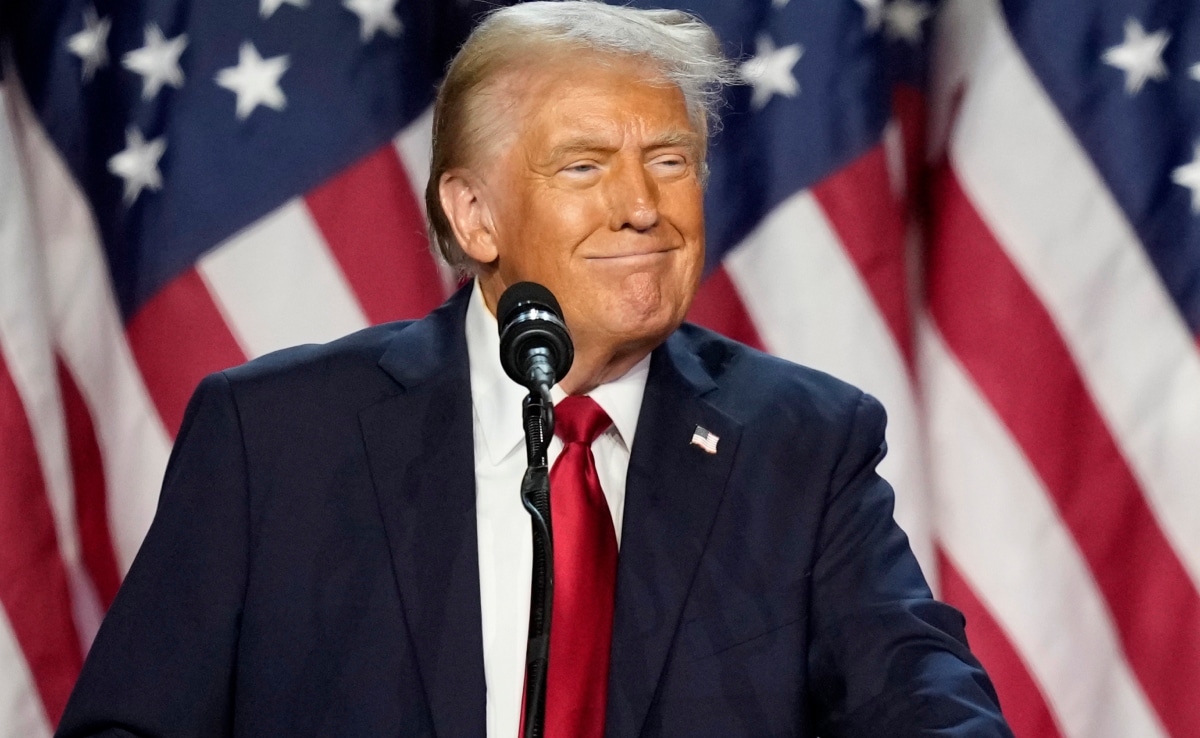
The first Donald Trump administration in August 2017 imposed sanctions prohibiting the Venezuelan government from accessing U.S. financial markets, a move that affected Venezuela’s state-run oil company, PDVSA. The U.S. went on, in 2019, to impose further and direct sanctions on PDVSA, preventing it from being paid for petroleum exports to the U.S, froze its U.S. assets and disallowed the supply of diluents that aided the refining of Venezuelan heavy crude, among other measures.

The U.S.-imposed economic sanctions were compounded by the EU’s own embargo on arms and material to be traded with Venezuela, imposed in 2017. Restrictions still remain. The country got a respite when the U.S. eased some sanctions following an agreement signed between Mr. Maduro and representatives of Opposition parties in October 2023 in Barbados with political prisoners being released. The country’s oil output saw an increase, resulting in more exports and a partial easing of the severity of the economic situation. However, in April 2024, the U.S. announced that sanctions would be reinstated on the oil sector.
International opprobrium
Just prior to the inauguration of his third term, the U.S. announced a $65- million bounty for the arrest of Mr. Maduro even as he received support from Russia and China apart from staunch allies in Cuba and Nicaragua.
The international opprobrium and increased polarisation in Venezuela is not deterring Mr. Maduro from doubling down on authoritarianism. A proposed law — the Simon Bolivar law — now stipulates severe punishment for dissidents and repression of civil movements. With Mr. Trump returning to power in the U.S., hostilities are set to renew afresh and the biggest casualty could be the millions of Venezuelans pushed into poverty from a combination of poor economic policies, international sanctions and authoritarianism under Mr. Maduro.
Published – January 12, 2025 01:15 am IST