





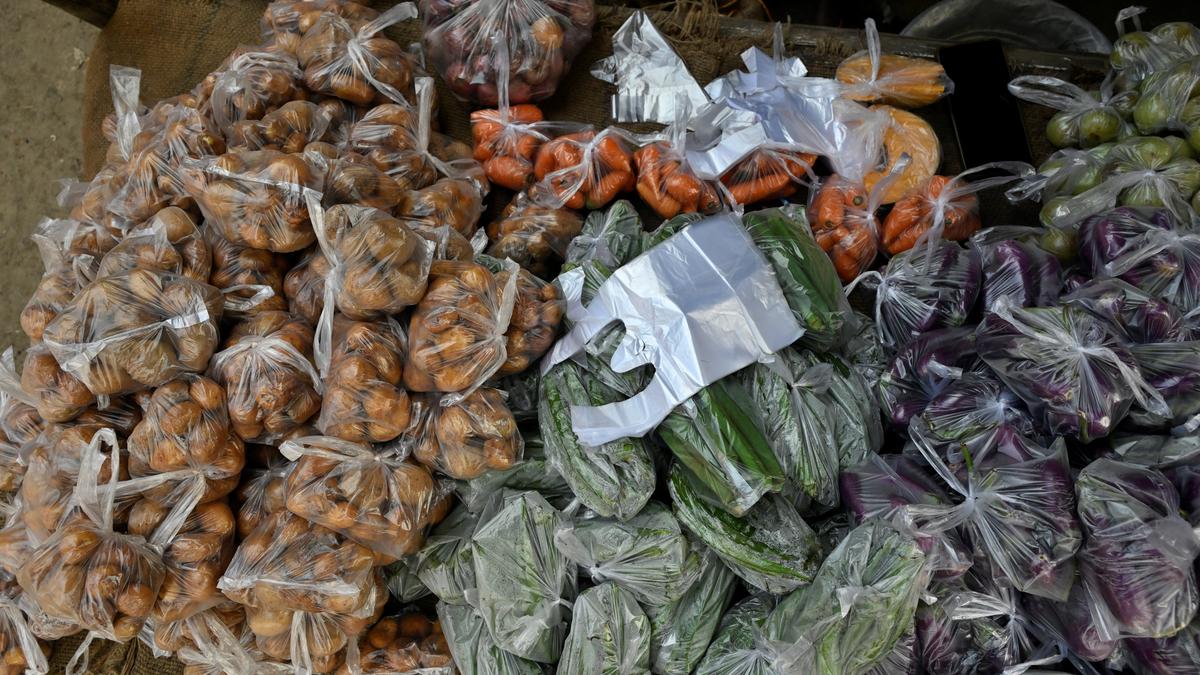
The Koyambedu Wholesale Market in Chennai, one of Asia’s largest wholesale flower and vegetable markets, hums with activity on a busy weekday morning. Truckloads of goods pour in as workers unload bags of vibrant flowers in bright blue plastic covers. Elsewhere, as evening falls, people head home after work. Along the way, many stop at roadside carts to buy vegetables. A woman reaches into her handbag, only to realise that she’s forgotten to bring a carry bag. She asks the vendor for a plastic cover, but he shakes his head. Just as she begins to walk away, he pulls a stash hidden under his cart and hands her a flimsy plastic cover.
It has been six years since the Tamil Nadu government enforced a ban on single-use plastics (SUPs). The ban on products such as carry bags, food wrapping sheets, plastic plates, straws, and pouches came into force on January 1, 2019. It is aimed at reducing the growing environmental and health hazards posed by plastic waste. The harmful impact of plastics is no longer deniable, as plastic waste chokes waterways, clogs storm water drains, and contributes to flooding. The environmental toll is severe, affecting wildlife and polluting ecosystems. Yet, a casual walk through any street or market in the State will likely show these items in circulation.
S. Manickam, a 50-year-old pushcart vendor, describes the challenge in avoiding SUPs. “I don’t earn much in a day, and if I don’t sell the produce, it will go to waste. What can I do?” A. Ajmir, a meat shop owner in Chennai, says, “No one comes with their own container for meat, so I have no choice but to give them the black covers. I try to keep it to two per customer.” Notably, there has been some progress in reducing the use of plastics over the past few years. While supermarket chains and restaurants have largely shifted from SUPs, these items are commonly encountered in everyday life. C. Thiruvettai, president of the Street Vendors Association, Chennai district, says there is a misconception that most plastic waste in cities and towns comes from roadside vendors. He says the plastic covers distributed by street vendors account for a small fraction of the waste, which is largely from pre-packaged products made by large corporations.
Pointing to the irony in carrying cloth bags for buying products packed in plastic covering, Mr. Thiruvettai says there has been a significant cultural shift towards consumption since industries took over production, distribution, and sales. In the past, most people bought goods in small quantities from street vendors, and items were often sold loose, wrapped in newspapers or leaves, but it is not the case now, he says. He acknowledges that while the use of plastic cover decreased in the first few years of the ban, it has increased among street vendors in recent years, partly owing to lax enforcement by the police.
A step towards change
To support implementation of the ban and promote the use of alternatives, the government launched Meendum Manjappai on December 23, 2021. The campaign is meant to raise awareness of plastic pollution, encourage the use of cloth bags, and enforce the ban on SUPs. The term is a hark-back reference to the ubiquitous yellow cloth bag people carried for shopping. As part of the campaign, the Tamil Nadu Pollution Control Board has installed manjappai vending machines at public places, collaborated with self-help groups to produce cloth bags, and inspected shops for plastic use. A 2024 study on the efficacy of the campaign, conducted by the Citizen Consumer and Civic Action Group (CAG) with 1,632 respondents in eight districts, showed that a major challenge in switching to the alternatives is that they are often expensive and hard to find. People in urban as well as rural areas face similar issues — plastics are easily available, but alternatives are not. Market vendors, though aware of the dangers of plastics and the ban, rely on SUP bags owing to customer demand and the high cost of the alternatives. “Can one see water packets anywhere these days? Or thermocol plates,” asks S. Chandrasekaran, an environmental engineer of the TNPCB. He sees in this the success of the ban, so far, in removing these two products from use.
In Ramanathapuram, the opening of the Rameswaram-Dhanushkodi-Arichalmunai Road brought a significant influx of plastic waste to the ecologically sensitive marine environment. In June 2023, Jagdish Bakan, District Forest Officer at the time, established a ‘plastic checkpoint’ at the Gulf of Mannar Biosphere Reserve, with the involvement of the local community, to prevent unnecessary plastics getting into the eco-sensitive zone. Vehicles are inspected for plastic, items are collected, and tourists receive eco-friendly cloth bags. An environment fee of ₹20 per four-wheeler funds the initiative, while the plastic is recycled for road construction, generating revenue, and promoting sustainability. “The initiative brought about a considerable, visible reduction in plastics,” Mr. Bakan says.
Despite such initiatives, enforcement remains inconsistent, particularly in regions like The Nilgiris. Shobana Chandrashekar, convener of the Make Ooty Beautiful Project, says the enforcement of the ban was strict until about two years ago, largely because locals who supported it kept up the pressure on the authorities. “It’s tiring,” she says, adding that three Collectors changed in the past two years. “At some point, the effort needs to be self-sustaining.” She adds that district administrators must recognise the positive impact of the ban on the environment and take measures to maintain it.
Though all plastics are technically recyclable, a significant portion fails to reach recycling centres. On the one hand, plastic covers, bags, and straws are still used, and on the other, pre-packaged food products have become increasingly prevalent in today’s consumer-driven economy, syncing in with the existing culture of excessive consumption. When one thinks of SUPs, flimsy plastic covers often come to mind, but it’s crucial to include items like packages of chips, biscuits, and other goods. This is where Extended Producer Responsibility (EPR) comes in. It requires brand owners, importers, and manufacturers to manage post-consumer waste. However, researchers say that companies often exploit loopholes to evade accountability.
Flowing from neighbouring States
According to official data, the TNPCB has closed down 240 plastic manufacturing units since the ban came into force. Many of these manufacturers have reportedly switched to eco-friendly alternatives. However, TNPCB Chairperson M. Jayanthi acknowledges that controlling the flow of plastic covers into Tamil Nadu from neighbouring Andhra Pradesh, Karnataka, and Puducherry remains a significant challenge.
Health Secretary Supriya Sahu says implementing a plastic ban is a complex undertaking, and its impact cannot be fully realised in three years. “We’ve been grappling with the onslaught of plastic for over five decades, so expecting an immediate change is unrealistic,” says Ms. Sahu, who spearheaded the Meendum Manjappai campaign when it was launched in 2021. “We are still in the initial phase of transformation. The primary goal of the campaign has been to raise public awareness, but the government is continuously working to create a more substantial impact.” She also points out that while the State has enacted a ban, the lack of uniformity in its enforcement across the country contributes to the presence of plastic.
The challenge of controlling plastic waste, however, is not just about enforcement but also about shifting the focus from waste management to reducing plastic production altogether. Mr. Thiruvettai suggests that the government provide eco-friendly alternatives to street vendors for a year to help change the mindset in both vendors and consumers.
Madhuvanthi Rajkumar, author of the CAG study, highlights the need to shift the focus from the consumption stage of plastics to production and pellet-manufacturing. The focus now tends to be on consumers, particularly at the consumption and dispersal stages, as these are the most visible aspects of the problem. However, this approach overlooks the root cause — how plastics are produced, she says.
Ms. Rajkumar, who is playing an honorary role in the Children and Youth Major Group to the United Nations Environment Programme, says nearly half of India’s plastic polymers are used to make single-use plastic products. Regulations must extend to the manufacture of pellets and polymers, and not just plastic products, she says, adding that though Tamil Nadu has made progress in regulating plastic bag production, centralised measures are needed to address the entire supply chain.
She points out that while consumers are blamed for prioritising convenience, the real issue lies in how corporations, especially multinational companies, have flooded the South Asian markets with cheap, non-recyclable plastic products in the past 40-50 years. “These products, including everything from shampoo to coffee-packaging, are often multilayer plastics. In contrast, in the countries where these companies are headquartered, you’ll find only recyclable options. This shows a double standard: these companies flood the South Asian markets with waste, while avoiding responsibility for its disposal,” she adds.
Steps ahead
Ms. Jayanthi says the TNPCB did not just stop with the ban but it is continuing the action on the ground, including special enforcement drives, as mandated by the Central Pollution Control Board. These drives are carried out four days a month. Official data show the TNPCB has closed 240 plastic manufacturing units since the ban, many of which have switched to making eco-friendly alternatives. However, the flow of plastic from neighbouring States remains a significant challenge.
She says recommendations were made at the eco-alternative conclave conducted by the TNPCB in November 2024, in which several State Pollution Control Boards and Tamil Nadu government departments participated. One way of strengthening the enforcement of the ban is to delegate authority to multiple agencies, as in Maharashtra, where 21 departments share jurisdiction. Broadening enforcement to include agencies such as the Sales Tax, Forest, and Tourism Departments could ensure more comprehensive compliance.
According to a document outlining the outcome of the conclave, local authorities could take inspiration from Odisha’s model of plastic-free picnic spots by designating key tourist sites and public places as plastic-free zones. These zones would be supported by awareness campaigns and stringent enforcement measures. Policies similar to Himachal Pradesh’s buyback scheme, which offers ₹75 per kg for non-recyclable plastic, could be introduced to help the informal sector take part in waste collection. Finally, expanding initiatives like Delhi’s Vikalp Stores — where customers can borrow and return reusable bags — could promote the use of eco-friendly alternatives.
Published – January 05, 2025 12:03 am IST