


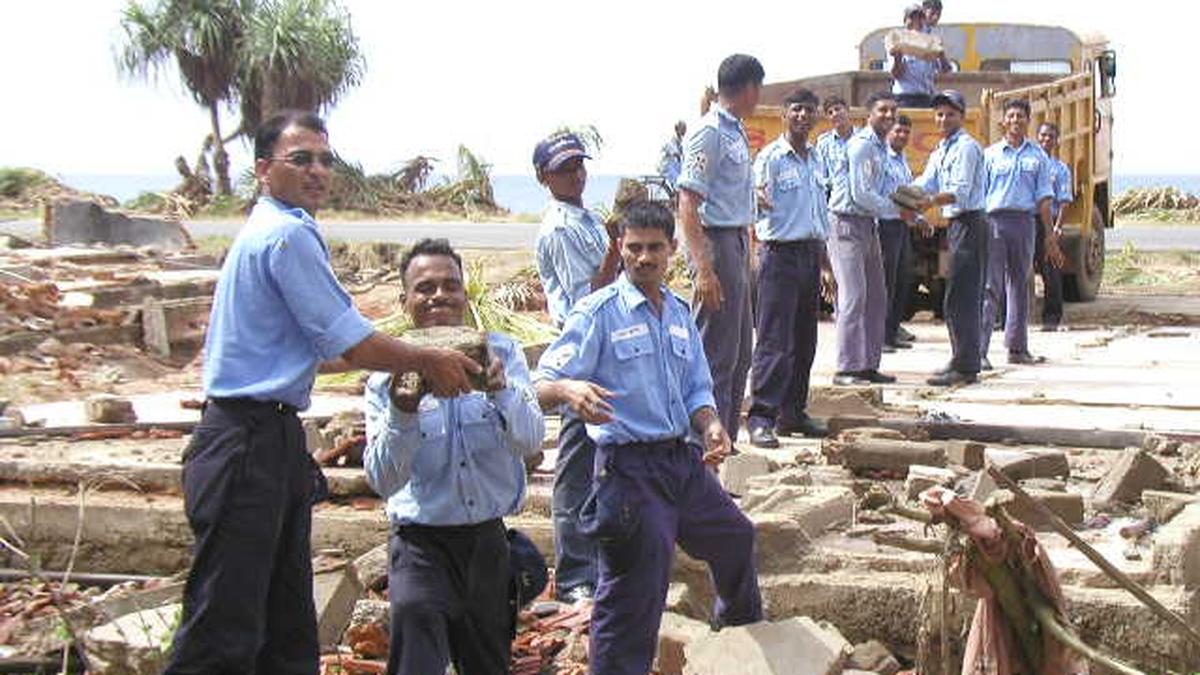
Indian Navy personnel retrieving rubble from destroyed buildings for reuse at Kahawa camp in Galle, Sri Lanka, in January 2005.
| Photo Credit: Special Arrangement
The terrible memories of the Asian tsunami of December 26, 2004 may never fade away from the minds of the millions of its victims and the people who worked to provide relief and rehabilitation in the immediate aftermath of the huge tragedy.
Memories that may never fade are of the initial phases, where the victims’ struggle to understand what was happening to them and their desperate look for their near and dear ones and where governments and other agencies tried to assess the damage and provide immediate relief.

Having been part of the rehabilitation works in Galle, Sri Lanka, my memories of those days remain as fresh as ever. Twenty years down the line, what lessons linger? What must be remembered?
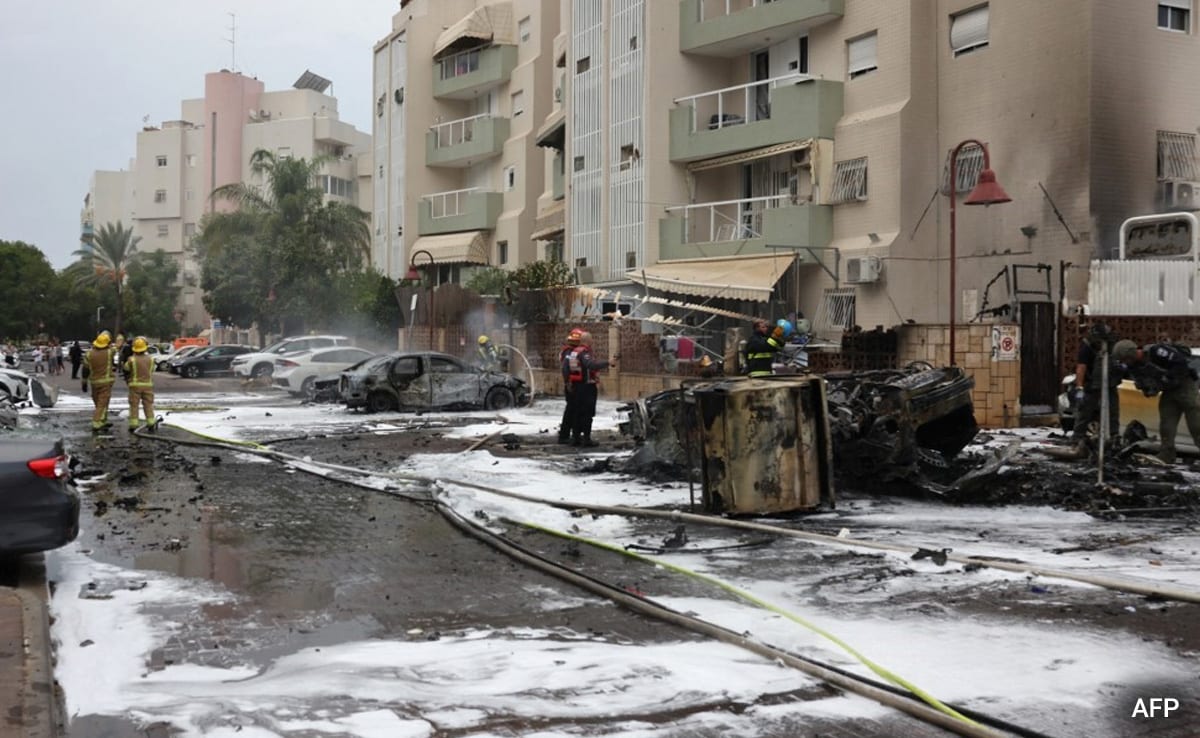
Since nature does not acknowledge manmade social classes, the tsunami dealt its destruction evenly across society. From the mighty authorities to the man on the street, everyone was trauma-stricken. Life and property had been simply rubbed out of a swathe of land adjoining the seas. Fishing boats dumped ashore as piles of broken timber, warships that lay capsized after having been lifted high out of the water and slammed back onto jetties, heavy trucks that had flown away as if made of paper, a strong naval base destroyed beyond what any enemy could have done, thousands of buildings reduced to rubble and a large populace bereft of any emotion, forced to lean on any helping hand that anyone could provide.
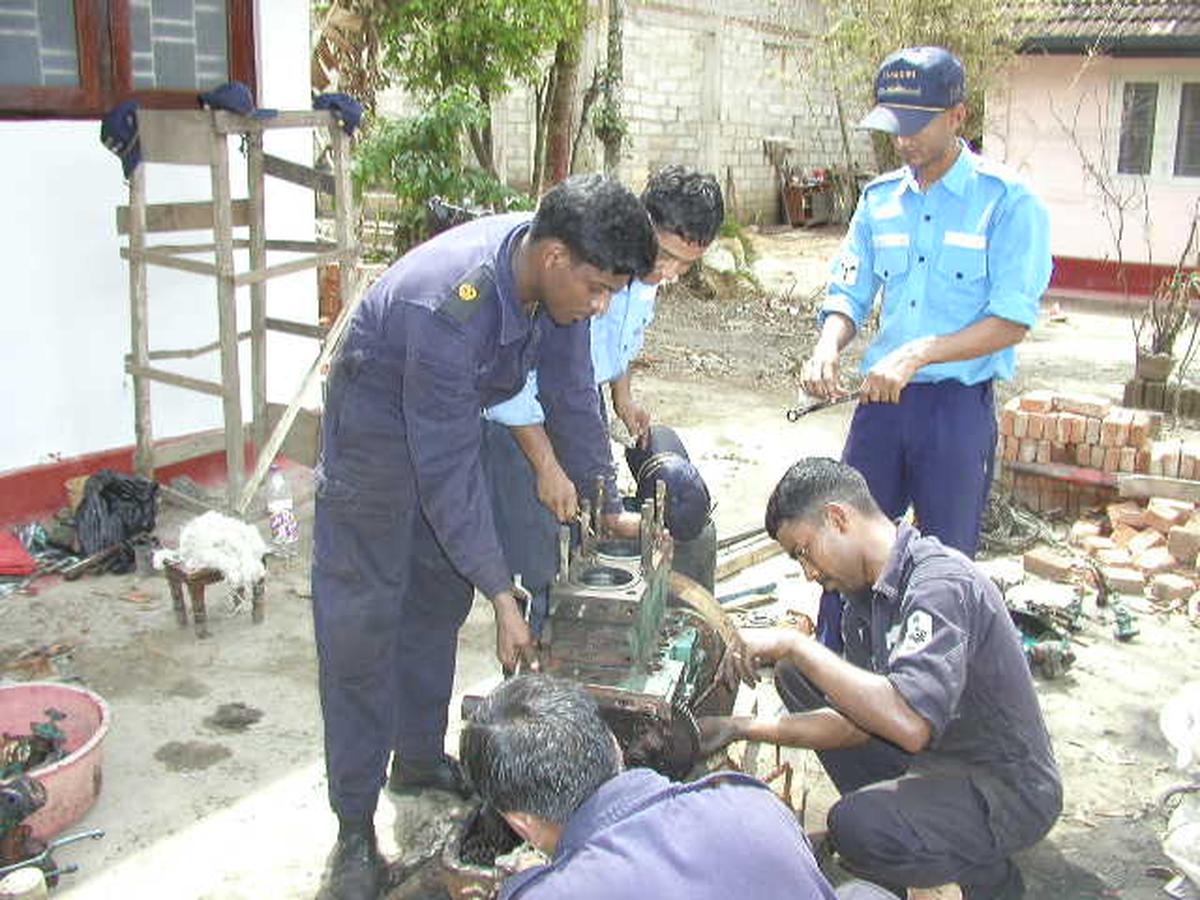
A trawler engine being repaired under the aegis of the Indian Navy in the aftermath of the 2004 tsunami.
| Photo Credit:
Special Arrangement
Military and disaster relief
Regardless of any structures made for the purpose, the military will always remain the primary and the most effective responders in any disaster. It is their sheer discipline, ability to perform through the fog of war, effective command and control structures, their mastery over every trade essential for working amidst destruction and the subsequent reconstruction, the ready availability of massive quantities of provisions that are meant for their own use and their never-say-die attitude are what lead to their perennial perch as the most effective responders. This is what came to be of use during the 2004 tsunami too.

Selfless response
India’s immediate, massive and selfless response which reached help to Indonesia, Sri Lanka and Maldives despite the massive destruction at the Andaman and Nicobar Islands, and along the coasts of Andhra Pradesh, Tamil Nadu, Kerala and Karnataka, was something the world sat up and took notice of.
The Army, the Navy and the Air Force delivered a performance that had a great impact on an array of areas. For instance, the Indian Navy had its aircraft landing in Sri Lanka within hours of the tragedy to deliver relief material. Indian Navy’s hydrographic ships reached foreign ports within 24 hours, cleared sunken craft from the path, and established navigable channels into harbours. Other warships brought in personnel and capacities of immediate use. The Navy and the Army flew in massive reconstruction teams, specialist teams and medical teams to provide wholesome services in conjunction with what the warships had brought.
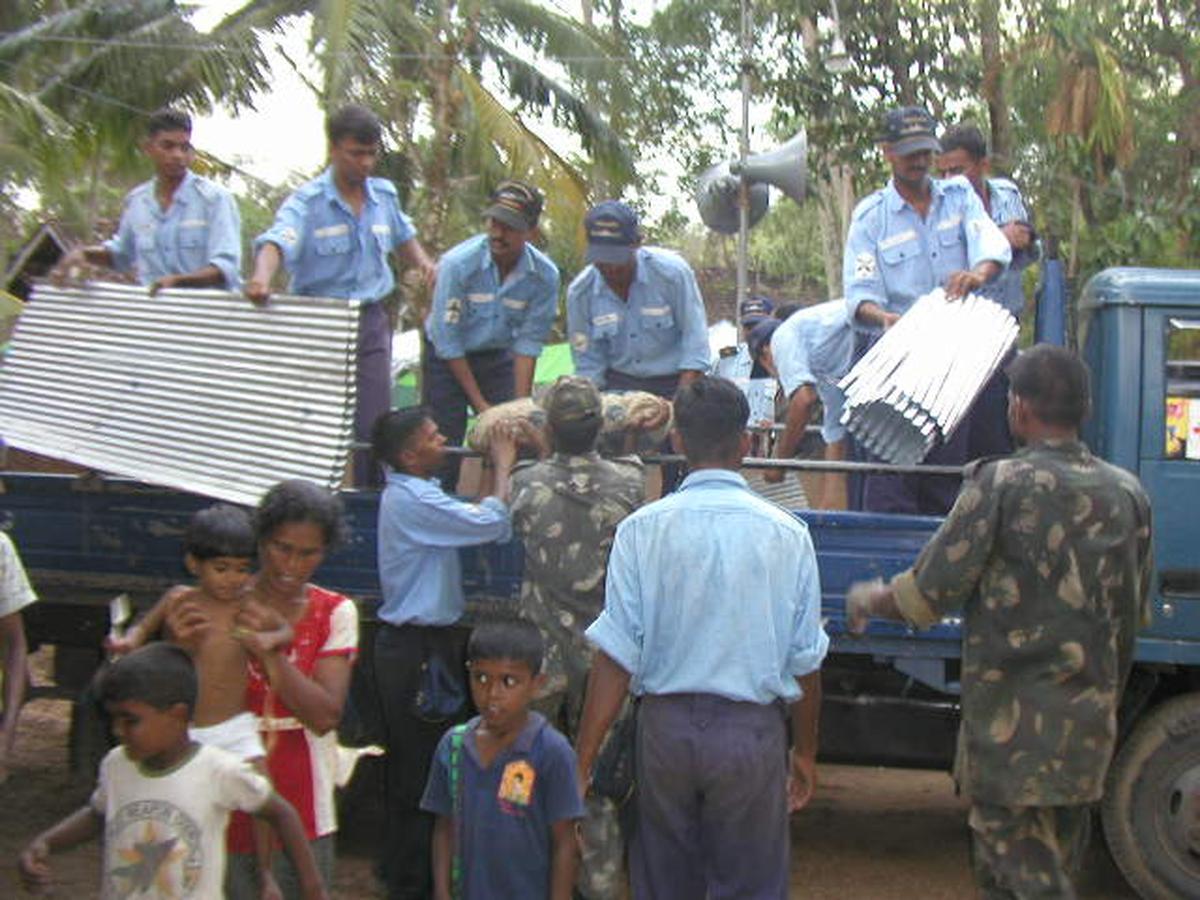
Indian Navy personnel help set up a camp at Kahawa, Galle, in the aftermath of the tsunami in 2004.
| Photo Credit:
Special Arrangement
Tasking and execution
Perhaps, the greatest asset that a Commander on ground like me received was total freedom to do what I wanted to do. Military leaders in India or Sri Lanka are the same. Purely professional. I received no iron-clad orders from either side. Both sides just said, ‘do your utmost and reach out to us if you need anything’. My own Commander in Chief in India, the local Sri Lankan Naval Commander in Chief and the Indian High Commission at Colombo stood like rocks behind us, never ordering anything. Nothing could have been better in getting down to work.

The Navy and the Army combined with ease and the massive work started. At the end of it, in a few weeks, in the Galle area alone, the dead had been buried, epidemics had been prevented, thousands of people had been provided food and medical help, dwellings for thousands of people had been created, complete with cook houses and even community centres. Hundreds of wells had been made usable, many kilometres of pipelines had been laid for water, electricity lines had been laid or repaired, many fishing boats had been revived, close to a score of underwater railway bridges had been examined for damage using specialist equipment and divers flown in from India.
Every dwelling created was immediately occupied and many smiles returned. The Sri Lankan authorities and members of the public who were not affected by the tsunami contributed excellently to make our work possible. The heartwarming fragrance of universal brotherhood was everywhere. The Sri Lankans had felt the steadying hand of a genuine friend. These things survive changes in political dispositions and geopolitical upheavals. Though other countries contributed men and material for work in Sri Lanka, the (then) President of Sri Lanka met only an Indian Navy delegation to personally convey the country’s gratitude.
Enduring lessons
Big powers have big responsibilities. It is essential to have the capacity in excess for the needs of others, after catering to our own purposes. Maintaining this excess despite the shifting requirements of geopolitics and the debilitating effects that inadequate budgets can have, is vital to being a big power.
The tsunami is understood to have been the real impetus to the final formulation of the National Disaster Management Authority (NDMA) and their subordinate structures. Since response to disasters demand speed and imagination, it is important to have as many people with background in armed forces in the disaster management system in positions where quick decision-making is necessary. Capacity creation and routine administration could be done by others.
While the world as a body and the country have taken many steps for disaster mitigation, it is important to differentiate between activity and achievement.
The sporadic SMSes that I receive on my phone as INCOIS-ITEWC bulletins, announcing earthquakes from distant places such as Kamchatka or Solomon Islands, are useful, made possible by the infrastructure now created. However, information is only one part of the requirements. Preparing vulnerable populations by spreading awareness of what perils can befall them through constant engagement and disseminating information in quick time so as to give those in danger the best chance to save their lives are of paramount importance. Tsunamis will happen again. But their effect can be minimised.
Commodore (retd) G. Prakash is a former Indian Navy Officer
Published – December 24, 2024 04:07 pm IST