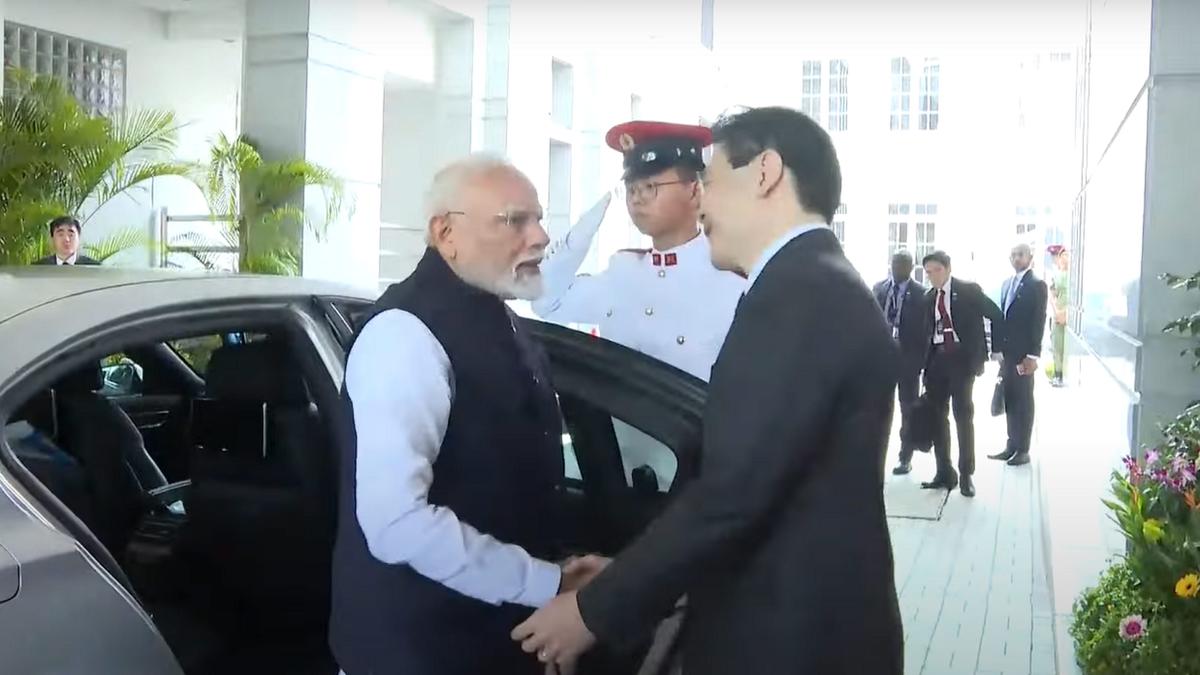



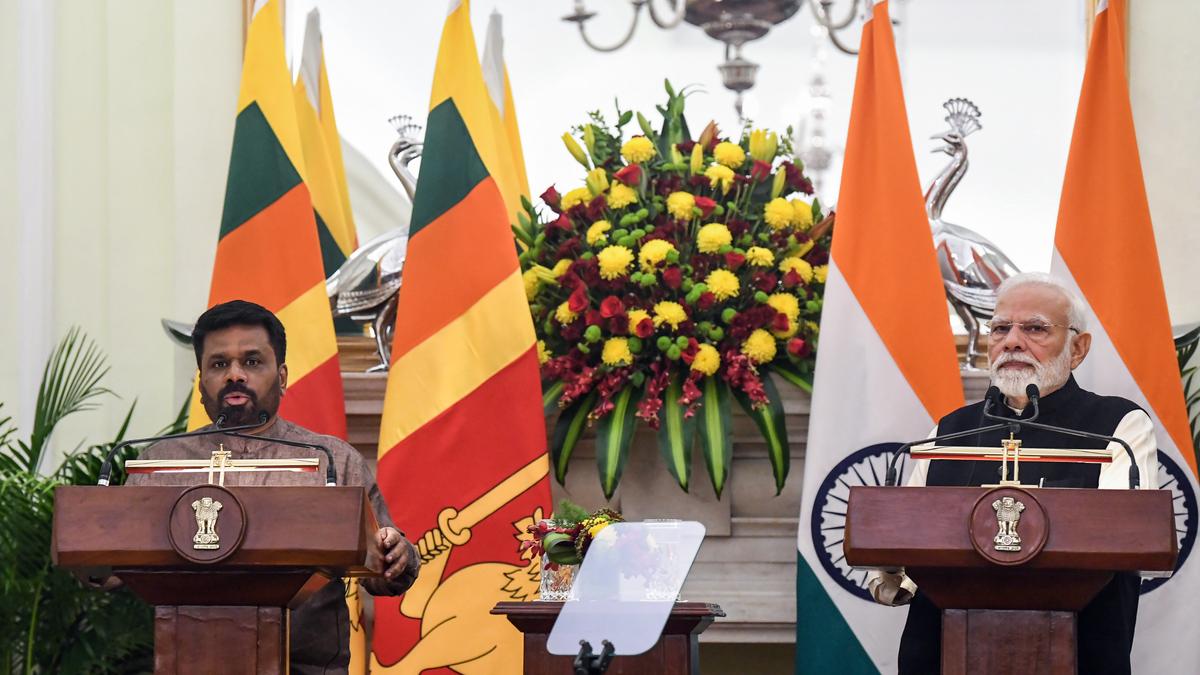
Many in Sri Lanka closely tracked their President Anura Kumara Dissanayake’s recent visit to India. The ceremonial red carpet welcome he received from Indian President Droupadi Murmu and Prime Minister Narendra Modi, his various engagements, and, importantly, the joint statement issued by the two governments, drew much notice in the local media.
It was Mr. Dissanayake’s first state visit abroad, after he won the presidency in September this year, and the ruling National People’s Power (NPP) won a spectacular two-thirds majority in the general election in November. India was hosting not just one of Sri Lanka’s most powerful Presidents but also a leftist leader from a party (Janatha Vimukthi Peramuna – JVP or the People’s Liberation Front) that once furiously opposed India and its perceived “interventionist” role in Sri Lanka.
Much has indeed changed in India, Sri Lanka, and in India-Sri Lanka relations. The JVP is not the same today, as the story of its rise to state power reveals. Neither is Sri Lanka, whose political landscape stands radically altered in ways few imagined possible two years ago. Analysts are yet to fully decipher the astounding victory of the JVP-led NPP, especially in the island nation’s north, east, and the hill country that are home to the country’s Tamil, Muslim and Malaiyaha Tamil minorities. India’s priorities, too, have seen a marked shift, as New Delhi remains preoccupied with countering Chinese influence in the neighbourhood.
Changing Indian interests
While everything else changes, Sri Lanka’s long-pending national question remains, with all past governments in Colombo failing to deliver a definitive political settlement. India’s past involvement as an arbiter of Tamil rights, for many in Sri Lanka, set high expectations for its influence in more recent decades, including the post-war years since 2009. In an interview to this daily in 2022, late Tamil leader R. Sampanthan said “India has a special duty” in ensuring that the spirit of the Indo-Lanka Accord of 1987, and the 13th Amendment to the Sri Lankan Constitution born out of it, are fully implemented. Except, Indian interests today are evidently different.
The joint statement issued by New Delhi and Colombo on December 16, 2024, offers a reality check. The 34-point document, titled ‘Fostering partnerships for a shared future’, and spanning political, economic, and strategic cooperation, makes no reference to the pending political solution, or post-war reconciliation, or Tamil aspirations. The only power sharing that finds mention is in a proposal for a high-capacity grid interconnection between India and Sri Lanka.
However, in his remarks at the joint press conference, Mr. Modi said, “We hope that the Sri Lankan government shall fulfil the aspirations of the Tamil people. And that they shall fulfil their commitment towards fully implementing the Constitution of Sri Lanka and conducting the Provincial Council Elections.” He did not reference the 13th Amendment.
Mr. Dissanayake framed the issue differently. He said, “People from all the Provinces — North, South, East, and West — representing diverse communities and various walks of life contributed to this mandate. As a leader entrusted with such an important responsibility by my people, I clearly understand that the essence of democracy lies in the coexistence of diverse political views and groups.”
The NPP’s poll manifesto includes an assurance to hold elections to the provincial councils, now defunct for over five years, and enact a new Constitution based on wide public consultations. President Dissanayake, too, has made the pledge more than once. But his government is yet to spell out its own vision for a durable political solution.
The NPP has consistently avoided the language of the “13th Amendment” that till date carries the baggage of “Indian imposition” for the country’s Sinhala-Buddhist majority, and likely triggers discomfort for the JVP party base. In a recent column, ‘NPP in Power: Possibilities for Post-War Reconciliation through Civic Nationalism’, Sri Lankan political scientist Jayadeva Uyangoda observed that the NPP shuns both the “devolution discourse” introduced by India, and the “liberal peace discourse” of conflict resolution, reconciliation, and peacebuilding, promoted by agencies of the United Nations, global and local rights groups. He wrote, “The NPP does not seem to want its agenda for inter-ethnic peace and reconciliation in Sri Lanka to be seen as a continuation of what it sees as ‘failed’ past attempts.”
Contentious amendment
The controversial 13th Amendment continues to evoke mixed, and often strong, reactions among Sri Lankans. Even the Tamils are divided over whether it is a necessary but insufficient measure of power devolution, or a problematic legislation that tamed historic demands for federalism. The last time that the 13th Amendment went out of focus was when the Maithripala Sirisena-Ranil Wickremesinghe administration (2015-19) attempted drafting a new constitution. The effort failed, but Mr. Dissanayake has said his government would build on the draft.
It is true that two main formulations of the past have not proved successful for the Tamil people. It is also not hard to see why the JVP may be wary of using either discourse. But the Tamils who contributed significantly to the NPP’s big win are justified in seeking greater clarity on what the government has in mind for them. Fifteen years after the end of the civil war, they are still doggedly chasing the truth about their forcibly disappeared loved ones. They are still fighting to reclaim their land held by the military. They are still struggling to rebuild their livelihoods shattered in those years of bloodshed and mass destruction. They still do not have a say in how their provinces, setback by a devastating war, should be reconstructed.
The government’s promise of national integration or a unified “Sri Lankan identity” can be evaluated only based on its specific policies to address war-time accountability, political agency, and meaningful development in the north and east. A new political order may now be at the country’s helm, but old questions will not go away.
The recent elections have given Mr. Dissanayake and the NPP rare national momentum and unprecedented legislative influence. The government now has a real chance to reimagine the political solution through people’s post-war realities.
State of the Tamil polity
Meanwhile, Sri Lanka’s Tamil polity, too, faces a big challenge. After the electorate delivered a clear message to the regional Tamil parties in the recent polls — the NPP beat them in all but one district in the north and east — the Tamil polity is struggling to regain its voice.
After habitually looking to the international community to push for Tamil rights, the Tamil political leadership is now forced to confront its own failure. Those counting on India would do well to understand that the Tamil question is no more an issue that serves a domestic political compulsion or provides diplomatic leverage to New Delhi. It is time they recognised India’s waning interest and influence on the Tamil question. Besides, they must ask if India has any moral standing to ask another country to treat minorities better.
The Tamil polity’s core strategy of engaging western powers dominating UN bodies, India, and the Tamil diaspora has clearly not yielded substantive progress on the ground. To remain relevant and rebuild credibility, the Tamil polity appears to have little choice but to reorient itself to the people it seeks to represent. The Tamil people in Sri Lanka have reminded their leaders, who were busy talking to actors elsewhere for years, to listen to them now.
meera.srinivasan@thehindu.co.in
Published – December 20, 2024 12:16 am IST