

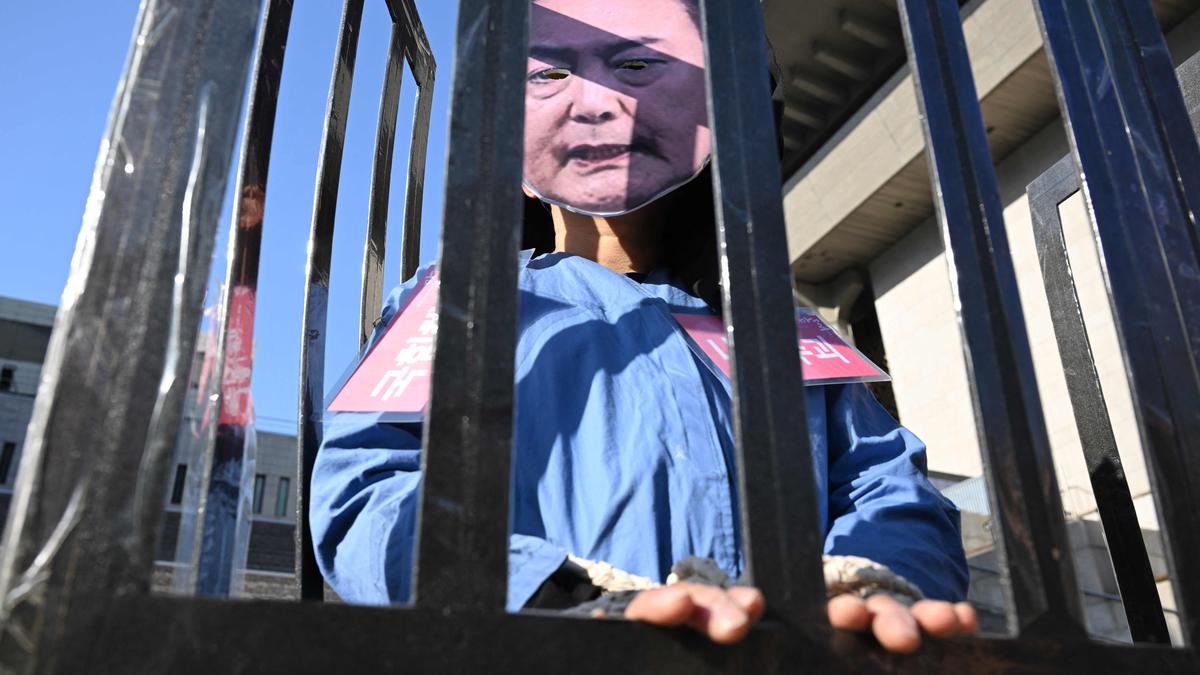
Nine days after coming to power, Democratic Party president Moon Jae-in appointed a new Chief of the Seoul Central District Prosecutors’ Office on May 19, 2017. The new Chief was able to indict two former Presidents belonging to the main conservative party in South Korea — Lee Myung-bak and Park Geun-hye. Mr. Moon and his party were impressed and in June 2019, the protagonist was appointed the Prosecutor General of South Korea. The Prosecutor General was Yoon Suk Yeol, who later became the President of South Korea and is now a key figure in the current political crisis, having been impeached by the National Assembly on December 14, 2024.
How it started
Mr. Yoon was playing a key role in the Moon Jae-in administration, but it was announced on August 9, 2019, that Cho Guk would be the next Justice Minister. Mr. Cho had studied at the same university as Mr. Yoon, with Mr. Yoon being a few years his senior. After learning of Mr. Cho’s nomination, Mr. Yoon reportedly approached President Moon expressing his disapproval. Mr. Moon, however, appointed Mr. Cho on September 9, 2019.
Mr. Yoon used his Prosecutor office to reveal several corruption charges against Mr. Cho. Allegations against him included that he plagiarised his writings, that an institute run by his family evaded taxes, and his family invested in illicit business activities, his daughter submitted false documents related to academic achievements. His wife was charged and later sent to jail for four years. All this led to huge protests by conservative party supporters demanding Mr. Cho’s removal. Finally, he resigned after just 35 days in office.
The incident led to a contest between the Moon Jae-in administration and Mr. Yoon. Mr. Moon avoided taking any undemocratic means to remove Mr. Yoon from his post, but subsequent Justice Ministers under his administration tried to settle scores with Mr. Yoon. On November 24, 2020, Justice Minister Choo Mi-ae suspended Mr. Yoon, accusing him of ethical violations and interference in key investigations. However, Mr. Yoon challenged the suspension in court and was reinstated.
Interestingly, Mr. Yoon, who was considered close to the Democratic Party and instrumental in the indictment of two conservative Presidents, became a hero among conservative party supporters.
In various opinion surveys, Mr. Yoon had the highest popularity among all the existing conservative leaders, and suggestions became strong that if he became the conservative party’s presidential candidate, he might be victorious. Conservative supporters were very hurt by two of their former Presidents in jail — one of them Ms. Park, who was the eldest daughter of Park Chung-hee whom the conservatives adore as a major Korean leader. The conservative supporters thought Mr. Yoon would be the right leader to teach Moon Jae-in and his peers in the Democratic Party a lesson.
Mr. Yoon grabbed this opportunity and resigned from the position of Prosecutor General on March 4, 2021, and announced his presidential candidacy in June 2021. He officially joined the conservative People Power Party (PPP) in July 2021. Despite making several political blunders, careless and controversial remarks, and lacking political experience, Mr. Yoon was selected as the PPP’s presidential candidate in November 2021. He had a difficult battle against the Democratic Party’s Lee Jae-myung but defeated him in the March 2022 presidential elections by a margin of less than one percent.
Two Koreas in South Korea
Over the years, the divide between conservatives and liberals in South Korea has become very sharp. Generally, conservative party supporters tend to be older, less educated, wealthy businessmen, and residents of Gyeongsang North, Gyeongsang South, and Gangwon provinces. Young, more educated, middle-class, people coming from Jeolla North and Jeolla South Provinces are more inclined towards the liberal party. In a way, the division is not only ideological but also generational and regional. In recent years, young males in South Korea have also moved towards conservative parties, as they feel that ultra-feminism has ruined traditional gender and social relations. For the conservatives, authoritarian leader Mr. Park Chung-hee who is considered to be the main architect of South Korea’s economic development is the source of inspiration and, for the liberals, Kim Dae-jung and Roh Moo-hyun are the leaders who brought democratisation to the country. Conservatives are typically pro-American, more accommodating toward Japan, and confrontational towards North Korea. Liberals, on the other hand, advocate for greater autonomy in South Korea’s foreign policy (while maintaining the U.S. alliance), are critical of Japan’s rising assertiveness, favour engagement with North Korea, and seek better relations with China.
The divide has been further accentuated by the prevalence of social media. In the tenures of the last five Presidents, there have always been street protests, affecting the smooth running of the country. Polarisation between the two groups has led to vendetta politics, where each new administration seeks to implicate and punish its predecessors on charges of corruption or illegality. It has led to a situation that all the previous Presidents of South Korea belonging from both conservative and liberal parties have been either exiled (Syngman Rhee), killed (Park Chung-hee), had jail sentences (Chun Do-hwan, Roh Moo-hyun, Lee Myung-bak and Park Geun-hye), charged for corruption (Kim Dae-jung and Moon Jae-in) or committed suicide (Roh Moo-hyun).
Presidency under Yoon
In March 2022, Mr. Yoon was elected as the President of South Korea. However, his popularity ratings were very low, hovering around 20%-30%. His inexperience and incompetence in politics became evident early in his tenure. Rather than working on South Korean domestic and foreign policies in a deft, nuanced manner, he started using broad strokes. Most acts and policies were announced as ‘big moves’.
For example, he tried to reach out to Japan despite the popular mood in South Korea not favouring it and Japan not making any concessions. He did not oppose Japan releasing the Fukushima nuclear power plant water into the sea, a decision disapproved by over 70% of South Koreans. He attended the annual summit meeting of NATO which was the first time by any South Korean leader. He visited Ukraine and indirectly supported it. He announced an Indo-Pacific strategy and opted for a tit-for-tat policy towards North Korea. All these ‘bold moves’ were not only disliked by liberals but also by most of the Korean people, especially those who believe that South Korea is a middle power and should not get into great power politics. His foreign policies strained relations with Russia and China while allowing North Korea to strengthen its ties with both nations.
In another ‘bold move’, he announced the doubling of seats for medical students, which were frozen for more than a decade. His approach to targeting Opposition leaders, combined with the heavy-handed use of prosecutors and police, further deepened public unease. Meanwhile, the South Korean economy, which was already facing problems in the post-COVID phase, was negatively affected. Moreover, his wife’s conduct and allegations of several corruption matters, including the ‘Dior bag scandal’, made him more unpopular.
This led to the growing unpopularity of Mr. Yoon and his party PPP. In the National Assembly elections in April 2024, six Opposition parties secured 192 seats out of 300 seats, which led to a huge problem of governance under Mr. Yoon. The Opposition started asserting against the President’s policies, his appointments of close friends to important positions in government, and demanded a special probe on charges against his wife.
What lies ahead
Mr. Yoon had no experience in dealing with political contests, and the Opposition’s aggressive approach in the National Assembly after April 2024 left him frustrated. In desperation, he decided to declare emergency martial law on December 3, 2024, at 10:24 p.m., despite reported opposition from most of his Ministers. Mr. Yoon, along with the Defence Minister, sent the military and police to various places including the National Assembly. He was in constant touch with them and ordered them to arrest several political leaders. He also reportedly ordered that members should not be allowed to enter into the National Assembly.
However, military and police officials moved reluctantly and they were not willing or able to stop a large number of people gathering in front of the National Assembly. National Assembly members voted 190-0 against martial law by midnight. As per the South Korean constitution, a simple majority in the 300-member House may repel martial law and the President has no choice but to comply. Finally, at the dawn of December 4, Mr. Yoon announced the withdrawal of martial law.
On December 5, an impeachment motion was brought in the National Assembly and put up for vote on December 7 evening.
Meanwhile, the ruling PPP was in fix on how to respond to this crisis. If it supported the impeachment motion, they would lose the support of hardcore conservatives, a substantial set of the electorate, and if they opposed it, they would lose face to the rest of the Koreans. So even though most of the conservative leaders expressed opinions against martial law, they refrained from supporting the impeachment motion. The PPP decided not to take part in the voting and the motion could not get passed. As impeachment requires the support of 200 out of 300 Assembly members, the motion failed with only three PPP members voting in favour.
The Opposition decided to bring another impeachment motion, which was voted on December 14. Mr. Yoon declared to be impeached by 204 votes in favour of the motion in the National Assembly. Mr. Yoon still stubbornly says that he would fight it out in the Constitutional court of South Korea and refused to resign.
The Constitutional court could deliberate on the impeachment for many months. Of the court’s nine seats, three are currently vacant, and a minimum of six affirmative votes is required to validate the impeachment. It means all present judges must agree with the motion and Mr. Yoon is aware that four of the six judges reportedly have conservative leanings, and one was appointed by him. Although popular pressure would be high on judges, Mr. Yoon still hopes for his survival.
Meanwhile, delaying tactics would mean that the leader of the main Opposition party, Mr. Lee, may get a jail sentence as the case against him for corruption charges is scheduled to be decided by February-March next year. Mr. Cho, who launched a political party and won 18 seats in the National Assembly, was given a two year jail sentence by the Supreme Court on December 12 and the Opposition thinks that if Mr. Lee also falls, it would be less advantageous for the Democratic Party in the next Presidential election.
The political crisis in South Korea may get over in a few months. However, it has laid bare the immaturity of its political leaders and parties and the weakness of its democratic institutions. The ray of hope comes from the South Korean people, who, while divided in two opposite camps seem to agree that the present represents an existential crisis for its democracy. If the political crisis does not get resolved and democratic institutions are not strengthened, the implications on South Korea’s image could be severe.
Sandip Kumar Mishra is Professor, Centre for East Asian Studies, School of International Studies, Jawaharlal Nehru University, New Delhi
Published – December 19, 2024 10:44 pm IST