


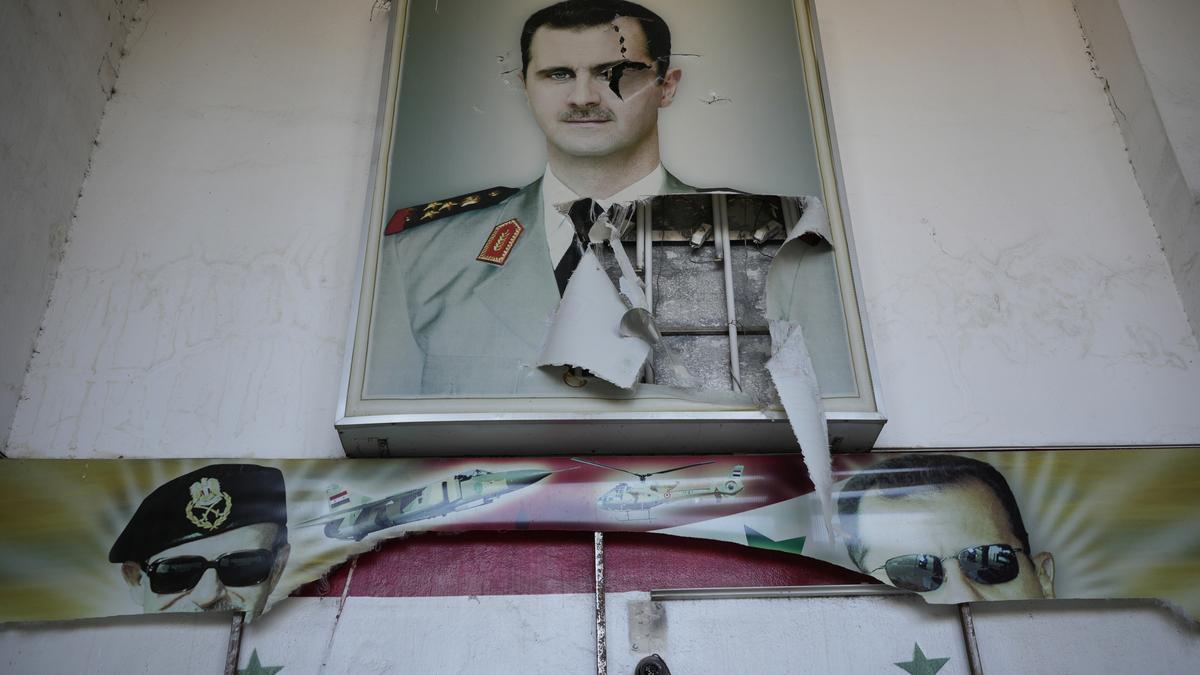
A torn posters shows the late Syrian President Hafez Assad and his son the ousted Syrian president Bashar Assad, that were set at the entrance of the notorious security detention centre called Palestine Branch, in Damascus, Syria, on December 14, 2024.
| Photo Credit: AP
The story so far:Bashar al-Assad, President of Syria for 24 years, has fallen. He and his family have taken refuge in Russia. Syria now has a transitional government, headed by the Hayat Tahrir al-Sham (HTS), an Islamist militant group that was controlling the northwestern province of Idlib. Many Syrians are celebrating the collapse of Mr. Assad’s dictatorial regime, but remain anxious about what is to come. Turkey, as the main backer of the HTS, sees an opportunity to expand its influence in West Asia, while Iran and Russia, the main backers of the Assad regime, have taken a setback. Israel, in the meantime, is exploiting the vacuum in Syria to grab more territories.
Why did the Assad regime fall?
Mr. Assad held on to power for 13 years after the civil war broke out in 2011, only for his regime to collapse in 12 days. By 2017, the Assad regime had taken over most of its lost territories, with help from Russia, Iran and Hezbollah. But he hadn’t defeated the militants. The strongest of them was the HTS, which was formerly called Jabhat al-Nusra, the al-Qaeda arm in Syria. Abu Muhammed al-Jolani, today the ‘emir’ of the HTS, was an al-Qaeda leader. The HTS-controlled Idlib emerged as a rebel stronghold. Jolani established a mini-administration in Idlib — the Syrian Salvation Government. He had been planning a large-scale offensive against the regime forces for months, if not years.
Also read | Twelve days that shook Syria
On the other side, a host of domestic, regional and international factors weakened Mr. Assad’s position. Syria’s economy is in a very bad shape. Its GDP shrank by 87% in the past 13 years, from $68 billion in 2011 to just $9 billion in 2023. Western sanctions stifled an already deteriorated economy further. The poorly paid soldiers of the Assad regime lacked motivation to preserve it. Syrian armed forces were also weakened by repeated Israeli air strikes, which picked up pace over the past year, after Hamas’s October 7, 2023 attack. Mr. Assad was heavily reliant on his external allies for security. However, their priorities also changed in recent years. Russia’s focus is now on the Ukraine war. Iran is involved in a hot and cold war with Israel. Hezbollah lost most of its leaders and thousands of fighters in its year-long war with Israel. The militants knew Mr. Assad was weak.
They launched an offensive on November 27 in the western outskirts of Aleppo, probably aimed at cutting the underbelly of his decaying regime. What happened next was a rapid collapse of the regime itself.
Who is in charge now?
Syria today has roughly four militant coalitions. The first one is the HTS, led by Jolani. The HTS says it has broken its ties with al-Qaeda, and promises to respect Syria’s ethnic and religious diversity. But its rank and file comprise transnational jihadists, who travelled to Syria from across the world, to fight “jihad” against the Assad regime. The HTS’s main ally is the Syrian National Army (SNA), another northern militia. The core of the SNA is the Free Syrian Army, a Turkish proxy that was formed with defected Syrian soldiers and officers. The HTS and the SNA launched the November 27 offensive together.
The second group is the Southern Front, a loose coalition of dozens of militias in Syria’s south (Daara and Quneitra). Some of them were backed by Jordan, which shares a border with southern Syria. When the HTS-SNA combine advanced towards regime-held cities from the north, the southern militias started an offensive from the south. And they reached Damascus first, on December 8. The third main group is the Syrian Democratic Forces (SDF). The core of the SDF is the People’s Protection Units (YPG), the armed wing of Syrian Kurdistan. The SDF enjoys relative autonomy in the Syrian Kurdish region. The SDF was armed by the U.S. in the past in its fight against the Islamic State. The fourth group is the Alawite militias in the coastal region. Alawites are Mr. Assad’s sect, who enjoyed power for over five decades in the country. The HTS, a Sunni Islamist group, had in the past targeted Alawites, who make up roughly 15% of Syria’s population. The HTS has asked the Alawite community to cut ties with the fallen regime. Of these four, the HTS is the most powerful force now. The transition government in Damascus is a replica of the HTS Salvation government in Idlib.
Why does geopolitics matter?
Syria has immense geopolitical significance. It hosts Russia’s Mediterranean naval base in Tartus, its only naval base outside the former Soviet territory. Russia also has built an air base in Syria. For Russia to project force, from the Black Sea to the Mediterranean and then to the Atlantic, it is essential to retain access to the Tartus base. It could also be one of the reasons Russia made a military intervention in Syria in 2015, to protect the Assad regime. Now that the regime has collapsed, Russia’s focus would be on protecting its bases. For Iran, a sworn enemy of America and Israel, Syria was its only state ally in West Asia. Syria was also a key conduit between Iran and Hezbollah, the Lebanese militia. The fall of the Assad regime could disrupt Iran’s supply networks in the region, which could invariably weaken the country’s deterrence.
Turkey, on the other side, appears to be stronger. For years, it had tried to pull down the Assad regime. When the Russian intervention made it immediately impossible, Turkey shifted its focus towards playing a long game with its proxies. Now that Mr. Assad is gone and the HTS-SNA coalition is in Damascus, Recep Tayyip Erdogan seems to have outwitted Vladimir Putin, and extended his influence from Ankara to the borders of Iraq, Jordan and Israel.
Will the militants build a new Syria?
Many think the fall of a dictatorial regime would lead to a new dawn. For now, Syria’s militants have made the right noises — about respecting the country’s diversity and rebuilding its dilapidated institutions and welcoming back refugees. But Syria still remains a complex case — with or without Mr. Assad. Before Hafez al-Assad, Bashar’s father, captured power in 1971, Syria had seen multiple coups and counter-coups. It was Hafez and his Ba’ath party that stabilised the country and built its modern institutions. Today, the challenge the militants face is to rebuild the country once again, by demobilising the militias. But the HTS neither has ideological clarity for an inclusive Syria nor the resources to demobilise other militias. The HTS is a Salafi-jihadist outfit, which wants to remake secular Syria and retain its tight grip over state institutions. If the HTS’s rule in Idlib is an example, the group is not any less dictatorial than Mr. Assad. The southern militias, backed by Jordan, would want to get their due share of power. And in the east, the SDF, the Kurdish militia, wants to keep their hard-earned autonomy. But Turkey sees the SDF as a terrorist outfit, and Turkish-backed militias have already started attacking the SDF.
In Afghanistan, throughout the 1980s, the U.S. and Pakistan-backed Mujahideen fought together against the communist regime as well as the Soviet troops. But after the Soviet withdrawal and the collapse of the communist rule, Afghanistan fell into deeper chaos. In Libya, NATO made a military intervention in 2011 to “liberate” the country from Mohammed Gaddafi. After Gaddafi’s regime, one of the most stable governments in Africa, was toppled and he was killed, the country fell into a bloody civil war — which is still going on. Iraq never recovered from the scars of America’s regime change war of 2003. None of these examples are encouraging for Syria.
Published – December 15, 2024 02:30 am IST