
Skip to content
  • Facebook
  • X
  • Linkedin
  • WhatsApp
  • Associate Journalism
  • About Us
  • Privacy Policy
  • 033-46046046
  • editor@artifex.news
Artifex.News

Artifex.News

Stay Connected. Stay Informed.

  • Breaking News
  • World
  • Nation
  • Sports
  • Business
  • Science
  • Entertainment
  • Lifestyle
  • Toggle search form
  • Joe Biden sharply hikes U.S. tariffs on Chinese chips, cars to woo voters in election year Business
  • Cops Involved In Anandpal Encounter Face Probe, Court Rejects CBI Report Nation
  • “No Delivery Is Unplayable But…”: Gautam Gambhir’s Blunt Take On Mitchell Starc’s ‘Ball Of IPL 2024’ Sports
  • Farmers to step up stir for MSP coinciding with budget session of Parliament Business
  • Babar Azam Unlikely To Be Given Back Pakistan Test Captaincy: Reports Sports
  • The View From India newsletter | Iran after Ebrahim Raisi World
  • On Pension Row, Nirmala Sitharaman’s Sharp Counter To Congress’ “U-Turn” Jab Nation
  • Nitish Kumar At All-Party Meet After Caste Survey Nation

Deepening India’s steps as a key space-faring nation

Posted on December 10, 2024 By admin


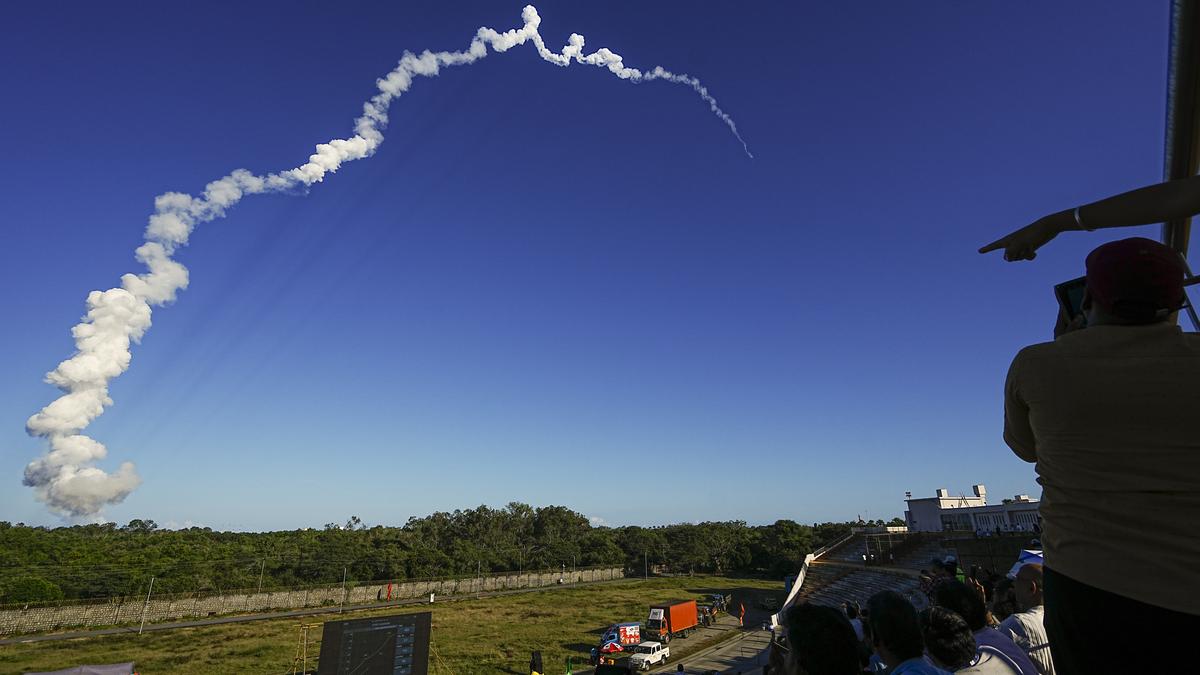
‘There is likely to be strong private sector interest in India to take up contracts with the right incentives’
| Photo Credit: PTI

India has set ambitious goals for its space programme in the next two decades. These goals hinge on powerful, reusable rockets such as the Indian Space Research Organisation (ISRO)’s upcoming Next Generation Launch Vehicle (NGLV). In addition to the NGLV, India must tap into its private sector to develop more such rockets in order to secure strategic autonomy in its access to outer space.

ISRO’s road map

From an infant space programme in the 1960s, India has grown into a powerful space-faring nation. Preparations for the Gaganyaan mission are underway. Gaganyaan will take an Indian crew to space for the first time, demonstrating Indian human-spaceflight capability. By the end of the next decade, India aims to have a more sustained presence in space by having its own space station in orbit around earth. It also aims to expand its human-spaceflight capabilities to the moon.

Realising these objectives effects a road map that consists of multiple uncrewed missions to the moon, mastering human-centric technologies for space travel and developing powerful new rockets. These rockets have to carry heavier payloads to support humans in space. They should also be financially viable as it will take many test flights to reach the safety and the reliability standards for human-spaceflight to the moon. ISRO is fulfilling these requirements with its upcoming NGLV, which has been recently approved for development by the Union Cabinet.

The significance of the NGLV lies in its heavy lift capability and reusability. The NGLV will triple the payload capacity of the LVM3 (Geosynchronous Satellite Launch Vehicle Mk III), which is India’s most powerful rocket. This comes with numerous benefits. Heavy lift rockets ease restrictions related to weight and volume. It frees up the focus of engineers and scientists that would otherwise have to be spent on miniaturisation or weight reduction. It greatly increases the potential of space-related missions. The possibilities increase exponentially.

In contrast to all of India’s existing rockets which are expendable as they are built for one-time use, a major part of the NGLV will be reusable. Reusability requires that the rocket keep some of its fuel for controlled descent back to the earth’s surface. This reduces the capacity of the rocket to carry heavier loads but offers massive cost savings. Reusability has become necessary for rockets to remain competitive.

The immediate need

The NGLV’s development phase will last for the next eight years. In the meantime, the need for heavy lift capability is already felt. India’s next uncrewed moon mission is slated to use not one, but two rockets. Two LVM3s will carry the requisite modules. They will then be assembled in space to form one composite vehicle that will go to the moon.

In another instance, GSAT-N2, a communication satellite built by ISRO, was launched on SpaceX’s Falcon 9 rocket. It weighed 4,700 kg while the maximum weight that an LVM3 can carry to the Geostationary Transfer Orbit (GTO) is 4,000 kg. A reusable Falcon 9 from SpaceX, a U.S. company, can carry up to 5,500 kg to the Geostationary Transfer Orbit (GTO). Foregoing reusability, an expendable Falcon 9’s capacity increases to 8,300 kg. Even this figure is dwarfed in comparison to SpaceX’s Falcon Heavy and Starship rockets.

The Starship, which completed its sixth test flight recently, has already achieved significant milestones surrounding heavy lift and reusability. Its mind-boggling capacity to lift over 21,000 kg to the GTO (1,00,000 kg to the Low Earth Orbit) while remaining reusable, shows that the Starship is already past the level of advancement that the NGLV hopes to achieve at the end of its eight-year development phase.

Leveraging the private industrial base

This is no surprise given ISRO’s wider scope, capability and focus. However, it also raises questions about why India is not exploring more paths to produce multiple reusable, heavy lift rockets.

In parallel to developing the NGLV, the Department of Space can give out contracts to the private industry in India to design and develop reusable, heavy lift rockets of their own. Space is an emergent sector with massive potential for commercialisation.

There is likely to be strong private sector interest in India to take up these contracts with the right incentives. Even with a lack of existing faculty in rocket technology among Indian corporations, they can explore foreign collaboration. For instance, various rocket engines are already sold commercially.

A milestone-based funding mechanism where the Department of Space pays private players after they meet certain objectives at every stage is a great way to ensure accountability and reduce cost overruns. In the best case, India may end up with multiple NGLV-like rockets alongside the NGLV, resulting in much-needed redundancy and greater launch frequency. In the worst case, there may be delays but that is accompanied by positive spillovers of innovation, technical capability and infrastructure which will ultimately yield positive outcomes.

The entire gamut of space activities, which ranges from using satellite data for development to extending Indian presence to the moon and Mars, hinges on a resilient supply of space transportation services. India must foster a strong ecosystem for the growth of a specialised industrial base that can cater to India’s needs and ambitions in outer space.

Ashwin Prasad is a Research Analyst at The Takshashila Institution

Published – December 11, 2024 12:08 am IST


Source link

Science Tags:gaganyaan mission, Geostationary Transfer Orbit, Geosynchronous Satellite Launch Vehicle Mk III, GSAT-N2 communication satellite, India and space programme, Indian Space Research Organisation, Low Earth Orbit, Next Generation Launch Vehicle, reusable rockets, strategic autonomy and outer space

Post navigation

Previous Post: Scientists From India, A Telescope In Chile, And An Astronomical Discovery
Next Post: Syrian President Bashar al-Assad In Russia, Confirms Senior Moscow Official

Related Posts

  • Geroscience: the science related to aging Science
  • The Science Quiz: Scientific terms beginning with ‘X’ Science
  • Google celebrates India’s Chandrayaan-3 feat with special doodle Science
  • IISc researchers develop sustainable method to remove heavy metal contaminants from groundwater Science
  • Daily Quiz | On India’s first satellite ‘Aryabhata’ Science
  • General, central obesities linked to higher risk of colorectal cancer Science

More Related Articles

Global coral bleaching event expands, now the largest on record Science
What is sonoluminescence? Science
How Sunita Williams ended up stranded in space: The unexpected ordeal Science
Science for all Why did scientists create a new type of nanopasta which is thinner than spaghetti Science
ISRO’s analogue space mission kicks off at Ladakh’s Leh Science
Endangered Charles Darwin’s frog exhibits unique upside-down spawning behaviour Science
SiteLock

Archives

  • December 2024
  • November 2024
  • October 2024
  • September 2024
  • August 2024
  • July 2024
  • June 2024
  • May 2024
  • April 2024
  • March 2024
  • February 2024
  • January 2024
  • December 2023
  • November 2023
  • October 2023
  • September 2023
  • August 2023
  • July 2023
  • June 2023
  • May 2023
  • April 2023
  • March 2023
  • February 2023
  • January 2023
  • December 2022
  • November 2022
  • October 2022
  • September 2022
  • August 2022
  • July 2022
  • June 2022
  • May 2022

Categories

  • Business
  • Nation
  • Science
  • Sports
  • World

Recent Posts

  • Republican-led U.S. Congressional report findings on COVID’s origins explained
  • As Rohit, Kohli, Other Batters Struggle, Shubman Gill Reveals “Key Discussion” In Team
  • Shubman Gill Shares Team India’s Message As Gukesh D Becomes Youngest World Chess Champion
  • How Can I Respect You?
  • Biden watching situation in Bangladesh very closely: White House

Recent Comments

  1. dfb{{98991*97996}}xca on UP Teacher Who Asked Students To Slap Muslim Classmate
  2. "dfbzzzzzzzzbbbccccdddeeexca".replace("z","o") on UP Teacher Who Asked Students To Slap Muslim Classmate
  3. 1}}"}}'}}1%>"%>'%> on UP Teacher Who Asked Students To Slap Muslim Classmate
  4. bfg6520<s1﹥s2ʺs3ʹhjl6520 on UP Teacher Who Asked Students To Slap Muslim Classmate
  5. pHqghUme9356321 on UP Teacher Who Asked Students To Slap Muslim Classmate
  • West Indies Legend’s ‘CSK And MS Dhoni’ Remark As Sri Lanka Star Lights Up Asia Cup Sports
  • Anaemia prevalence in eight States found to be overestimated Science
  • Study says microbes, not fossil fuels, produced most new methane Science
  • Rachin Ravindra gets central contract from New Zealand Cricket Sports
  • Girl, 9, Complains Of Pinch. Then Mother Discovers Spider Bite That Quickly Spread World
  • “India Are Missing Virat Kohli”: Ex-India Star’s Rant Amid Ranchi Test Is Viral Sports
  • China Restricts Visas To US Officials Who “Interfered” In Hong Kong Affairs World
  • Union Minister Rajkumar Ranjan Singh Big Charge On Those Not Giving Peace A Chance In Manipur Nation

Editor-in-Chief:
Mohammad Ariff,
MSW, MAJMC, BSW, DTL, CTS, CNM, CCR, CAL, RSL, ASOC.
editor@artifex.news

Associate Editors:
1. Zenellis R. Tuba,
zenelis@artifex.news
2. Haris Daniyel
daniyel@artifex.news

Photograher:
Rohan Das
rohan@artifex.news

Artifex.News offers Online Paid Internships to college students from India and Abroad. Interns will get a PRESS CARD and other online offers.
Send your CV (Subjectline: Paid Internship) to internship@artifex.news

Links:
Associate Journalism
About Us
Privacy Policy

News Links:
Breaking News
World
Nation
Sports
Business
Entertainment
Lifestyle

Registered Office:
72/A, Elliot Road, Kolkata - 700016
Tel: 033-22277777, 033-22172217
Email: office@artifex.news

Editorial Office / News Desk:
No. 13, Mezzanine Floor, Esplanade Metro Rail Station,
12 J. L. Nehru Road, Kolkata - 700069.
(Entry from Gate No. 5)
Tel: 033-46011099, 033-46046046
Email: editor@artifex.news

Copyright © 2023 Artifex.News Newsportal designed by Artifex Infotech.