


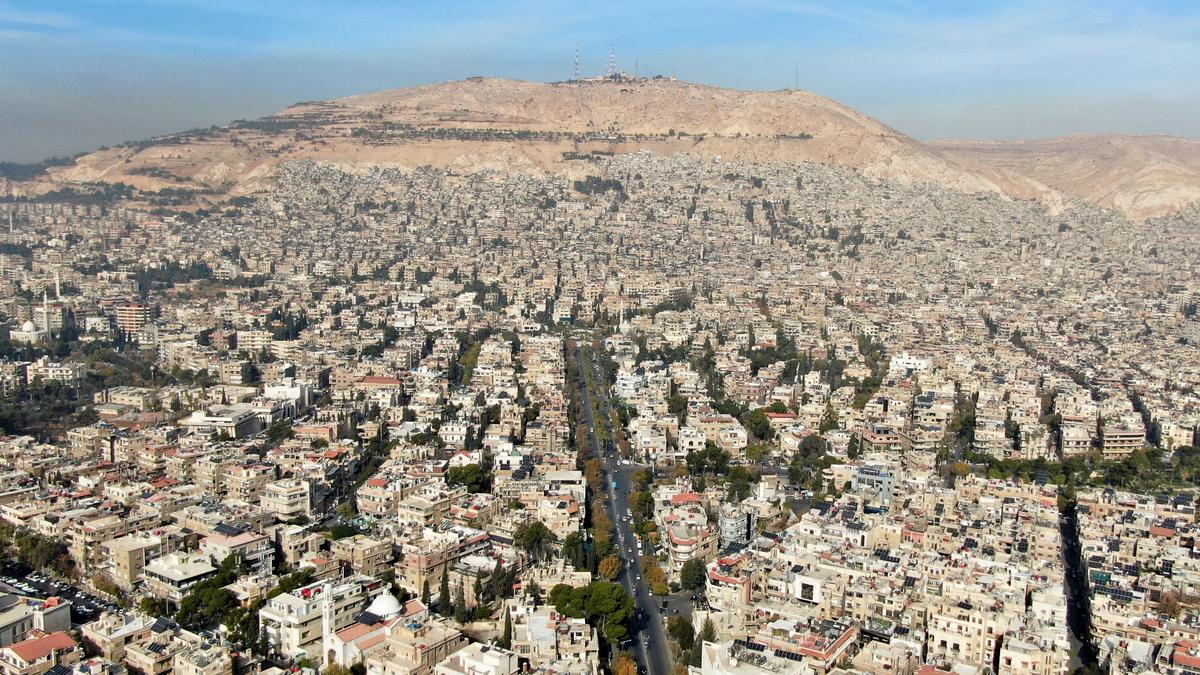
A drone view shows buildings in Damascus, after Syrian rebels ousted President Bashar al-Assad, Syria December 10, 2024
| Photo Credit: Reuters
The Hayat Tahrir al-Sham (HTS), the Syrian Islamist militant group, had been preparing for months for a large-scale offensive against regime forces. The civil war was quiet for years, particularly after the regime of President Bashar al-Assad captured most of its lost territories — including Aleppo, Hama and Homs. The HTS, formerly al-Nusra Front, the Syrian arm of al-Qaeda, had built a statelet in Idlib, in northwestern Syria, under the leadership of its ‘emir’, Abu Muhammed al-Jolani. The HTS and its ally Syrian National Army (SNA), formerly the Free Syrian Army, had informed Turkiye, their patron, at least six months ago about the offensive plan, according to a Reuters report. And Ankara had given its tacit approval.

Mr. Assad’s troops were in a bad shape. Soldiers were poorly paid and lacked motivation. The country never recovered from the scars of the civil war. Under crippling American sanctions, its finances were in shambles. During the peak of the civil war, in 2015-16, Mr. Assad had heavily relied on his external allies for security — Russia, Iran and Hezbollah. Now, the situation was different. The Russians were focused on Ukraine. Iran lost a host of its Syria commanders to Israeli strikes. Hezbollah had been weakened in a year-long war with Israel. The HTS launched its offensive on November 27, the day Israel and Lebanon signed a ceasefire. On the 12th day, the Assad regime fell, sending tremors across the region.
Offensive begins
When they launched the offensive, the militants’ initial target was the western suburbs of Aleppo, Syria’s second largest city which Mr. Assad’s forces recaptured in 2016, after four years of a brutal battle. When HTS and SNA militants advanced towards Aleppo, they faced little resistance from government forces. Within four days, they reached Aleppo’s city centre.
The rapid collapse of government forces in Aleppo stunned both the militants and the regime alike. And Mr. Assad’s allies took note of it. The HTS’s victory triggered rebellion elsewhere in the country. In the south, local militias, who were backed by Jordan, started attacking government positions. In the northeast, the Syrian Democratic Forces (SDF), a Kurdish militia, started advancing towards the eastern city of Deir Ezzour. The HTS, the main militant group, marched south from Aleppo towards Hama. On December 5, they entered Hama. Mr. Assad’s forces did not fight back. Some of them crossed the border to Iraq, seeking refuge. Others abandoned their uniforms and fled. The militants raided military depots and grabbed more weapons, making their position stronger. Mr. Assad turned to Iran and Russia for help. But Syrian and other Arab officials say both Russia and Iran told the Syrian President that they could not help him much this time. Iran, according to some reports, evacuated its personnel from Syria.

Shrinking circle
Mr. Assad’s circle was shrinking. His troops are not fighting back. He is not getting any external help. The militants are on a march from multiple fronts. From Hama, the HTS advanced towards Homs, a strategically important city that sits at an intersection between Syria’s Mediterranean coast and Damascus, the seat of power. If Homs falls, Damascus would be cut off from Mr. Assad’s coastal stronghold. On December 7, HTS-linked militants entered Homs, Syria’s third largest city. The next day, the Southern Front, militants from the south who had already taken Daara, entered Damascus first, followed by the HTS. Syria’s Prime Minister Muhammad al-Jalali said he would ensure a peaceful transition of power. The army chief said Mr. Assad’s government was over, bringing the almost 60-year rule of the Arab Socialist Ba’ath Party in Syria to a dramatic end. Later in the day, Russia said Mr. Assad and his family were in Moscow and granted political asylum.

Different rebel groups
The fall of the regime leaves a huge vacuum in Syria. Until December 8, the opposition militias had a common enemy–’Assad the tyrant’. Now, they are facing each other while trying to expand their influence. Roughly, there are four rebel coalitions in Syria. One, the HTS, led by Jolani. It is the most prominent one. HTS telegram channels already call him ‘President’ Shara, referring to his real name, Ahmed Hussein al-Shara. The HTS has built a statelet in Idlib and some 25,000 soldiers under its command. But that’s not enough to run a vast country like Syria. But the HTS certainly wants to play a key role in the new Syria, and has sent reconciliatory messages to the country’s different sects and militias. The SAA, another northern militia, is an ally of the HTS and a proxy of Turkiye.
Two, local militias in the south. They would not like to give up their privileges. That they entered Damascus first was a clear message to Jolani that he was not the only ‘rebel’ in the game. Three, the SDF, the Kurdish militia. In the northeast, the Kurds have enjoyed relative autonomy since the beginning of the civil war. But Turkiye was alarmed by the Kurds’s growing strengths and had launched incursions into Syria in the past, grabbing territories on the border. The SDF would not like to give up their autonomy, which could put them on a collision course with the HTS and the SAA, the Turkish backed groups. And lastly, there are Alawites, Mr. Assad’s sect who live mostly in the mountainous coastal regions of Latakia and Tartus, and enjoyed power for nearly 50 decades. The Alawites were the backbone of the Syrian army. They are unlikely to immediately trust Jolani, a committed Salafi Islamist militant, whose group in the past had carried out targeted attacks against Alawites.

Syria is a diverse country. It now has a diverse set of militias, without a central authority. And then there are external players. Turkiye, as the main supporter of northern militias (HTS and SAA), would seek to extend its influence in the government formation. Jordan would like to see the southern militias getting their due. The Gulf Arabs, who are wary of both Islamists and Turkiye, would be alarmed by the developments. Iran risks losing its territorial link with Hezbollah. Russia’s primary objective would be to safeguard its Tartus naval base and Khmeimim air base. And Israel has already sent troops to capture land in Syria’s Golan Heights and is carrying out massive air strikes aimed at destroying the Syrian army’s military capabilities.
Published – December 10, 2024 05:37 pm IST