





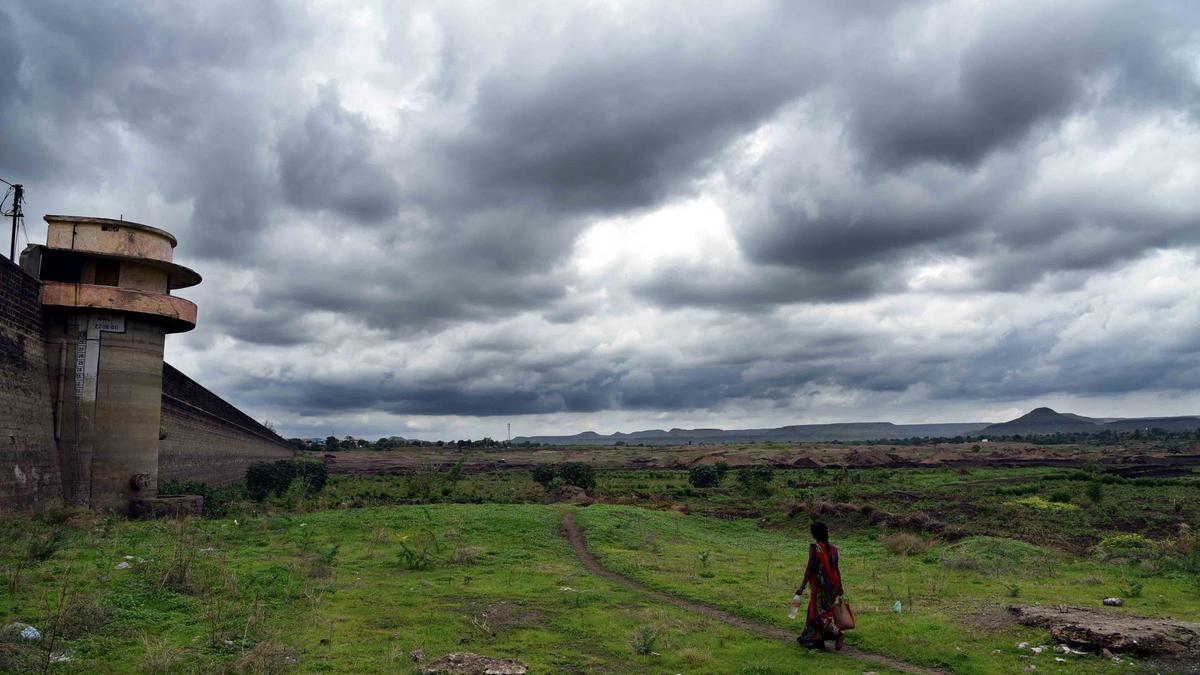
In Maharashtra’s Jalna district, Dada Rao Ghatode, a farmer from Babultara village, owns eight acres of land where he grows soybean, cotton, and pigeon pea (tur) during the kharif season (July to October). This season, he expected at least ₹80,000 in return from four acres of soybean. However, a single day of heavy rains in September ruined nearly 80% of his crop.
This was not an isolated incident. Across Marathwada, farmers are grappling with unpredictable changes in rainfall distribution, which are threatening their livelihoods. Jalna, along with all other districts in Marathwada, has experienced a sharp increase in extreme rainfall events, disrupting traditional farming practices and water management systems.
Rise in extreme rainfall events
Through the last two decades, the distribution of rainfall in Jalna has changed significantly, according to our analysis of daily gridded rainfall data from the India Meteorological Department. The region’s total annual rainfall has been relatively stable but the timing and intensity of the rains have become erratic. Already infamous for its droughts, Marathwada now oscillates between periods of little water and those of too much, which also cause severe waterlogging during the kharif season.
Traditionally, farmers grow water-intensive crops such as paddy, maize, pulses, soybean, and groundnut during the kharif cropping season, and expect good yields. But with an increasingly unstable monsoon, the farmers have had to fall back more and more on rabi season (November to April) crops such as sorghum, chana, and wheat, which have lower market prices. Even though most farmers own medium to large land-holdings, they are not prospering.
Data from 2001 to 2023 indicated that rains in July, August, and September accounted for 70% of Jalna’s annual rainfall, and that the monsoon arrived late in July and August in most of these years (Chart 1). Further, the amount of rain in July and August fell short as much as 70% of the time, while there was a 50% chance of downpours deviating from normal patterns in September.
Chart 1 | A long period average was calculated for the period from 1961 to 2010, and each category of rainfall was estimated for that month for the last 22 years (as per the IMD method)
The greater cause for alarm may be the number of rainy days: the frequency of those with more than 3 mm of rain dropped by 30% in August, a critical period for crop growth. September had 18% more rainy days, meaning the land was water-logged just as the crops approached harvest (Chart 2 and 3).
Chart 2 | The chart show the number of rainy days for the month of August. The frequency of those days with more than 3 mm of rain dropped by 30% in August, a critical period for crop growth
Chart 3 | The number of rainy days for the month of September. September had 18% more rainy days, which means that the land is water-logged just as the crops approach harvest
These patterns are disrupting farming cycles and putting farmers who depend on kharif-season crops at even more risk. Extreme rainfall events — defined as a day with rain falling in the 99th percentile by quantity — have not only become more frequent but also more intense. The intensity on these days increased from 59 mm/day in 1951-2000 to 70 mm/day in 2001-2023. There are similar trends across central India, where studies have recorded a threefold increase in the frequency of extreme precipitation events.
Black soil and water-logging
Farmers, researchers, and policymakers often discuss water scarcity in relation to the impact of climate change on agriculture, leaving the challenges of excess water to still be understudied. The Marathwada region’s black soil can hold a large amount of water before having to discharge it, and is thus prone to waterlogging.

When this soil type becomes saturated with water, it restricts drainage and prevents water from seeping into aquifers, resulting in flooding even with normal rainfall. For farmers, waterlogging is equal to disaster because it deprives the crops of oxygen, which leads to rotting, wilting, and increased susceptibility to pests and diseases.
The hydrogeology of Marathwada further complicates this situation. Although farm ponds and wells fill quickly after the rains, the underlying basalt rocks are not conducive to long-term water storage. In other words, farmers can’t rely on these resources for irrigation throughout the year. The result is a continuous cycle of surplus water in the monsoon and scarcity in the dry months — both of which are bad for farming.

Evolving water management
The changes in rainfall distribution in Jalna reveal a pressing need for new agricultural water management strategies. Prevailing water management practices in Marathwada are based on storing excess water in farm ponds. These ponds do provide some relief, but they don’t prevent waterlogging or retain water beyond a single season. This limits their usefulness.
For conventional methods to manage watersheds, experts use historical rainfall data to determine storage capacity. But with the monsoons becoming less predictable, Jalna and other similar areas need watershed structures that can withstand high runoff volumes from extreme rain events. One sustainable approach would be to focus on enhancing the region’s drainage networks and improving surface water storage.

Transitioning from farm ponds that depend on groundwater to surface runoff capture systems could also reduce the pressure on aquifers and prevent groundwater depletion.
Additionally, shifting to more water-tolerant varieties of crops can allow the water to percolate through the soil more and help sustain the landscape even when it is inundated.
This combination of improved drainage infrastructure, surface water storage facilities, and resilient land use can foster a balanced water management system capable of withstanding the disruptive weather changes in Marathwada.
Source : Daily gridded rainfall data of the Indian Meteorological Department
Ishita Jalan and Lakshmikantha NR are hydrologists at the Water, Environment, Land and Livelihoods (WELL) Labs.
Published – December 05, 2024 06:35 pm IST