




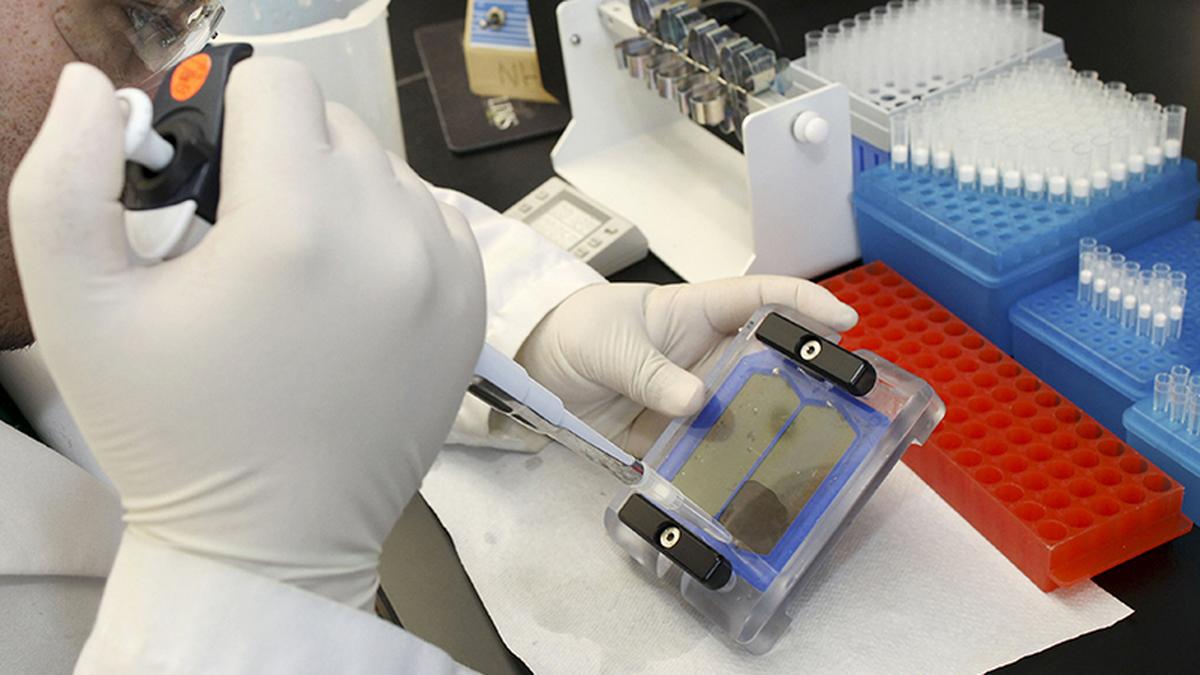
The Centre for DNA Fingerprinting and Diagnostics (CDFD) is a government laboratory in Hyderabad. It provides DNA-based investigative services to the police, the judiciary, and to hospitals that offer organ transplant procedures. Recently, the CDFD handled the case of a family in which the father offered to donate an organ to his ailing son. CDFD technicians generated DNA profiles of the donor, the patient, and also the patient’s mother.
While the DNA profiles of the mother and the son were consistent with their claimed mother-son relationship, those of the father and his son were not. The DNA showed that the woman’s husband was not the actual father of the patient but a close paternal relative, possibly a brother of the actual father. These findings didn’t preclude the organ transplant procedure but by revealing the practice of levirate they created a potentially awkward situation for the family.
Levirate is the custom in some families in which a woman who is widowed or one whose husband is mentally or physically incapacitated has children fathered by her husband’s brother. Understandably, the family would prefer to keep such knowledge private. The report from the CDFD was meant to tell doctors they could proceed with the transplant operation because the donor and the recipient belonged to the same family. But by explicitly revealing the woman’s husband was not her son’s father, it created the risk of an unwanted breach of the family’s privacy.
What are DNA profiles?
Every cell in our body has a nucleus that contains two copies of each of the 23 chromosomes, numbered 1 to 23. This 1-23 lump is our genome. One chromosome of each pair is inherited via the mother’s egg and the other via the father’s sperm.
When we make our own reproductive cells — eggs or sperm — each egg or sperm receives only one chromosome from a pair, i.e. one genome set. When a sperm cell and an egg fuse, they create a cell with two genome sets. This cell, called the zygote, divides to produce all the other cells of the baby.
Every chromosome contains a single DNA molecule that runs from end to end. A DNA molecule has two strands. Each strand is a long, linear sequence of four chemicals: adenine (A), cytosine (C), guanine (G), and thymidine (T). The As on one strand form bonds with the Ts on the other, while Gs bond with the Cs. The As, Cs, Gs, and Ts on one strand are called the DNA’s bases and the A-T and G-C combinations are the DNA’s base-pairs.
The largest chromosome in humans, chromosome 1, has more than 240 million base-pairs; the shortest, chromosome 21, has more than 40 million. The 23 chromosomes together have 3.2 billion base-pairs.
At several locations, or loci, on each of the 23 chromosomes, some short DNA sequences are repeated multiple times. These loci are called simple tandem repeats (STRs). For example, one strand of an STR locus might have multiple repeats of GGCCA (GGCCAGGCCAGGCCA…). These are paired with complementary CCGGT repeats on the other strand (CCGGTCCGGTCCGGT…). The repeat number of STR loci can differ in the two chromosomes of a pair. For example, a particular chromosome derived from the father might have 30 repeats while the same one from the mother may have 35.
The DNA profile of a person is simply the number of times the simple sequences are repeated in the STR loci. This number can be found by first creating lots of copies of DNA from a sample (using the polymerase chain reaction, PCR), then segregating the DNA fragments by size using a technique called capillary gel electrophoresis. It is sensitive enough to both accurately and precisely establish the number of repeats in an STR.
For example, the table below shows the number of repeats of the father, the mother, and the son in the case illustrated above — i.e. their DNA profiles.
Autosomal STR DNA profiles
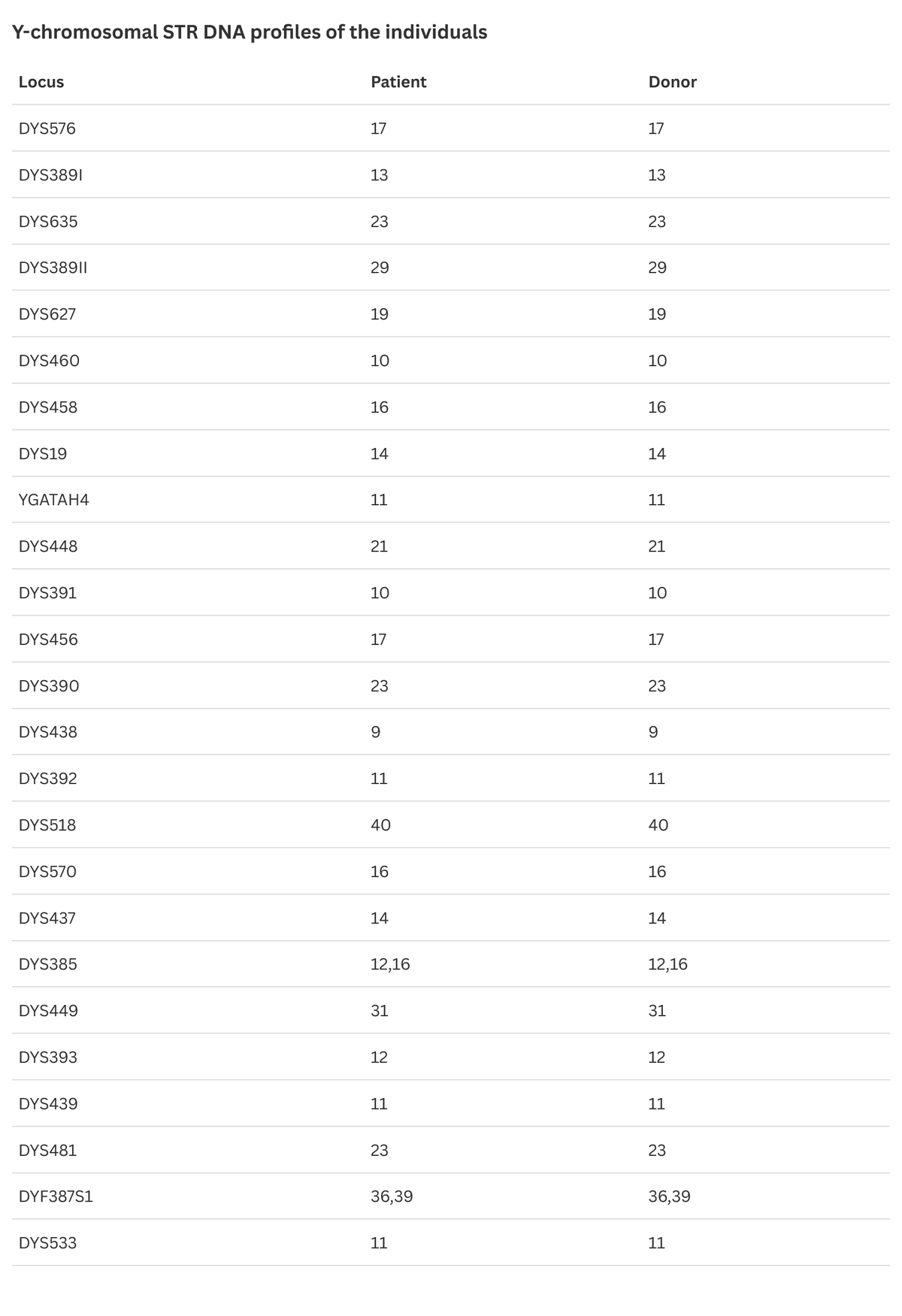
Y-chromosomal STR DNA profiles
According to the table, the mother’s versions of locus D18S51 had 14 and 15 repeats, while the son’s versions had 15 and 17 repeats. But the father’s versions of D18S51 had 14 and 14. The son received his 15-repeat version from his mother and the 17-repeat version from his father. But the woman’s husband didn’t have a 17-repeat variant, so this man couldn’t be the actual father. Likewise, for three other STR loci, the son received paternal variants that were absent from the donor.
The son and the man still had identical Y-chromosome profiles, plus identical variants in 19 of the 23 non-Y STR loci. This indicated that the woman’s husband is closely related to the biological father — possibly a brother. Thus the marriage is levirate.
Levirate marriages in India
Projit Bihari Mukharji, a historian of science at the University of Pennsylvania and Ashoka University in Haryana, ably discussed the practice of levirate marriage in India in his 2022 book ‘Brown Skins, White Coats Race Science in India, 1920-66’.
Mukharji cited the pioneering anthropologist and writer Irawati Karve (1905-1970) when he wrote that she spoke “of the three debts that any Hindu man owed and upon the repayment of which his ultimate liberation depended. These debts were respectively to the gods, the sages, and the ancestors. Each of these … required the making of regular offerings. These offerings could only be made by a son. Hence, the function of a son was the making of ancestral offerings, rather than the maintenance of a biological or genetic lineage.”
This pushed families to explore all possible ways, including levirate, to beget a son.
Mukharji added that families are reluctant “to divulge information … not simply … by a modern desire to avert scandal. Rather, it was because, within an older customary framework of kinship, ‘descent’ itself worked differently and to other ends. … The refusal … to share sexual information was tacitly rooted in a more radical refusal to accept a narrowly biologised notion of inheritance.”
Unfortunately, in the end, DNA analysis appears to have allowed the “narrow biologised notion of inheritance” to win for no reason other than that DNA just doesn’t know when to shut up. And if this isn’t a problem enough, consider what it could mean for the laws we have — or don’t — to protect our genetic privacy.
D.P. Kasbekar is a retired scientist.
Published – December 03, 2024 05:30 am IST