





There’s something about balloons that fascinates almost all of humankind. It is probably a fascination that we are born with, as children seem most drawn to it, even though that charm never fades off completely for many people. There was even a period of public interest in hot air balloons called balloonomania that spanned for decades beginning in 1783. What follows is something that happened in that year that helped spark this mania.
You might have heard of the Montgolfier brothers – Joseph-Michel and Jacques Etienne. Aviation pioneers instrumental in the development of hot-air balloons, they came from a family that had made its name manufacturing paper in France for generations. The balloon bug first bit Joseph, who, after building and flying small hot air balloons in 1782, got his brother Jacques on board as well. On June 4, 1783, their balloons were up and about – the first public demonstration of hot-air balloons – in Annonay, France.
Faujas’ impatience
Barthélemy Faujas de Saint-Fond was a French geologist, volcanologist and traveller of the time, who was also a member of the Academie Royale at the time. Impatient for a balloon demonstration in Paris, Faujas sold tickets for such a balloon flight and handed over the money to Jacques Alexandre-César Charles.
Born in 1746, Charles had switched to science after clerking in the finance ministry. He experimented with electricity and also came up with a number of inventions, including a hydrometer and a reflecting goniometer.
The Robert brothers
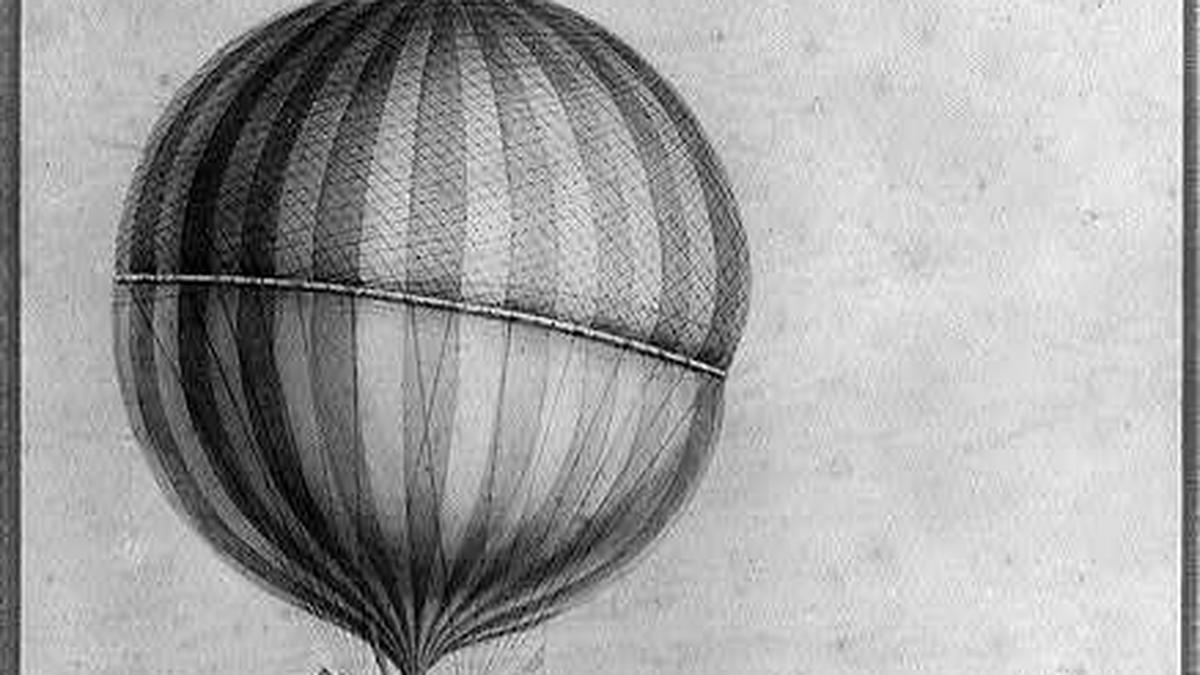
Tasked now with the challenge of designing, constructing, and launching a balloon, Charles got to work. Collaborating with the Robert brothers – Nicolas and Anne-Jean – Charles built the first hydrogen balloon. On August 27, 1783 – 83 days after Montgolfiers’ demonstration – Charles launched the first hydrogen-filled balloon from the Champ de Mars in Paris, the present-day site of the Eiffel Tower.
Digitally enhanced picture of Jacques Charles.
| Photo Credit:
pixel17 / flickr
As the race was on, the Montgolfier brothers were at it again. On September 19, they conducted another demonstration, this time from Versailles. They sent the first living creatures – a sheep, a duck, and a rooster – aboard a balloon. The passengers aboard the first hot-air balloon flight were recovered unharmed, with the only injuries sustained being the result of the sheep kicking the rooster!
Rozier’s ride to fame
A teacher and an experimental aviation pioneer, Jean-François Pilâtre de Rozier rode in a balloon tethered to the ground on October 15. On November 21, he made the first free flight on a hot-air balloon alongside French soldier François Laurent d’Arlandes.
Less than two weeks after this success – and less than 100 days after his initial hydrogen balloon launch – Charles conducted another demonstration of his own on December 1, this time from the Jardin des Tuileries. Along with the younger of the Robert brothers, Nicolas, Charles made the first free flight aboard a hydrogen balloon.
An estimated 4,00,000 people had gathered to witness this event as Charles and Robert flew skywards. While the wealthy had purchased tickets that gave them access to the inner circular enclosure around the launch site, the guards didn’t have the wherewithal to handle nearly half of the Paris population. People crowded around vantage points that gave them just a glimpse of the show on offer.
The flight lasted 2 hours and 5 minutes and the duo landed safely in the village of Nesles-la-Vallée, 35 km northwest of Paris. Following their safe landing, Charles requested Robert to exit the balloon in order to become the first to make a solo flight by reascending.
Process of filling gas
In addition to being the first hydrogen balloon flight with passengers, this was also one of the first flights to provide meteorological measurements of the atmosphere above the Earth’s surface. While the flight in itself was impressive, the process of filling the balloon with hydrogen gas before take-off was also an incredible feat.
This was achieved by pouring concentrated sulphuric acid onto oak barrels filled with iron nails successively. As the iron replaced the hydrogen in the H2SO4 in the barrels, the released hydrogen gas gushed to the surface in a rush. The barrels were arranged in a circle, and the gas was transported by tube to a central vat. Here, it was bubbled through water to ensure that there was no remaining acid, before the gas was piped to the balloon.
The exothermic nature of this reaction meant that a lot of heat was released, pushing some of the barrels close to ignition, and making the tubes impossible to touch. With hydrogen gas also being extremely flammable, it was nearly a miracle that the whole episode panned out without incident.
Charles’ work with balloons enabled him to notice a relationship between the volume of the gas and the temperature – something that we now know as Charles’s Law. While that does bear his name, the French masses immortalised him in another way: hydrogen balloons are simply called charlières.
Balloonomania
The strong public interest or fad in balloons and ballooning that began in France late in the 18th Century and extended well into the 19th Century during the advent of balloon flights came to be referred to as balloonomania.
An English writer and politician, Horace Walpole coined the term balloonomania. He complained that “all our views are directed to the air; balloons occupy senators, philosophers, ladies, everybody”.
The balloons had a huge social impact as spectators in those mass gatherings were beginning to get accustomed to the idea of change and that science and technology could pave the way for future progress.
Balloons were literally everywhere. From fashion trends to new product lines, everything featured balloons. This included jewellery, wallpaper, fans, clocks, hats,.. you name it, and you could get it designed with balloon motifs.
The Americans negotiating the conclusion of the American revolution and living in Paris were no exceptions. This included Benjamin Franklin, an American polymath and the Founding Father of the United States.
“All conversation here at present turns upon the Balloons…and the means of managing them so as to give Men the Advantage of Flying,” Benjamin Franklin conveyed to Richard Price, an English friend.
Published – December 01, 2024 12:43 am IST