





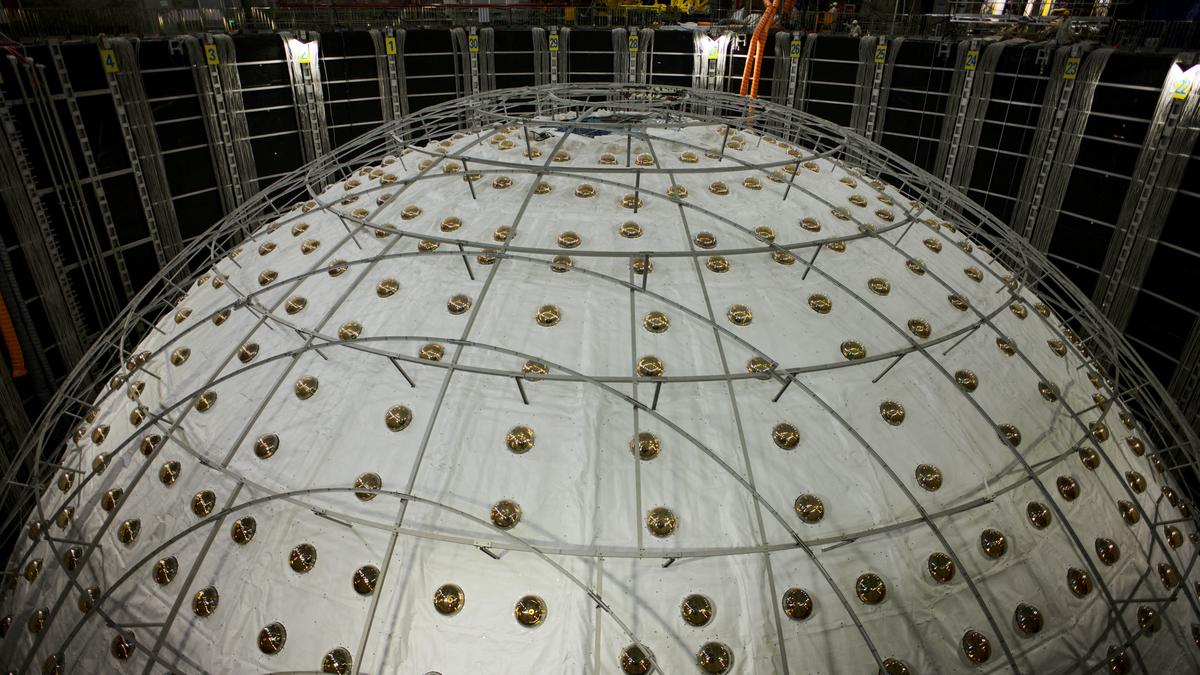
A giant sphere 700 m (2,300 ft) underground with thousands of light-detecting tubes will be sealed in a 12-storey cylindrical pool of water in coming months for an experiment that will shine new light on elusive subatomic particles known as neutrinos.
After years of construction, the $300 million Jiangmen Underground Neutrino Observatory (JUNO) in China’s southern Guangdong province will soon start gathering data on neutrinos, a product of nuclear reactions, to help solve one of the biggest mysteries in particle physics.
Every second, trillions of extremely small neutrinos pass through matter, including the human body. In mid-flight, a neutrino, of which there are three known varieties, could transform into other types. Determining which types are the lightest and the heaviest would offer clues to subatomic processes during the early days of the universe and to explaining why matter is the way it is.
To that end, Chinese physicists and collaborating scientists from all over the world will analyse the data on neutrinos emitted by two nearby Guangdong nuclear power plants for up to six years.
JUNO would also be able to observe neutrinos from the sun, gaining a real-time view of solar processes. It could also study neutrinos given off by the radioactive decay of uranium and thorium in the Earth to better understand mantle convection driving tectonic plates.
Due to go operational in the latter half of 2025, JUNO will outpace the far larger Deep Underground Neutrino Experiment (DUNE) under construction in the United States. DUNE, backed by the Long-Baseline Neutrino Facility (LBNF) under the U.S. Department of Energy’s (DOE) top particle physics laboratory, Fermilab, will come online around 2030.
The race to understand neutrinos and advance the study of particle physics, which has transformed medical imaging technologies and developed new energy sources, intensified when the DOE abruptly cut funding for U.S. institutes collaborating on JUNO. It instead focused on building DUNE, which has since been plagued by delays and budget overruns, with costs skyrocketing to more than $3 billion.
“China had supported Fermilab’s LBNF at the time, but later the cooperation could not continue,” Wang Yifang, chief scientist and project manager of JUNO, told Reuters during a recent government-backed media tour of the facility.
“Around 2018-2019, the U.S. DOE asked all national laboratories not to cooperate with China, so Fermilab was forced to stop working with us.”
The DOE, the largest U.S. funding agency for particle physics, did not respond to Reuters’ request for comment.
Sino-U.S. tensions have risen sharply over the past decade. A trade war erupted during the Trump administration and President Joe Biden later cracked down on the sale of advanced technology to China.
In August, a bilateral science and technology cooperation pact signed in 1979 lapsed, potentially pushing more scientists to seek alternative partners, creating duplication in research and missing out on collaboration that otherwise might have led to beneficial discoveries.
In the 2010s, the countries jointly produced a nuclear reactor that could use low-enriched uranium, minimising the risk of any fuel being weaponised.
China’s foreign ministry said Beijing was “in communication” with Washington about the lapsed science agreement. The U.S. State Department did not comment.
Sole U.S. Collaborator
Institutions collaborating on JUNO hail from locations including France, Germany, Italy, Russia and the U.S., and even self-governed Taiwan, which China claims as part of its territory.
Neutrino observatories are also being constructed in other places.

“The one in the U.S. will be six years behind us. And the one in the France and in Japan, they will be two or three years later than us. So we believe that we can get the result of mass hierarchy (of neutrinos) ahead of everybody,” Wang said.
So far, real-life neutrino applications remain a distant prospect. Some scientists have mulled the possibility of relaying long-distance messages via neutrinos, which pass through solid matter such as the Earth at near light speed.
Researchers are keeping their distance from politics to focus on the science, although they remain at the mercy of governments providing the funding.
One U.S. group remains in JUNO, backed by the National Science Foundation, which recently renewed its funding for its collaboration for another three years, the group’s leading physicist told Reuters.
In contrast, more than a dozen U.S. institutes participated in the predecessor to JUNO, the Daya Bay experiment, also in Guangdong.
“Despite any political differences, I believe that through our collaboration on this scientific endeavour, we are setting a positive example that may contribute, even in a small way, to bringing our countries closer together,” said J. Pedro Ochoa-Ricoux of the University of California, Irvine.
Data integrity
The passage of neutrinos from the two power stations will be logged by JUNO’s 600 metric ton spherical detector, which will immediately transmit the data to Beijing electronically. The data will be simultaneously relayed to Russia, France and Italy, where it can be accessed by all of the collaborating institutions, said Cao Jun, JUNO’s deputy manager.

Data integrity has been a concern among foreign companies in China since a law was enacted in 2021 on the use, storage and transfer of data in the name of safeguarding national security.
“We have a protocol to make sure that no data is missing,” Cao said.
For data on the more crucial aspects of the experiment, at least two independent teams will conduct analyses, with their results cross-checked.
“When these two groups get a consistent result, we can publish it,” Cao said.
U.S.-based Ochoa-Ricoux, who previously collaborated on China’s Daya Bay experiment, will lead the data analysis for JUNO. He will also be involved in the DUNE data analysis.
“We welcome the Americans,” said Wang, also director of the Institute of High Energy Physics, the Chinese counterpart of Fermilab.
Published – October 16, 2024 12:15 pm IST