



Skip to content
  • Facebook
  • X
  • Linkedin
  • WhatsApp
  • Associate Journalism
  • About Us
  • Privacy Policy
  • 033-46046046
  • editor@artifex.news
Artifex.News

Artifex.News

Stay Connected. Stay Informed.

  • Breaking News
  • World
  • Nation
  • Sports
  • Business
  • Science
  • Entertainment
  • Lifestyle
  • Toggle search form
  • How Dust From India’s Thar Desert Significantly Impacts Glaciers In Tibet Nation
  • Bengaluru Congress Pick Says Students Forced To Attend Tejasvi Surya Rally Nation
  • “I Will Retire At…”: Cristiano Ronaldo Makes Big Announcement On Future Amid Al Nassr Exit Talks Sports
  • Paris Olympics 2024: Prize Money In Store For Athletes Besides Medals Sports
  • Akshata Murty makes U.K. political stage debut for ‘best friend’ PM Sunak World
  • Rescuers retrieve remains of all 62 passengers in Brazil plane crash, families gather in Sao Paulo World
  • Apollo Hospitals Q4 PAT up 76% to ₹254 crore Business
  • “Either You Cut Off…”: Ex-Pakistan Captain’s Fiery Message To BCCI On Champions Trophy 2025 Sports

The mystery of Déjà vu

Posted on October 20, 2024 By admin


Déjà vu is a French term that means “already seen.” It describes the strange feeling that you’re repeating a moment, even though it’s happening for the first time. It’s like your mind plays a trick, making you feel as if you’ve been in that exact situation before, even though you haven’t.

Why does it happen?

Scientists think déjà vu happens because your brain is mixing up memories. Sometimes, you see or experience something that reminds your brain of a past event, even if it’s not exactly the same. This confusion tricks your brain into believing you’ve lived the moment before, creating that déjà vu feeling.

The Science

The brain works like a computer, storing and recalling memories. Normally, it keeps track of past experiences and new ones separately. But sometimes, signals in the brain get crossed or misfired. When this happens, your brain mistakenly thinks a new experience is actually an old memory, and that’s what creates the feeling of déjà vu.

Some scientists believe that déjà vu may be related to the temporal lobe of the brain, which is responsible for memory, language, and emotions. Disruptions between the temporal lobe and the hippocampus (which manages short-term memory) might trigger déjà vu.

Highlighted temporal lobe
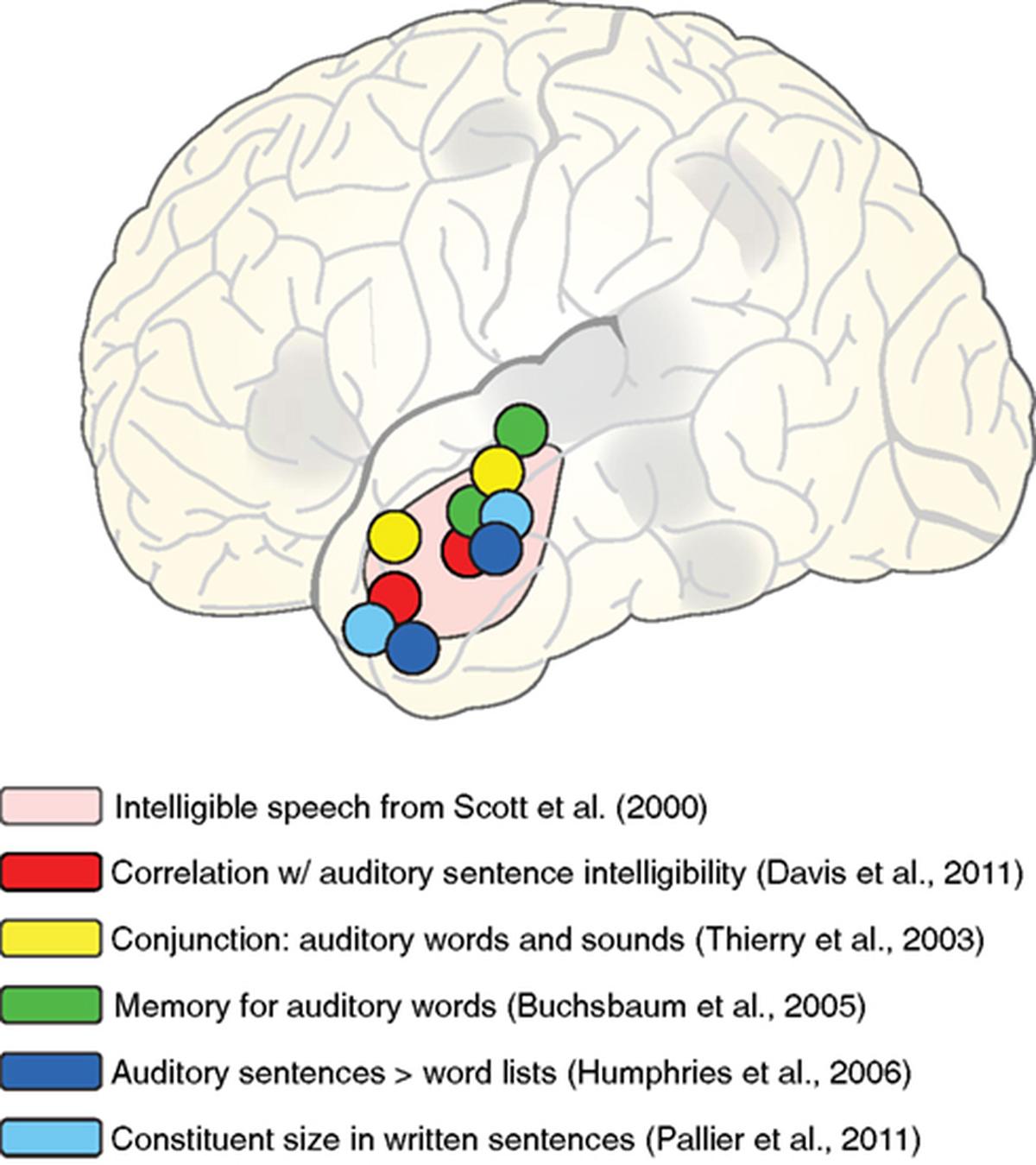
Schematic illustration of peaks from various fMRI studies in which activation of left anterior lateral temporal cortex was observed, overlaid on the region showing sensitivity to speech intelligibility from Scott et al. (2000)

Schematic illustration of peaks from various fMRI studies in which activation of left anterior lateral temporal cortex was observed, overlaid on the region showing sensitivity to speech intelligibility from Scott et al. (2000)
| Photo Credit:
Jonathan Peelle

Unconscious processing

Another possible explanation for déjà vu involves our brain’s ability to process information unconsciously. Our brains are constantly taking in and processing information from our senses, even when we’re not actively aware of it. It’s possible that sometimes, our brains unconsciously recognize a familiar pattern or element within a new situation. When we later consciously become aware of this situation, our brain might mistakenly interpret the familiarity as a sign that we’ve experienced it before, leading to a feeling of déjà vu.

Think of it like listening to a song for the first time. You might not consciously recognize the tune, but if you’ve heard it before in the background or in a commercial, your brain might unconsciously recognize it. When you hear the song again in a different context, you might suddenly feel like you’ve heard it before, even though you can’t remember where.

Memory glitch

Our brains are indeed very intricately complex organs responsible for storing and retrieving memories. Sometimes these processes go wrong and lead to memory glitches or, worse still, some develop déjà vu.

Imagine holding a keyring containing a number of keys. You’re trying to reach the right key to open your front door. In this dim light, you have grasped the wrong key. For a moment, you feel that sense of familiarity, like you’ve used this before, but when you take a closer look at it, you realise it is the wrong key. Similarly, the brain may also make mistakes at times and might attach a wrong familiarity leading one to it even though it is a new situation.

The experience of déjà vu raises intriguing questions about the nature of memory and consciousness. What does it tell us about how our brains store and retrieve information?

There are three main theories behind déjà vu.

One suggests it’s caused by your brain mixing up memories, another points to signals in the brain misfiring, and a third links it to your brain recognizing something similar from your past. While these ideas help explain déjà vu, the exact science is still being researched.

This leaves us with an intriguing question: What does the experience of déjà vu tell us about the nature of memory and consciousness?

Fun facts

Déjà vu happens more often in young people and tends to decrease with age.

Traveling to new places can trigger déjà vu experiences. This is because unfamiliar environments create a strong sense of familiarity that can conflict with your knowledge that you’ve never been there before.

Sights, sounds, smells, fatigue, and stress can all trigger déjà vu.

Déjà vu can also happen when you’re not paying full attention to a situation. For example, if you’re distracted while doing something and later return your focus, you might feel as though you’ve done it before.

Published – October 20, 2024 05:56 pm IST



Source link

Science

Post navigation

Previous Post: Son’s Post After Baba Siddique Murder
Next Post: South Africa vs New Zealand Highlights, Women’s T20 World Cup 2024 Final: New Zealand Beat South Africa By 32 Runs To Clinch Maiden Title

Related Posts

  • Air pollution harms pollinators more than pests, study finds Science
  •  Global project ‘paints’ evidence of air pollution in India Science
  • European Space Agency to provide support to Aditya-L1 mission Science
  • Nobel Prize in Chemistry 2024: Protein design and protein structure prediction DeepMind win | Explained Science
  • Sci-Five | The Hindu Science Quiz: On Octopus Science
  • Big Butterfly Month | A month for the winged ones Science

More Related Articles

Boeing’s beleaguered Starliner capsule leaves space station and heads home without any astronauts Science
Daily Quiz | On World Organ Donation Day Science
Acclaimed primatologist Frans de Waal dies at 75 Science
Dispersal out of Africa may have occurred during arid period Science
Does frequently updating COVID-19 vaccines have any benefits? | Explained Science
Trilobite fossils from upstate New York reveal extra set of legs Science
SiteLock

Archives

  • October 2024
  • September 2024
  • August 2024
  • July 2024
  • June 2024
  • May 2024
  • April 2024
  • March 2024
  • February 2024
  • January 2024
  • December 2023
  • November 2023
  • October 2023
  • September 2023
  • August 2023
  • July 2023
  • June 2023
  • May 2023
  • April 2023
  • March 2023
  • February 2023
  • January 2023
  • December 2022
  • November 2022
  • October 2022
  • September 2022
  • August 2022
  • July 2022
  • June 2022
  • May 2022

Categories

  • Business
  • Nation
  • Science
  • Sports
  • World

Recent Posts

  • India well positioned to capitalise on new growth opportunities: Nirmala Sitharaman
  • Sanju Samson Was Set To Play T20 World Cup 2024 Final, Then Rohit Sharma Told Him This
  • WHO certifies Egypt as malaria-free; calls it ‘historic feat’ ending ancient scourge
  • 6 Of Family Killed After House Collapses Due To Cylinder Blast In UP
  • Markets rebound in early trade amid buying in blue-chip stocks

Recent Comments

  1. dfb{{98991*97996}}xca on UP Teacher Who Asked Students To Slap Muslim Classmate
  2. "dfbzzzzzzzzbbbccccdddeeexca".replace("z","o") on UP Teacher Who Asked Students To Slap Muslim Classmate
  3. 1}}"}}'}}1%>"%>'%> on UP Teacher Who Asked Students To Slap Muslim Classmate
  4. bfg6520<s1﹥s2ʺs3ʹhjl6520 on UP Teacher Who Asked Students To Slap Muslim Classmate
  5. pHqghUme9356321 on UP Teacher Who Asked Students To Slap Muslim Classmate
  • The Science Quiz: Modern India’s foundations of science and scholarship Science
  • Community members in Seattle hold rally, demand justice for Jaahnavi Kandula World
  • Latest Flashpoint In Trinamool vs Bengal Government: Rejected Bills Nation
  • Iran slams Meta’s removal of Khamenei’s social media accounts World
  • BJP’s Huge Membership Drive In Madhya Pradesh Hit By False Data Row Nation
  • Election Commission Asks X To Take Down BJP Karnataka’s Post Nation
  • ‘It’s All Over’: Bayern Defeat Sends Leverkusen 13 Points Clear Sports
  • Kerala Couple Dies By Suicide In Nagpur Nation

Editor-in-Chief:
Mohammad Ariff,
MSW, MAJMC, BSW, DTL, CTS, CNM, CCR, CAL, RSL, ASOC.
editor@artifex.news

Associate Editors:
1. Zenellis R. Tuba,
zenelis@artifex.news
2. Haris Daniyel
daniyel@artifex.news

Photograher:
Rohan Das
rohan@artifex.news

Artifex.News offers Online Paid Internships to college students from India and Abroad. Interns will get a PRESS CARD and other online offers.
Send your CV (Subjectline: Paid Internship) to internship@artifex.news

Links:
Associate Journalism
About Us
Privacy Policy

News Links:
Breaking News
World
Nation
Sports
Business
Entertainment
Lifestyle

Registered Office:
72/A, Elliot Road, Kolkata - 700016
Tel: 033-22277777, 033-22172217
Email: office@artifex.news

Editorial Office / News Desk:
No. 13, Mezzanine Floor, Esplanade Metro Rail Station,
12 J. L. Nehru Road, Kolkata - 700069.
(Entry from Gate No. 5)
Tel: 033-46011099, 033-46046046
Email: editor@artifex.news

Copyright © 2023 Artifex.News Newsportal designed by Artifex Infotech.