



The 1979 Iranian revolution, which saw the fall of a thousands-of-years-old monarchy and spawned the birth of a theocratic republic, was one of the most consequential events of post-World War West Asia. Shah Mohammed Reza Pahlavi, the last king of Iran, was a close ally of the U.S. and Israel. In 1953, the U.S. helped orchestrate a violent coup in Iran against Mohammad Mosaddegh, an elected Prime Minister, and reinstated the authority of the Shah. The monarch was largely seen as a pawn of the U.S. by the revolutionaries. Anti-imperialism was one of the ideological forces behind the revolution. The theocratic regime, established by Ayatollah Khomeini, broke with the U.S., “the great Satan”, and the existing order of the day in West Asia.
Then the Islamic Republic was instantly seen as an enemy by Sunni Arab states and the U.S. Within a year, when the Ayatollah was still consolidating his authority in Iran, neighbouring Iraq, backed by Sunni Arab monarchies and the U.S., attacked Iran. Isolated, attacked and lacking conventional capabilities to face the growing geopolitical challenges around it, Iran turned to a new model of deterrence — forward defence or build the formation of a network of militias across the region through which it can project its influence. This is how the so-called Axis of Resistance was born.
Hezbollah
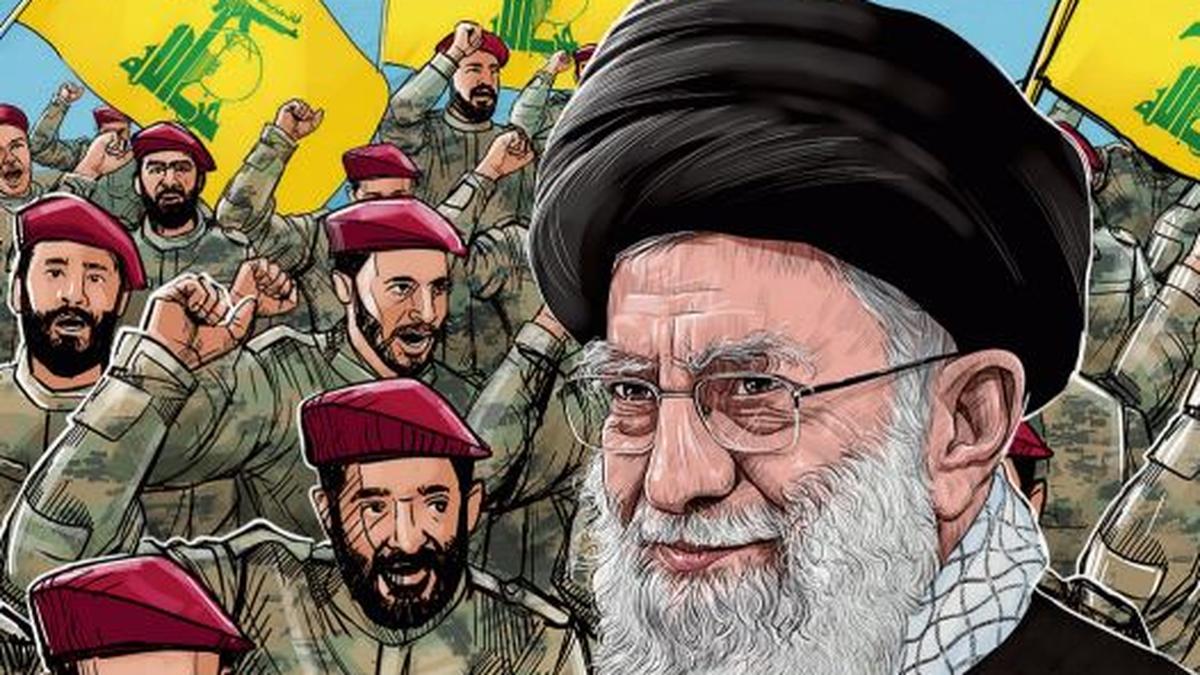
Among the groups that are part of the Axis, there are organisations that Iran helped create and groups that it co-opted into its orbit. Hezbollah is part of the former. In 1982, after the Israeli invasion of Lebanon, the Islamic Revolutionary Guard Corps (IRGC) helped form a loose network of Shia militias called the ‘Islamic Resistance’, whose initial target was the Multi-National Force (MNF) deployed in Lebanon. After the 1983 U.S. embassy and military barracks bombing orchestrated by the new militia group, the MNF announced its withdrawal from Lebanon. But Israeli troops continued its occupation of a sliver of territory in southern Lebanonbordering Israel. In 1985, the network announced itself as Hezbollah (Party of God), whose primary objective was to fight the occupying Israeli troops.
The gist
Iran’s Revolutionary Guard helped create Hezbollah in the early 1980 in the aftermath of Israel’s invasion of Lebanon. Hezbollah, a Shia militia, played a crucial role in forcing Israel to withdraw from Lebanon in 2000
Hamas, a branch of the Muslim Brotherhood, announced its existence in 1987, during the first intifada; it grew closer to Iran when the PLO, backed by Arab countries, recognised Israel and signed the Oslo agreements
Ansar Allah (Houthis), which was formed in Yemen by Badr al-Din al-Houthi taking inspiration from the Iranian revolution and Hezbollah emerged as a prominent actor after they captured Sana’a in 2015
In 2000, when Israel announced its withdrawal from Lebanon, ending 18 years of occupation, Hezbollah claimed ‘the first Arab victory against the Zionist entity’. From the 1990s onwards, Hezbollah, under the leadership of Hassan Nasrallah, who was killed on September 27 by an Israeli strike on Beirut, transformed itself into a state within a the state in of Lebanon. According to the Office of the U.S. Director of National Intelligence, Hezbollah has over 40,000 well-trained fighters and many more reservists. The group also possesses hundreds of thousands of short, medium and long-range rockets and missiles. The group has been the crown jewel of the Axis of Resistance — Iran’s arm on Israel’s borders.
Hamas and Islamic Jihad
If the Shah’s Iran was a close ally of Israel, the Islamic Republic, driven by anti-imperialism, turned against Israel (the ‘little Satan’), like it turned against the U.S. Ayatollah Khomeini said support for Palestine was a duty of the Islamic Republic. Two years after the revolution, the Islamic Jihad was formed in the Palestinian territories. A Sunni Islamist outfit, it was inspired by the clerical rule established by Khomeini in Iran.
In Gaza, there was another Islamist organisation, the Islamic Centre, which was established by Sheikh Ahmed Yassin as a branch of the Muslim Brotherhood in the 1970s. In late 1987s, after the first intifada broke out in Palestinian territories, the Islamic Centre reinvented itself as Hamas (Harakat al-Muqawamah al-Islamiyyah, or the Islamic Resistance Movement).
Theocratic Iran saw allies in these Islamist groups rather than the secular Palestinian Liberation Organisation, which was backed by Arab countries and was ready to engage with the Israelis. When the PLO recognised the state of Israel as part of the Oslo agreements, which was rejected by Hamas and the Islamic Jihad, Iran started cultivating stronger ties with these militant groups. Unlike Hezbollah, which gets direct Iranian support through Syria, Hamas and the Islamic Jihad get limited material support from Tehran. But they are the Palestinian wings of the Axis and enjoy unlimited political support from Tehran. When Hamas carried out the October 7, 2023 attack in Israel, Iran instantly supported the group.
Ansar Allah (Houthis)
Unlike Hezbollah, Hamas and the Islamic Jihad, the Houthis of Yemen came into the picture much later. The roots of the Houthi movement can be traced to “Believing Youth” (Muntada al-Shahabal-Mu’min), a Zaydi revivalist group founded by Hussein al-Houthi and his father, Badr al-Din al-Houthi, two Zaydi clerics, in the early 1990s. Inspired by the Iranian revolution of 1979 and the rise of Hezbollah in southern Lebanon in the 1980s, Badr al-Din and his sons started building vast social and religious networks among the Zaydis of Yemen, who make up roughly one-third of the Sunni-majority country’s population.
They called themselves Ansar Allah (Partisans of God), mobilised tribesmen in the north against the government of Ali Abdullah Saleh and chanted “Death to America”. In 2004, Saleh’s government issued an arrest warrant against Hussein al-Houthi. He resisted the arrest, starting an insurgency. In September, the government troops attacked the rebels and killed Hussein. The government’s high-handedness only strengthened the Houthis, who are named after their slain leader. When Yemen fell into chaos after the Arab Spring-inspired protests in 2011, the Houthis marched towards Sanaa and by January 2015, they captured the capital and much of northern Yemen. They still control those parts, despite a large-scale bombing campaign launched by a Saudi alliance. When Israel launched its retaliatory war on Gaza after the October 7 attack, the Houthis declared war against Israel. Ever since, they have targeted hundreds of commercial vessels in the Red Sea and launched direct missile attacks on Israel.
Hashad al-Shabi
When the U.S. invaded Iraq and brought down the Saddam Hussein regime in 2003, the country fell into chaos and spiralling violence. Subsequently, a new Shia political class emerged in Iraq. Iran, which had historically built close ties with different Shia groups in Iraq, found the fall of Saddam as an opportunity to expand its influence in the neighbouring country.
When Syria fell into a civil war following the 2011 protests, which also saw the rise of the Islamic State in Syria and Iraq, Iran offered direct support for Shia militias that fought in Iraq and Syria against the IS. These groups came to be called the Shia Popular Mobilisation Forces or Hashad al-Shabi. This includes Kata’ib Hizballah, Asa’ib Ahl al-Haq, Harakat al-Nujaba, Kata’ib Sayyid al-Shuhada, and the Badr Organisation.
Gen. Qassem Soleimani, the charismatic commander of Iran’s Quds Force, was the main architect of the Hashad and the key strategist of the Axis. Gen. Soleimani was killed in an American airstrike on Baghdad in January 2020, along with Abu Mahdi al-Muhandis, the leader of Kata’ib Hizballah and deputy leader of Hashad. The killings were a setback for the network, but the militias remain powerful across Iraq and Syria.
All these groups have been part of the unfolding conflict in West Asia. Hamas attacked Israel on October 7. When Israel retaliated, Hezbollah and Houthis started attacking Israel. Hashad targeted U.S. bases in Iraq, Syria and Jordan. In response, the U.S. and allies have carried out air strikes against Hashad militias and Houthis. Israel has taken the war straight to Hezbollah, killing Nasrallah and launching an invasion of Lebanon. In retaliation, Iran launched its second direct missile attack on Israel and the latter has vowed to hit Iran back. This is already a regional conflict, with both sides, Iran and the Axis and Israel and its allies, on the escalation ladder. When viewed collectively, these actions constitute a regional conflict, with Iran and the Axis on the one side and Israel and its allies on the other, both willing to climb up the escalation ladder.
Published – October 06, 2024 01:02 am IST