






The story so far:
In the last few years, maritime East Asia has become an arena for intensified power politics. The East China Sea borders China, Taiwan, Japan, and South Korea. China asserts that the Senkaku/ Diaoyu islands, located in the East China Sea and under Japanese control, belong to Beijing. There have been multiple crises over these islands in the past. The South China Sea lies between China, Taiwan and five Southeast Asian countries — Vietnam, Malaysia, Brunei, the Philippines, and Indonesia — and has emerged as one of the most important flashpoints in the Indo-Pacific. China has been aggressively pushing its claims in the South China Sea.
Why are the seas important to China?
China views the East and South China Seas through the prism of sovereignty, territorial integrity, and national security. China’s Defence White paper, issued in 2019, declares, “South China Sea islands and Diaoyu Islands are inalienable parts of the Chinese territory.” In responding to the criticism regarding China’s activities, it asserts that “China exercises its national sovereignty to build infrastructure and deploy necessary defensive capabilities on the islands and reefs in the South China Sea, and to conduct patrols in the waters of Diaoyu Islands in the East China Sea.” What China perceives as its defensive actions are considered offensive and provocative by the regional countries surrounding the East and South China Seas.
What is the significance of the seas?
The key maritime trade routes in East Asia pass through these two seas. Taiwan Strait is a critical maritime choke point. The region is home to undersea cables that are important for the global digital economy. As per the U.S. Energy Information Administration, in 2023, 10 billion barrels of petroleum and petroleum products and 6.7 trillion cubic feet of liquefied natural gas passed through the South China Sea. It is also home to vast reserves of untapped oil and natural gas.
What is China doing in the region?
China has been aggressively pushing its territorial claims in both seas in two ways: by building defence-related infrastructure such as ports, military installations, airstrips, and artificial islands and by pushing back against the claims of regional countries. In the East China Sea, China vehemently contested Japanese claims and, both countries found themselves embroiled in multiple crises, the most notable being the arrest of a Chinese captain of a fishing boat in 2010 and Japan’s nationalisation of the Senkaku islands in 2012. These crises saw both countries taking maximalist positions. China had imposed a ban on the export of rare earth minerals to Japan. In the last few years, there has been a slight easing of tensions over the issue regarding the Senkaku/Diaoyu islands. As per the Japan Coast Guard data, 2023 saw the highest level of activity by the Chinese Coast Guard in the contiguous zone of the Senkakus. Owing to China’s assertive foreign policy, its relationship with South Korea, Taiwan and Japan has deteriorated rapidly.
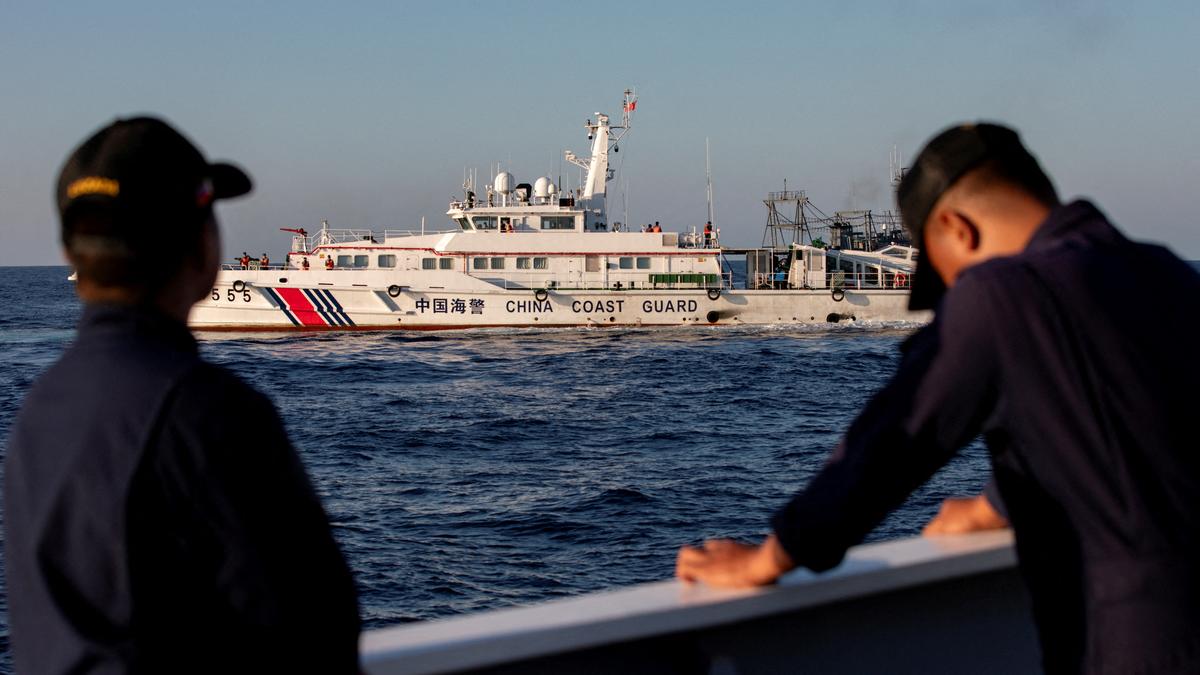
Meanwhile, the South China Sea has become a major theatre of Chinese belligerence. The power asymmetry between China and the South China Sea claimant countries is large and is growing continuously. China’s navy is also the largest naval force in the world by numbers. Therefore, the South China Sea is seeing the ever-growing projection of Chinese power. For asserting its claims, China has deployed a Coast Guard and maritime militia. The tactics include dangerous and aggressive manoeuvres at sea, harassing resupply missions, ramming vessels, collisions, and using water cannons and military-grade lasers, etc. These tactics are known as ‘grey zone’ operations, which fall short of war but are designed to alter the status quo.
China has been actively pushing its claims in the Exclusive Economic Zone (EEZ) of the Philippines. Since 2022, tensions between China and the Philippines have been rising due to a significant increase in the frequency of such incidents. In June-July 2024, multiple incidents of clashes occurred. The Second Thomas Shoal and Sabina Shoal have been the focus of China’s recent assertiveness. The Philippines’ resupply missions to the grounded ship, BRP Sierra Madre, have been repeatedly disrupted by China and have become a point of contention. China aims to drive a wedge between the U.S. and its treaty partners in East Asia. Chinese Coast Guard ships are considerably heavier and larger in terms of tonnage compared with Coast Guard vessels of other countries. For example, the Chinese vessel CCG 5901 (541 feet long and displaces 12,000 tons) is three times larger than the main ships of the U.S. Coast Guard. Hence, China’s frequent ramming of the Philippines’ vessels is dangerous and risky. There is a chance of miscalculation.
In July, China conducted naval exercises with Russia in the South China Sea to demonstrate the support that it enjoys over it while projecting its claims. China’s claims in the South China Sea lack a legal basis, according to a permanent court of arbitration ruling in 2016. However, China has rejected that ruling.
What has been the response from regional countries?
The regional countries have responded in three ways: First, they are building their defence capabilities. Defence spending has increased across the Indo-Pacific with regional countries trying to catch up with China. For example, by 2027, Japan wants to double its defence expenditure. The Philippines too is ramping up its defence capabilities and, among others, has acquired the anti-ship, BrahMos missiles from India.
Second, regional countries are responding to China’s activities at sea. From 2016 to 2022, Under President Rodrigo Duterte, the Philippines sought to minimise the friction between Manila and Beijing. Since 2022, the Philippines has been pushing back and publicising these incidents. The change in policy was crafted by the new President Ferdinand Marcos Jr. As a result, the frequency of incidents has gone up. Regional countries are engaged in a battle of narratives as well. They are deploying tools such as public diplomacy. The Philippines has been filming the behaviour of Chinese vessels and is releasing it through social media. The Philippines has also taken international journalists along with its resupply missions in the West Philippine Sea. The shaping of perceptions has become a key battleground.
Third, the Philippines, Japan and South Korea are treaty allies of the U.S. and are strengthening their defence relationship with it. The U.S. and the Philippines have enhanced their cooperation in the South China Sea to “historic levels” and expanded cooperation in domains such as base access, training and joint exercises. They are working with Australia and Japan in “a complex multilateral maritime cooperative activity.” It is dubbed as the ‘Squad’. According to U.S. Secretary of Defence Lloyd Austin, the U.S.’ commitment to the security of Japan is “ironclad” and includes the Senkaku islands as well. The U.S., Japan, and South Korea are deepening their trilateral cooperation. For the first time in history, the Defence Ministers of the three countries met in Japan in July 2024. In view of aggressive Chinese maritime activities, the press statement noted that these three countries “strongly oppose any unilateral attempts to change the status quo in the waters of the Indo-Pacific.” They also “stressed the importance of fully respecting international law including the freedom of navigation and overflight.”
Despite the efforts at bolstering the U.S.’ alliances in the Indo-Pacific, concerns remain about American credibility and the impact of the U.S.’ domestic politics on its external security commitments. There is also a debate about whether the U.S. engagement in East Asia balances the Chinese power or fuels conflict.
(Sankalp Gurjar is an expert on Asian Security and Indo-Pacific Geopolitics)
Published – September 26, 2024 10:46 pm IST