


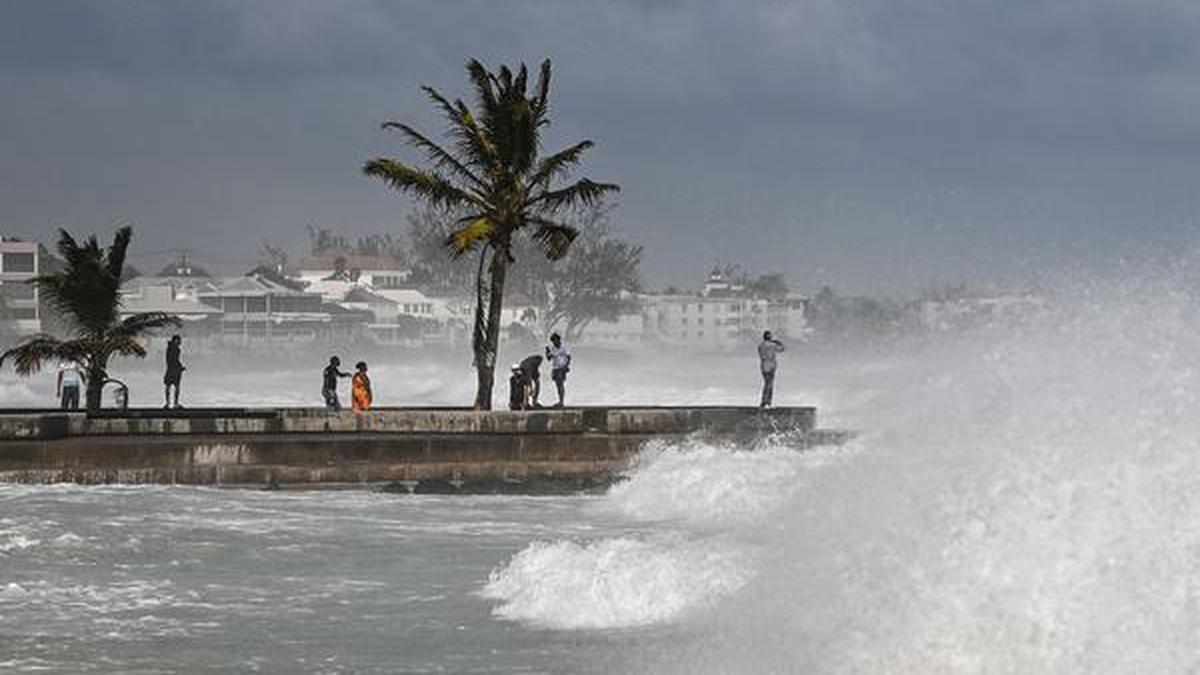
With the record warming of 2023-2024, we are getting a clearer picture of what global warming does. The medley of extremes strewn across the planet have covered the gamut from deadly heatwaves to devastating cyclones and floods, from droughts to wildfires.
According to some estimates, the world has already crossed the 1.5º C warming threshold. (That is, the earth’s average surface temperature has increased by more than 1.5º C over the pre-industrial average.) The caveat is that global temperatures are an estimate produced from a combination of data and climate models. Because the 1.5º C limit is part of a demand by the Alliance of Small Island and Developing States, scientists have built models to predict what environmental disturbances crossing this threshold could invite.
However, and more importantly, it is not yet clear how long the warming has to remain above the threshold for the projected impacts to materialise.
The spectacular show that nature has put up during 2023-2024 is also a stark reminder that we are far from able to predict the weather and the climate with the requisite skills and spatial-temporal scales to manage disasters effectively. The loss of lives, livelihoods, property, and infrastructure continues to traumatise humanity, especially the poor, who remain very vulnerable to extreme events.
2024 v. our predictions
Meteorologists predicted the 2023 El Niño as early as in the spring of that year, which is remarkable. But the level of warming during 2023-2024 has caught them, and the public, by surprise because it was much higher than expected from the addition of the so-called mini-global warming by the El Niño to the ongoing background warming. We speculate that water vapour thrown up by the underwater volcano Hunga Tonga–Hunga Haʻapai during 2022 and carbon dioxide emitted by the wildfires exacerbated the warming.
The 2023 monsoon was deficit but it did not qualify as an El Niño drought, the reasons for which researchers are yet to diagnose. Predictions from nearly all major weather centres earlier promised a strong La Niña in late 2024. Now this seems less likely. Perhaps nature has another googly in waiting.
Similarly, weather forecasts have called for the most intense hurricane season in decades but which has yet to step beyond normal.
The monsoon season has evolved erratically and has once again left many parts of India dry while producing devastating floods and landslides in many others. Now 2024 is set to emerge as a monsoon-surplus year yet it can hardly be called a typical La Niña monsoon.
The cyclone season in the North Indian Ocean has also been weaker than one would expect in a La Niña year.
Some weather centres were very gung-ho about an Indian Ocean Dipole (IOD) emerging in the Indian Ocean but it has played truant so far.

To be clear: this is not a litany of grievances against predictions. It is an expression of caution: that we will be remiss if we don’t learn all the lessons from this extraordinary period of warming vis-à-vis their implications for the future of predictions and for the climate projections we keep producing.
Predictions may pose bigger challenges
A quote often attributed to physicist Niels Bohr is apt here: prediction is difficult, especially if it’s about the future. Weather and climate predictions frequently remind us of this. We do learn our lessons and continue to improve the models and the observational networks we need to produce better predictions.
But what if predictions continue to become more difficult with global warming? Put another way, are all the misfires we have had this year just a coincidence or are they a portent of what is to come?
Many studies have reported the impacts of warming on hurricanes, monsoons, El Niños, La Niñas, the IOD, etc. But the bigger question is: if the world is already warmer than 1.5º C, are there any conclusions we can draw about how all these natural variabilities have responded thus far?
Unfortunately, the period of warming we have experienced of late hasn’t been long enough for us to confidently say what changes we can already detect in the dominant climate modes. The models are amazing in their ability to reproduce all natural modes given just the energy coming from the Sun at the top of the atmosphere. But they are not perfect: model answers often disagree; even the same model can produce different answers depending on its configuration.
For example, existing models cannot reproduce monsoon trends in the past half century and are considered unreliable for the future; they can only make skillful forecasts for the present. We have also not sorted out yet whether monsoon patterns are variable from decade to decade — patterns that we may currently be calling trends. We also don’t know whether climate change can extend the timescale of natural decadal variability and make it a real trend. We need to address these critical questions to advance our understanding of processes and to make better predictions.
Predicting the future of predictions
There is plenty of hope for the future of predictions, but as the adage goes, hope is not a strategy. We have our work cut out for us. We obviously need to continue to improve our models and build on the fact that models are already capable of amazing feats, with some deficiencies. We need to figure out if the predictability of natural modes such hurricanes, El Niño, La Niña, IOD, etc. will decrease as the warming is relentless, if not accelerating.
Well-trained and enthusiastic scientists toil to improve models and data networks and bring the latest technologies, including artificial intelligence, machine learning, and sensor-fit drones, to bear on this pressing challenge. We have plenty of reasons for optimism vis-à-vis reliable and actionable early warnings at the hyperlocal scale.

Lessons from 2023 for climate projections
We currently make climate projections using the same or similar models that project future climate based on how the concentrations of specific emissions increase, how populations grow, and what mitigation policies we implement, among other factors. For the coming decade or two, projection uncertainties depend on the model uncertainties themselves plus natural variabilities in a warming world.
The uncertainties in projections beyond a couple of decades are related entirely to the imagined scenarios that drive model simulations. The inability to capture the response of natural modes to warming will continue to haunt all projections. It will be necessary to translate improved weather and climate predictions to improve the models.
The best strategy to ensure projections are reliable may be to restrict ourselves to just a decade or two into the future. The ongoing geopolitical perturbations and their cascades into markets, economies, and societies underscore the difficulty of imagining the future beyond a decade or so as well.
Overall, it is critical that we assess the costs and benefits of the considerable human, financial, and computational resources for climate projections out to 2100.
Raghu Murtugudde is professor, IIT Bombay, and emeritus professor, University of Maryland.
Published – September 25, 2024 09:30 am IST