





On September 16, 2023, several seismic stations worldwide detected a bizarre signal. Earthquakes are not rare. In 2023 alone, 1,712 earthquakes of magnitude 5 or more were registered worldwide. But these seismic waves were puzzling; the signatures clearly indicated that earthquakes had not caused them, and the reverberations lasted for a staggering nine days.
A mysterious ringing
“We saw it on sensors everywhere, from the Arctic to Antarctica,” Stephen Hicks, a computational seismology research fellow at University College London, and Kristian Svennevig, senior researcher at the Geological Survey of Denmark and Greenland, wrote in a recent article. They are coauthors of the study reporting their findings, published in Science on September 12.
When you play the violin, you yank multiple strings together, which emit sounds at a mix of frequencies. Seismic waves from earthquakes behave the same way. However, the hum the seismologists recorded had only one frequency — like only one string of the violin had been plucked. That isn’t characteristic of tremors.
At first, the seismologists classified this wave as a “USO”, an unidentified seismic object. “Even more puzzling was that the signal kept going for nine days,” Hicks and Svennevig wrote. Earthquake vibrations also produce aftershocks. But in this case, the reverberations faded more slowly than one might anticipate from an earthquake.
A global effort
What set off the tremble? Only powerful events like volcano eruptions or clandestine nuclear weapons tests could unleash this much energy. Seismologists were intrigued.
To resolve the enigma, more than 68 researchers from 40 universities in 15 countries teamed up across disciplines. After piecing together numerous datasets and using computer simulations, the team realised the waves were caused by a massive landslide on the banks of the Dickson Fjord in Greenland.
According to Hicks and Svennevig, “solving this mystery required putting many diverse pieces of evidence together, from a treasure trove of seismic data to satellite imagery, in-fjord water level monitors, and detailed simulations” of how the water reacted.
The team even had to obtain a classified army bathymetric map of the fjord from the Danish Navy. It took about a year to assemble the jigsaw pieces and get the complete picture.
Rocks in the water
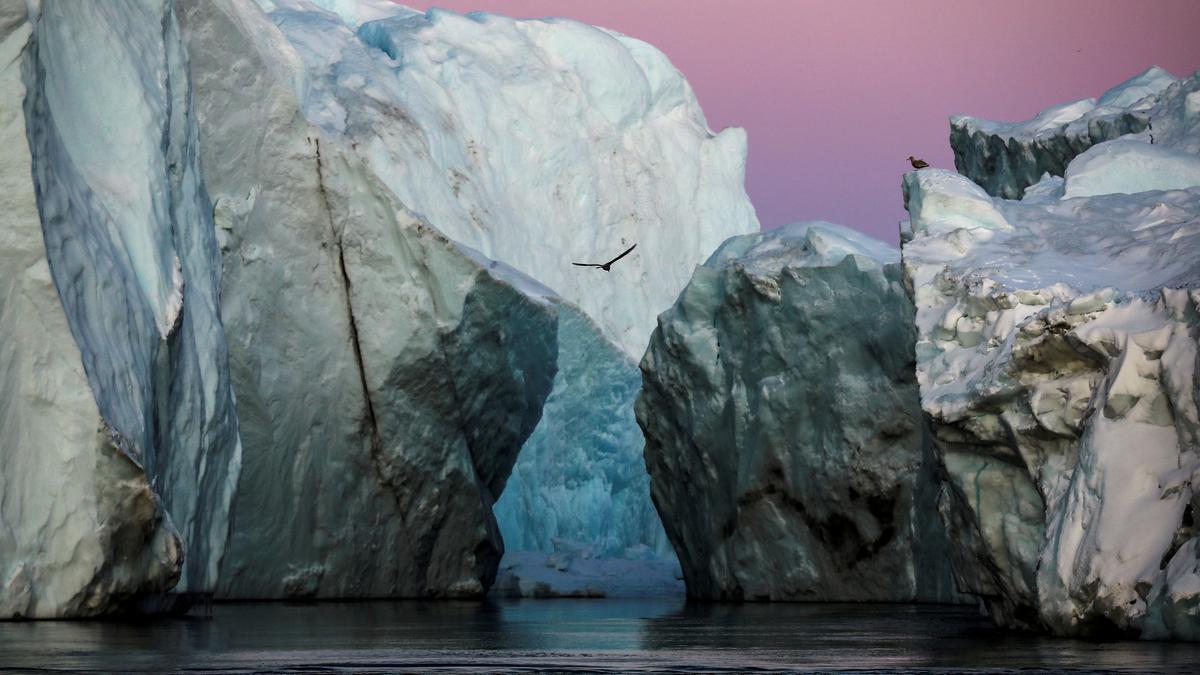
A fjord is a geological structure created when glaciers erode a valley below sea level and the sea water floods it. They frequently feature U-shaped channels that stretch well inland, surrounded by high cliffs or hills.
A series of events, starting with the collapse of Hvide Støvhorn peak, located approximately 1.2 km from the fjord, culminated in a mega-tsunami. The rockslide rolling down gained momentum and shattered the glacier, resulting in a rock-ice avalanche. According to the authors, the avalanche triggered a submarine landslide.

Roughly 25 million cubic metres of ice and rock, enough to fill 10,000 Olympic-sized swimming pools, splashed into the fjord, displacing the water enough to give rise to a 200-metre-high mega-tsunami, nearly three times the height of the Srirangam Temple.
Sloshing waves
The mega-tsunami didn’t kill anyone but it damaged an unstaffed research facility on the island of Ella, some 72 km away, as well as monuments of cultural and archaeological importance in the area.
A tsunami’s waves in an ocean would have spread and dispersed. But in the 540-metre-deep and 2.7-km-wide fjord, the waves were reflected back and forth by the opposing banks. The rebounding waves reached a height of almost 110 metres.
This back-and-forth sloshing in the fjord is called a seiche. About five minutes after the material plunged into the water, the waves settled slowly into a seiche with a maximum amplitude of 7.4 m and a dominant frequency of 11.45 MHz, oscillating every 90 seconds.
For more than nine days, the waves in the Dickson Fjord fjord kept up their dance, moving from side to side around 10,000 times. These oscillations matched the strange waves the seismic stations had recorded.
The alarm bell
The ice-rock avalanche and the waves’ motions rang the earth’s surface like a gong, and the reverberations spread across the globe, causing the entire earth to ring like a bell.
Researchers also examined the cause of the enormous landslide. Before the collapse, the ice at the glacier’s foot had supported the rocky slopes. Satellite pictures and other data revealed the foot had been shrinking rapidly the last few decades thanks to global warming. As the ice thawed, it couldn’t support the weight at the top. The rock breached it and slid violently downslope, concluding with the mega-tsunami.
“It is a stark reminder that we are navigating uncharted waters,” Hicks and Svennevig wrote. “Just a year ago, the idea that a seiche could persist for nine days would have been dismissed as absurd. Similarly, a century ago, the notion that warming could destabilise slopes in the Arctic, leading to massive landslides and tsunamis happening almost yearly, would have been considered far-fetched. Yet these once-unthinkable events are now becoming our new reality.”

Nature’s earthshakers
A melting glacier led to a planet-wide tremor, and it may not be the last.
Arctic and subarctic regions are warming at a pace two- to three-times that of the rest of the planet. As the ice cover melts, the darker rock surfaces are exposed. They absorb more light, leading to faster melting of the ice cover in the Arctic. And we can expect glacial melting will only increase the rate of ice-related landslides.
“This certainly won’t be the last such landslide mega-tsunami,” Hicks and Svennevig cautioned. “As permafrost on steep slopes continues to warm and glaciers continue to thin we can expect these events to happen more often and on an even bigger scale across the world’s polar and mountainous regions.”
T.V. Venkateswaran is a science communicator and visiting faculty member at the Indian Institute of Science Education and Research, Mohali.
Published – September 24, 2024 05:30 am IST