


Skip to content
  • Facebook
  • X
  • Linkedin
  • WhatsApp
  • Associate Journalism
  • About Us
  • Privacy Policy
  • 033-46046046
  • editor@artifex.news
Artifex.News

Artifex.News

Stay Connected. Stay Informed.

  • Breaking News
  • World
  • Nation
  • Sports
  • Business
  • Science
  • Entertainment
  • Lifestyle
  • Toggle search form
  • Cornell University Student Patrick Dai Arrested For Making Online Threats To Jewish Students On Campus World
  • Nearly 1.6 Lakh Vehicles Fined In Delhi For Pollution-Check Violations Nation
  • Veteran Spinner Ignores India For T20 World Cup Final, Says It Will Be Pakistan vs… Sports
  • Boxing Great Floyd Mayweather Offers Prayers At Mumbai’s Shri Siddhivinayak Temple – Watch Sports
  • SBI reckons poverty levels between 4%-5%; inflation to ease if core inflation is declining vis-a-vis food price rise Business
  • Defence Minister Rajnath Singh To Visit US From August 23 To 26. Here’s The Agenda World
  • Chandrayaan-2 Team Member Makes Final Of UK’s Toughest TV Quiz Nation
  • Special Treatment For Murder Accused Actor In Jail? Viral Pic Sparks Row Nation

On Germany’s electoral architecture | Explained

Posted on September 2, 2024 By admin


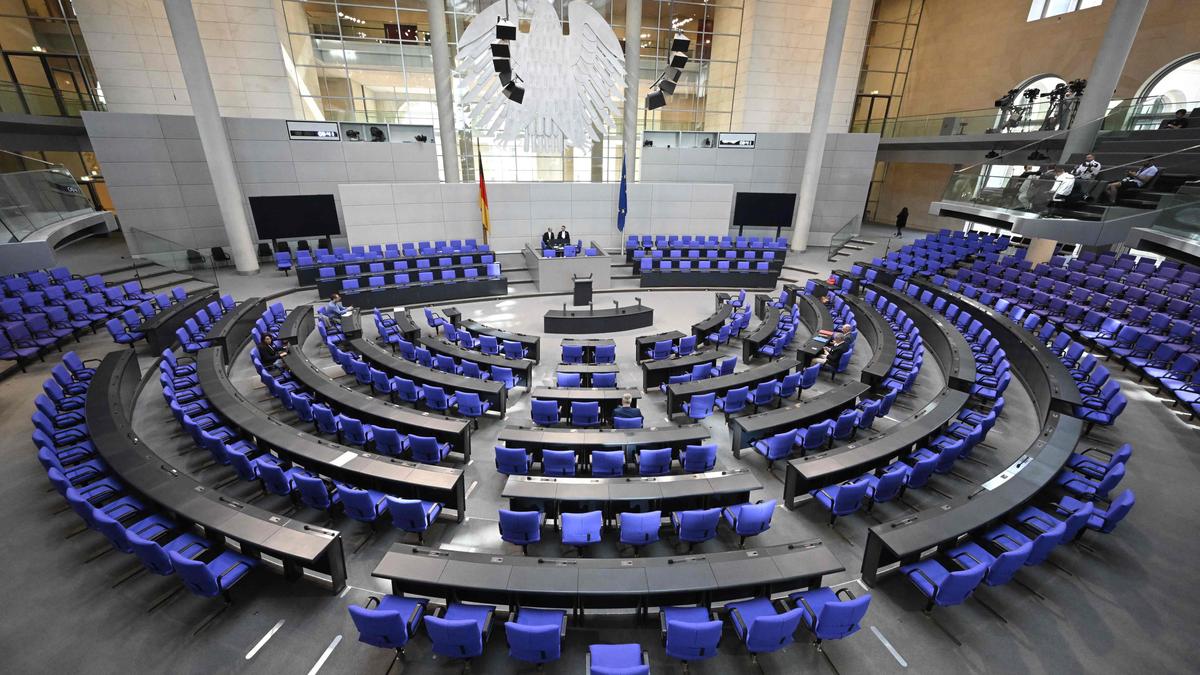
A general view of the empty plenary of the Bundestag prior the start of a session in Berlin in 2022.
| Photo Credit: AFP

The story so far: On July 30, Germany’s federal constitutional court upheld the government’s move to downsize the lower house of parliament, with effect from the 2025 federal elections. The present 20th Bundestag (German Parliament) is its largest ever, since the first post-war legislature was inaugurated in 1949, with a total of 736 deputies. The current tally positions the Bundestag as the largest Parliament among democratically elected assemblies, even bigger than the 720-strong parliament of the European Union. The steady rise in the number of representatives has raised concerns on the strain imposed on the public coffers, as well as implications for the functional efficiency of the Bundestag.

What is the background?

The context to the July judgment is the constant enlargement of the Bundestag, a consequence of Germany’s complex electoral architecture as well as the fragmentation of the party system in recent years.

Since the country’s second quadrennial federal elections of 1953, each voter has exercised two votes, in what is known as the personalised proportional or mixed-member proportional representation system. The first vote is cast to directly choose a candidate from a local constituency via the conventional first-past-the-post method of obtaining a simple majority for a total of 299 seats. Voters simultaneously cast a second ballot to choose a political party for another 299 parliamentary seats, which are distributed across Germany’s 16 regions. A party must have secured either 5% of the second vote share or a minimum of three individual constituencies to qualify for entry into parliament. The 5% threshold was stipulated to prevent too many splinter parties from entering the Bundestag. It is the second, that is, the state list vote that determines the relative strength of parties in the Bundestag, because the allocation of seats is proportionate to the number of second votes each party has received.

The conversion of the second votes into seats involves a two-stage process. Each region receives seats in proportion to the population resident therein. These are then distributed among the parties based on their respective share of second votes. The seats for each party at the federal level is subsequently fixed as per the number of candidate seats it won in the state, as well as the number of seats it was entitled to, based on the share of the second vote it received. The higher of the above two figures is the final tally of the party’s seats in a region. The cumulative addition of seats across the regions makes up the party’s strength in the Bundestag.


Also read: The far-right swing in European Parliament elections | Explained 

Why have legislators increased?

Germany’s two largest parties, the ruling Centre-left Social Democrats (SPD) and the opposition Centre-right Christian Democratic Union (CDU), have over the decades garnered the maximum number of directly elected seats. These first vote seats are invariably greater than the seats that they would be entitled to on the basis of their share of the second votes and as such are known as extra seats or overhang seats. However, in view of Germany’s personalised proportional system, parties have been allowed to retain these overhang seats. Crucially, even though the support base of the larger parties has eroded in recent years consequent to the emergence of smaller parties, they have managed to retain their dominance of first vote seats.

In a 2008 decision, the constitutional court ruled the rising numbers of overhang seats as violative of the equality of elections and hence unconstitutional. In 2012, the constitutional court addressed this imbalance by ruling that the large number of extra or overhang seats that accrued to the larger parties must be compensated through the creation of “balance seats” for smaller parties. This would be in accordance with the principle of equal suffrage, direct elections and equal opportunities for political parties. The verdict therefore inevitably resulted in a further addition to the number of legislators. The Court has since upheld amendments to the election law that broadly reflect its 2012 judgment.

What move did the govt. propose?

On March 17, 2023, the government enacted legislation which would cap the size of the Bundestag at 630 representatives with effect from the 2025 federal elections. Whereas the number of candidate seats will remain at 299, the party list will increase to 331 seats. The new limit was decided under the guidance of an Electoral Rights Commission in 2022 and would be achieved by scrapping both the “overhang seats” and “balance seats”. Crucially, the weightage hitherto attached to candidate seats would be reduced. Obtaining a simple majority in an individual constituency will not henceforth automatically translate into a parliamentary seat. Where parties win more candidate seats than their second vote share entitles them to, individual winners who poll the lowest share of the vote will not be awarded a seat. This has now been upheld by the federal constitutional court.

However, the government has faced strong criticism that the new measure was not backed by a wide consultative process ahead of its passage. The main opposition CDU has already said that it would roll back the law when it regained office.

The writer is Director, Strategic Initiatives, AgnoShin Technologies.


Source link

World Tags:German elections, German Parliament, germany electoral structure, Germany federal constitutional court

Post navigation

Previous Post: MiG-29 Fighter Jet Crashes In Rajasthan, Pilot Safe
Next Post: Acharya urges detariffing, break-up of conglomerates

Related Posts

  • North Korea says deal between Putin, Kim requires immediate military assistance in event of war World
  • Rishi Sunak’s Fate Hangs In The Balance As UK To Vote In Local Polls This Week World
  • Prabowo Subianto confirmed as Indonesia’s next President World
  • Russia Releases 10 Ukrainian Civilian Prisoners: Volodymyr Zelensky World
  • The Dalai Lama’s Untold Story’ Releases On His Birthday Today World
  • BJP Attacks Congress Over Mani Shankar Aiyar Pakistan Remark World

More Related Articles

More Monkey Pox Cases Likely To Hit Europe Soon, Says WHO World
A Look At Rishi Sunak’s India Connection World
Trade and security ties between India and Australia are gathering pace: Speaker Milton Dick World
Hezbollah says fires at Israel after east Lebanon strike World
UK Minister For Local Government World
U.S. and India mum on Canada spat in describing Jaishankar Blinken meet World
SiteLock

Archives

  • September 2024
  • August 2024
  • July 2024
  • June 2024
  • May 2024
  • April 2024
  • March 2024
  • February 2024
  • January 2024
  • December 2023
  • November 2023
  • October 2023
  • September 2023
  • August 2023
  • July 2023
  • June 2023
  • May 2023
  • April 2023
  • March 2023
  • February 2023
  • January 2023
  • December 2022
  • November 2022
  • October 2022
  • September 2022
  • August 2022
  • July 2022
  • June 2022
  • May 2022

Categories

  • Business
  • Nation
  • Science
  • Sports
  • World

Recent Posts

  • Vinicius Jr vs Rodri vs Jude Bellingham: Ballon d’Or 2024 Must Crown Real Winner In Post Cristiano Ronaldo-Lionel Messi Era
  • Sodomy, Lesbianism Withdrawn As Unnatural Sex Offences From Medical Books
  • Centre asks Karnataka Labour Department to intervene on delayed onboarding of Infosys campus recruits
  • Man Gets Woman Drunk, Rapes Her On Road In Madhya Pradesh
  • Ajeet Singh Yadav Wins Paralympics Silver, Had Lost Hand In Train Accident While Saving Friends Life

Recent Comments

  1. TpeEoPQa on UP Teacher Who Asked Students To Slap Muslim Classmate
  2. xULDsgPuBe on UP Teacher Who Asked Students To Slap Muslim Classmate
  3. KyJtkhneiLmcq on UP Teacher Who Asked Students To Slap Muslim Classmate
  4. mOyehudovB on UP Teacher Who Asked Students To Slap Muslim Classmate
  5. GFBvgSrWPcsp on UP Teacher Who Asked Students To Slap Muslim Classmate
  • UN rights office says Israeli settlements in Palestinian areas amount to a ‘war crime’ World
  • Welsh leader Vaughan Gething resigns after allies desert him over campaign donation scandal World
  • Andy Murray To Have Back Surgery Days Before Wimbledon Sports
  • Dubai Faces Persistent Flooding Due To Lack Of Storm Drains World
  • Vistara Cuts Flights To Deal With Pilot Shortage, Offers Refund To Passengers Nation
  • Lively Interaction, Nirmala Sitharaman’s Chat With Students At Andhra Pradesh, Telangana Bhawan Canteen Nation
  • Hundreds of pro-Palestinian protesters rally in Washington to mark a painful present and past World
  • RSS Leader Indresh Kumar’s U-Turn After “Those Who Took Up Lord Ram’s Resolve…” Remark Nation

Editor-in-Chief:
Mohammad Ariff,
MSW, MAJMC, BSW, DTL, CTS, CNM, CCR, CAL, RSL, ASOC.
editor@artifex.news

Associate Editors:
1. Zenellis R. Tuba,
zenelis@artifex.news
2. Haris Daniyel
daniyel@artifex.news

Photograher:
Rohan Das
rohan@artifex.news

Artifex.News offers Online Paid Internships to college students from India and Abroad. Interns will get a PRESS CARD and other online offers.
Send your CV (Subjectline: Paid Internship) to internship@artifex.news

Links:
Associate Journalism
About Us
Privacy Policy

News Links:
Breaking News
World
Nation
Sports
Business
Entertainment
Lifestyle

Registered Office:
72/A, Elliot Road, Kolkata - 700016
Tel: 033-22277777, 033-22172217
Email: office@artifex.news

Editorial Office / News Desk:
No. 13, Mezzanine Floor, Esplanade Metro Rail Station,
12 J. L. Nehru Road, Kolkata - 700069.
(Entry from Gate No. 5)
Tel: 033-46011099, 033-46046046
Email: editor@artifex.news

Copyright © 2023 Artifex.News Newsportal designed by Artifex Infotech.