





The story so far: The Taliban last week announced a new law on the “Propagation of Virtue and Prevention of Vice” which imposes its interpretation of sharia or Islamic law on the people of Afghanistan. It not only bans women from showing any part of their bodies or faces in public, but silences their voices as well. It also seeks to regulate many aspects of daily life, from music and games, to travel, dress, and sexual practices.
What does the law say?
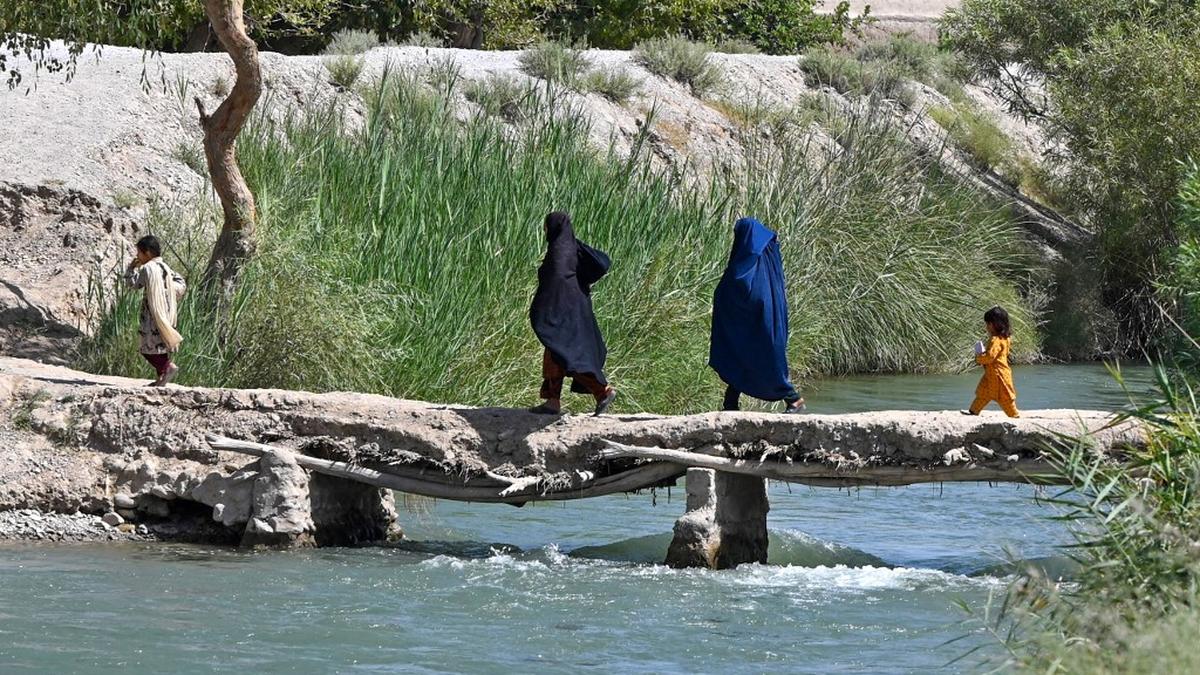
The 114-page document published in the official gazette says that women must cover their entire bodies and faces “due to the fear of temptation”, in the presence of unrelated men, as well as non-Muslim and “immoral” women. A woman’s voice — singing, chanting, or reciting aloud — is considered awrah or intimate and must not be heard. “Whenever a grown woman leaves her house out of necessity, she is obliged to cover her voice, face, and body,” it said, stipulating that any violation will lead to punishment. Unrelated men and women are not allowed to even look at each other.
Men must grow their beards, and must not wear neckties or have Western-style haircuts. All games and forms of entertainment, even traditional children’s games played with marbles or walnuts, are banned as a form of gambling. Travel must be planned to avoid times of prayer, and drivers are forbidden from transporting women who are not accompanied by a related male guardian.
The morality police, called Muhtasib, are authorised to mete out discretionary punishment, including up to three days in prison. They can compel people to revere Islamic symbols, and check phones and laptops to ensure there are no images of living beings. They can also ensure that women’s voices or music do not emanate from homes or gatherings.
Is this a new development?
Many of these regulations are already in place in Afghanistan, with some having been declared through Taliban decrees over the past three years, or imposed more haphazardly by local enforcers. Observers fear that the official codifying of these so-called “morality laws”, however, will lead to more brutal punishment and give a stronger backing to the Muhtasib.
Also read | Afghan women filmed singing in protest of ban on their voices
A look at Afghan history shows the extreme regressiveness of these laws. Women in Afghanistan were granted the right to vote in 1919, a year before women in the U.S. The early 1920s saw a rush to modernise the country with changes in dress and education opportunities, led by the royal family, which sparked a backlash from conservative forces. From the 1960s to the 1980s, however, women’s rights and participation in public life expanded, first among the urban upper classes but spreading to some extent in rural areas as well. Women became ministers and judges, doctors and diplomats, singers and entertainers. The Taliban’s first stint, from 1996 to 2001 was a brutal shock, imposing sharia law and taking women back to the medieval era. During the two decades before the Taliban came back to power, however, a new generation of young women grew up in relative freedom to study and work, and many hoped that the Taliban had also changed its stance.
“They were portrayed as Taliban 2.0, as more moderate, so we engaged with them,” said Fawzia Koofi, a former woman lawmaker from Afghanistan, in an interview with CNN after the new laws were announced. She noted that even some of the daughters of Taliban leaders had been educated abroad in the interim period. But since they came back to power, they have been “constantly targeting women” with “draconian measures”, she said.
Nayanima Basu, an Indian journalist who covered the Taliban takeover on the ground in Afghanistan, and the author of The Fall Of Kabul: Despatches From Chaos says that people she spoke to in the provinces outside of the “bubble in Kabul” were clear that the Taliban’s thought processes had not changed. “There is a disparity between the Taliban leadership in Doha — which has offered assurances to the international community that exclusive schools and universities for girls will reopen — and the Stone Age thinking of those actually in power in Afghanistan,” she pointed out.
How are women in Afghanistan reacting?
Some Afghan women have defied the ban on raising their voices in public, with videos being posted on social media showing them singing, even while dressed head to toe in black, with faces covered. Others can be seen raising their fists. A few have even reportedly protested on the streets, which “indicates that a small number do not care about their life and death because they do not have anything left to lose”, Ms. Koofi told CNN.
Others engage in subtler forms of resistance, but with long-term effects. Pashtana Dorani, now in exile, founded a non-profit called LEARN to open underground schools for teenage girls within Afghanistan, which now has 661 students in five schools, which run clandestinely, in shifts, changing locations when they learn of Taliban surveillance. In a social media post a few days after the new law was announced, Ms. Dorani showed videos of girls in full burkhas learning science, mathematics and language. “They may shut the doors but they can’t take away our dreams,” she wrote. “No ban can stop us from reaching for a better future. This week, our girls kept moving forward. Education opens doors, even when they’re locked.”
What is the response of the international community?
There was condemnation from governments and celebrities. German Foreign Minister Annalena Baerbock criticised the new laws as “almost 100 pages of misogyny”, while actress Angelina Jolie termed the regime “cowardly and oppressive”.
The United Nations issued immediate denunciations of the new law, but said it would continue to “engage” with the Taliban. UN Women said the new rules were “oppressive”, while the office of the UN Commissioner for Human Rights called for the “utterly intolerable” law to be immediately repealed. However, after criticism of the law by the UN Assistance Mission in Afghanistan, the Taliban reportedly said it would no longer cooperate with the Mission. In response, a UN Spokesperson Stéphane Dujarric said that the UN backed the criticism, but “will continue to engage with all stakeholders in Afghanistan, including the Taliban”.
“I am a firm believer that political pressure will make the Taliban respond, but that political pressure has never been exerted,” Ms. Koofi told CNN, noting that the UN had agreed to the Taliban demand to exclude Afghan women from talks in Doha this summer. “So the Taliban thinks the world doesn’t really care about women’s rights,” she said, adding that there are differences among the global north and south and that has “further emboldened the Taliban”. Some countries, including China, have accepted the credentials of the official Taliban ambassador. While India has not established official diplomatic relations, The Hindu has reported on efforts by the Taliban to install appointees in India.
Asked about the new law, officials in the Ministry of External Affairs shared a statement reiterating India’s position regarding Taliban’s treatment of women in Afghanistan. “We have noted with concern the reports in this regard. India has consistently supported the cause of women’s education in Afghanistan. We have been emphasising the importance of the establishment of an inclusive and representative government that ensures equal rights of women and girls to participate in all aspects of society, including access to higher education,” he said.