





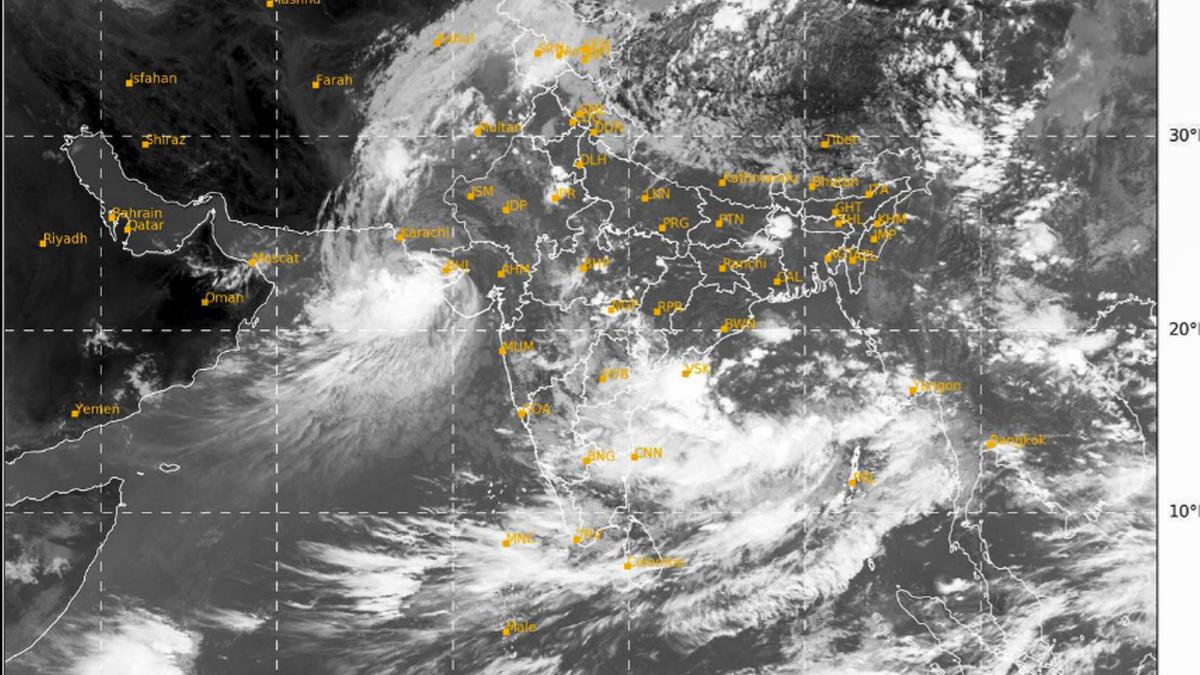
The North Indian Ocean supplies a large part of the moisture required to generate the 200 lakh crore or so buckets of water during the summer monsoon. That implies a lot of evaporation from the Arabian Sea and the Bay of Bengal, which requires these seas to be warm enough to allow evaporation. This is why warm tropical oceans also tend to lend themselves lots of cyclones.
And yet, the North Indian Ocean is the least active region of the world’s oceans vis-à-vis the number of cyclones. The combination of some factors that favour cyclogenesis and some that suppress it make this area unusual in terms of cyclone seasons, numbers, and the response of the ocean and the cyclones to global warming.
The unusual Indian Ocean
The Indian Ocean receives a lot of attention for its monsoonal circulation and the dramatic seasonal wind reversals to the north of the equator. But it’s also unique because it has ‘oceanic tunnels’ connecting it to the Pacific Ocean and the Southern Ocean. The Pacific tunnel brings a significant amount of warm water every year in the upper 500 m while the Southern Ocean tunnel brings in cooler waters under about 1 km.
The Arabian Sea warms rapidly during the pre-monsoon season as the Sun crosses over to the Northern Hemisphere. The Bay of Bengal is relatively warmer than the Arabian Sea but warms further and begins to produce atmospheric convection and rainfall. The trough that eventually leads to the monsoon onset over Kerala arrives in mid-May itself over the Bay of Bengal.
The post-monsoon season is the northeast monsoon season for India, and produces significant amounts of rain over several states.
All these wind patterns and sea surface temperatures influence cyclogenesis throughout the year over the North Indian Ocean and sustain the stark contrast in cyclogenesis between the Arabian Sea and the Bay of Bengal.
The ocean’s response to climate change
Climate change amplifies the uniqueness of the Indian Ocean. More heat is coming in from the Pacific Ocean now while the Southern Ocean also is pushing in warmer waters. The Indian Ocean is warming rapidly due to these inputs, plus atmospheric changes in winds and humidity.
The North Indian Ocean and the monsoon are now responding to the related climate change drivers from tropical oceans as well as pole-to-pole influences.
The Ocean’s rapid warming is now reported to be affecting the heat uptake by the Pacific Ocean and the sinking of heavy waters in the North Atlantic Ocean. The Indian Ocean is essentially acting like a clearinghouse for ocean warming during climate change.
All these region-specific idiosyncrasies play into cyclogenesis, cyclone numbers, and their responses to climate change over the Indian Ocean.
Two cyclone seasons
During the monsoon itself, the strong southwesterly winds — or the so-called low-level jet — drive a strong evaporation and mixing of cold subsurface waters with the surface waters, so the Arabian Sea becomes significantly cooler than during the pre-monsoon. The strong convective activity over the Bay of Bengal produces many low-pressure, or cyclonic, systems during the monsoon but they rarely grow into cyclones.
This is because the strong monsoon winds vary in strength and direction from the surface to the middle atmosphere. This variation is called vertical shear and it tends to strip off the energy from any cyclone that may be trying to grow.
The net result is that the dominant cyclone season is uniquely split into the pre- and post-monsoon seasons over the North Indian Ocean. All other cyclogenesis regions have a single cyclone season during the year.
Weaker activity in the Arabian Sea
The main impact of the monsoonal circulation is that the warm ocean, the heat content, and the atmospheric convection favour cyclogenesis over the North Indian Ocean. This leads to cyclones being formed during the pre-monsoon and the post-monsoon seasons.
However, the Arabian Sea has much less convective activity during the pre-monsoon and is relatively less prone to cyclogenesis. The northeast monsoon and dry continental air ends up cooling the Arabian Sea during the post-monsoon. The number of cyclones in the Arabian Sea is thus about half of that over the Bay of Bengal in both seasons.
Thus, the cooler temperatures, stronger wind shear, and the relatively low convective activity over the Arabian Sea make the Arabian Sea relatively a desert for cyclones. Some upward trend in the number of cyclones was reported from 2010 onwards or so but the Arabian Sea has been eerily calm the last few years.
A rare August cyclone
There is a lot of excitement right now about a rare August cyclone – named ‘Asna’ – born from the transition of a strong land-born depression onto the warm Arabian Sea. This is the first North Indian Ocean cyclone in August since 1981.
The depression that grew into this cyclone itself was unusual in terms of its powerful growth over land. Low-pressure systems are typically born over the Bay of Bengal and traverse the core monsoon zone to bring about 60% of the total seasonal rainfall.
Ocean-born depressions can feed off of prior rainfall (as soil moisture) as they pass over India. There is some evidence that these low-pressure systems are now contributing to extreme rainfall events, but they have been stuck in a corridor for over a century.
The unusual growth of the low-pressure system that brought deluges to western India fed off the soil moisture from excess rainfall since the beginning of the season. It was big enough to start hitting the warm northern Arabian Sea as it approached the western end of land. The ocean supplied the energy required for convection and to retain, and even, grow in strength.
Once its transition to the ocean is complete, it can be expected to grow into a regular cyclone, but as a remarkably unusual land-born cyclone. The warming over the Arabian Sea has already been reported to be related to the northward shift of the low-level jet, which itself is driven by rapid warming over West Asia.
Expect nothing, be surprised
As the English writer Daniel Defoe said, “Expect nothing and you’ll always be surprised.” The warm 2023-2024 that resulted from a combination of global warming and El Niño, with a likely contribution from underwater volcanic eruptions, has produced plenty of surprises in terms of extreme events across the planet.
The monsoon’s evolution has also been unusual, especially since the forecasted strong La Niña hasn’t emerged yet. The rainfall distribution remained as unpredictable as ever with a wet peninsular India and a strange mix of wet and dry regions over the country’s north.
A low-pressure system is unusual but its amplification over land is. Its dash across land onto the ocean is another unexpected event. We didn’t expect it and obviously were duly surprised.
Raghu Murtugudde is professor, IIT Bombay, and emeritus professor, University of Maryland.