





For his monumental work in transforming our understanding of gravity and spacetime, Albert Einstein won his sole Nobel Prize for explaining the photoelectric effect. In the early 20th century, physicists found that when a metal is irradiated with light, it emits some electrons. Curiously they found the emitted electrons’ kinetic energy depended on the incoming rays’ frequency, not intensity.
In 1905, Einstein explained the effect by proposing that light is made of particles called photons. When a photon possesses more energy than some threshold, it is able to kick an electron in the metal out.
This effect is at the heart of solar power: solar cells are specially engineered materials whose electrons can be knocked out by the photons in sunlight. The electrons are made to flow through a wire to produce an electric current.
Understanding the photoelectric effect better could help us make new, more efficient solar cells and shed more light on the physics that produces the effect. Because it involves the material’s electronic properties, its clear theoretical understanding means physicists can use it to reveal subatomic features that are inaccessible to other probes. Motivated by these opportunities and advances in electronics and optics in the post-war era, physicists took their studies to new highs in the 20th century.
A fleeting light
One important tool to study the photoelectric effect has been the ultrashort light pulse. Just last year, three physicists won the physics Nobel Prize for their contributions to developing such pulses.
A simple analogy illustrates their usefulness. The quality of images captured by a camera depends among other things on the amount of time for which a photosensitive surface is exposed to light. If the camera has to capture an image of the wings of a bird in flight, its exposure needs to be shorter than the time taken for a wing to move by a short distance. If the exposure is longer, the wings will look blurred.
Similarly, physicists try to produce very short pulses of light that illuminate an atom or a molecule while a sensitive camera is pointed at it. The shorter the pulse, the more short-lived event the camera can capture. Physicists found they could study the physics of some heavy atomic nuclei using femtosecond pulses of light. One femtosecond is just 10-15 seconds.
Last year’s Nobel laureates developed a way to generate attosecond pulses — each pulse is around 10-18 seconds long — required to study electrons, which move around faster.
Designing molecules
In the last decade, researchers have used attosecond pulses to study the photoelectric effect at shorter and shorter timescales. One focus area has been the photoionisation delay: the time lapsed between some reference event and when an electron is knocked out. As two physicists from Germany wrote in a 2016 review in Physics:
“The length of ionisation delays provides important information on the electronic structure of matter. These delays arise from the interactions of electrons with their environment, typically in the form of a potential representing the molecule’s electronic structure. Measuring such delays can thus shed light on the details of the potentials in which electrons move, which can help us develop and validate theoretical models for molecules. Such advances could ultimately open the door to controlling matter at its most fundamental level, enabling scientists to design molecules with desired electronic behavior.”
For example, in 2010, Ferenc Krausz — one of the 2023 laureates — led a team that discovered a 20-attosecond delay between two electrons leaving two close energy levels in a neon atom, rather than leaving at the same time as expected. Researchers from the Autonomous University of Madrid reported on June 20 this year that the assumption that an atom’s nucleus is too slow-moving compared to its electrons for nuclear effects to matter is not well-founded. Instead, they found the nucleus’s motion in just a few attoseconds could “substantially increase” the photoionisation delay of electrons leaving an atom in an H2+ molecule.
Designing molecules
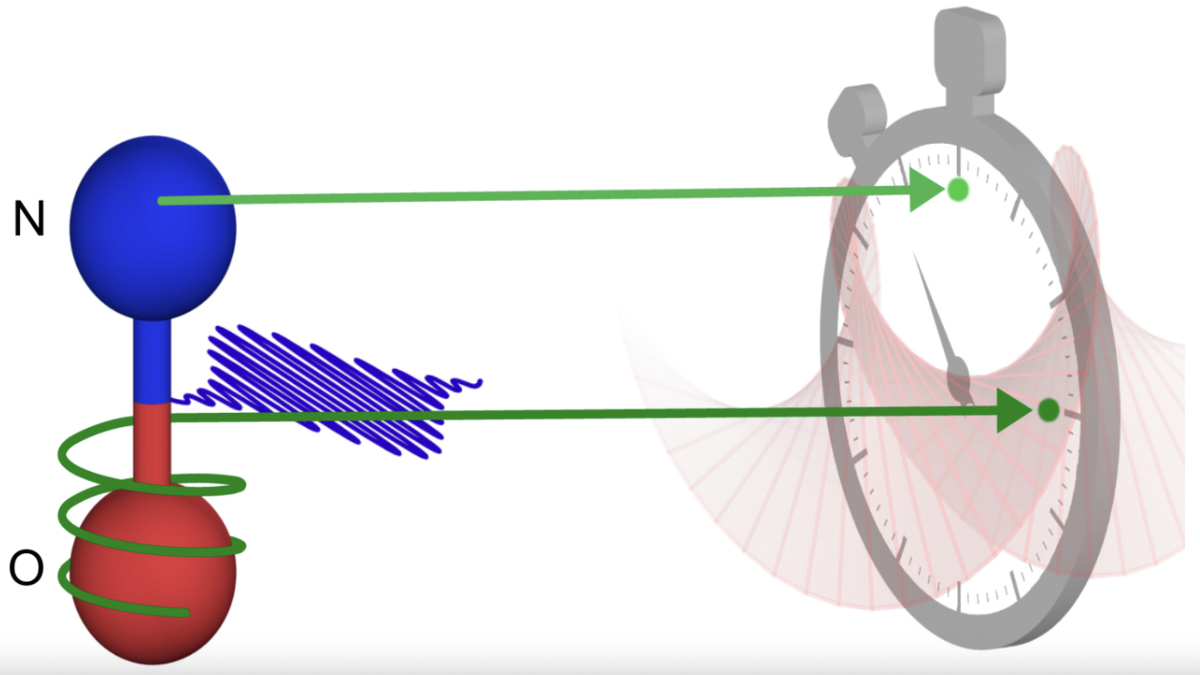
In a newer study published on August 21, researchers from the SLAC National Accelerator Laboratory, California, reported an unexpectedly large delay in the photoemission of electrons from oxygen and nitrogen atoms in nitric oxide (NO) molecules. The team’s innovation included building a device that could produce photons with the energy required to knock off core electrons, i.e. non-valence electrons that don’t participate in chemical reactions, in an attosecond-physics setup.
“Our work is the first measurement of the photoemission delay in the X-ray regime. Previous pioneering experiments have measured the photoemission delay in the ultraviolet regime, but not the X-ray regime. When X-rays interact with matter, the most likely outcome is the removal of a core-level electron,” SLAC physicists and three of the result’s coauthors James Cryan, Agostino Marinelli, and Taran Driver wrote in an email to The Hindu. “Ultraviolet light, on the other hand, only has enough photon energy to release the less weakly bound electrons.”
They found core electrons in oxygen were emitted up to 700 attoseconds after their counterparts in nitrogen, rather than emerging at the same time. Their paper attributed this delay to “several contributions”, including a leaving electron being ‘trapped’ by a potential energy barrier in the molecule called a shape resonance, by colliding with another electron ejected by the atom — called the Auger-Meitner electron —, and “multi-electron scattering effects”.
Mountains in the way
The results echo those of a 2016 study in which another research group examined photoionisation delays in water and nitrous oxide (N2O) molecules. The researchers wrote in their paper: “In the case of N2O, our measurements … reveal surprisingly large delays reaching up to 160 attoseconds… In contrast, delays measured at the same photon energies in H2O all lie below 50 attoseconds in magnitude.” Based on complicated modelling and analysis, they were able to attribute the delay in N2O to a barrier imposed by the shape resonance.
The constituents of a molecule of nitric oxide or nitrous oxide exert electric and magnetic fields depending on their charges. An electron knocked out by the photoelectric effect needs to pass through these fields before it can completely exit the molecule. Sometimes, however, the electron may not have enough potential energy to overcome them and becomes trapped — like a tired hiker being surrounded by mountains.
A shape resonance occurs when the electron’s wavelength is comparable to the size over which the trapping potential is spread. If their energies are comparable as well, the electron is likely to be trapped for longer, resonating with the trapping potential. The electron can escape by acquiring more energy to surmount the mountains or if the trapping potential decays by some other means. Quantum physics also allows the electron a small but non-zero chance of tunnelling through the barrier. In every case, the result is a delay in the molecule’s photoionisation.
“The photoemission delays we observe in the X-ray regime are significantly larger than [in] this previous measurement,” the trio said of the 2016 paper. “This is a result of a few effects.” One is that they used nitric oxide whereas the older experiment used nitrous oxide, “and the photoemission delay is very sensitive to molecular structure”. Another is because “the electrons involved in X-ray photoionisation are particularly highly correlated, and we have found that overall this results in larger photoemission delays.”
A third reason is the Auger-Meitner effect. When a core-level electron is removed from an atom, a higher energy electron may drop down and fill this vacancy. Its excess energy is transferred to a valence electron that exits the atom as the Auger-Meitner electron. When these electrons “caught up with the electrons whose delay we were measuring, they dragged the electrons back a little and increased the photoemission delay some more.”
‘Could not have imagined’
According to Cryan, Marinelli, and Driver, their new work “furthers our fundamental understanding of X-ray-matter interactions, which are particularly interesting for a few reasons. One notable reason is that the core electrons released by X-ray photoionisation have strong interactions with the other electrons in the molecule.”
These interactions “are relevant in many applications, including the imaging of proteins and viruses that takes place right here at SLAC, and around the world at synchrotrons and X-ray free-electron lasers,” they added. “In making these measurements, we are also developing new experimental methods to probe electron correlation in real-world systems. Electron correlation is critical for defining and tuning the fundamental properties of matter, and a better understanding of this ubiquitous phenomenon will ultimately help us gain a deeper understanding of important biochemical reactions and choose new materials for next-generation electronics.”
As the trio put it: “So much of the research we perform is basic, ‘blue-sky’ science, powered by the conviction — which is backed up by ample historical evidence — that studying the fundamental behaviour of the universe reliably produces practical applications, which we could not have imagined before beginning the research.”
The author thanks Adhip Agarwala, assistant professor of physics at IIT Kanpur, for his feedback.