

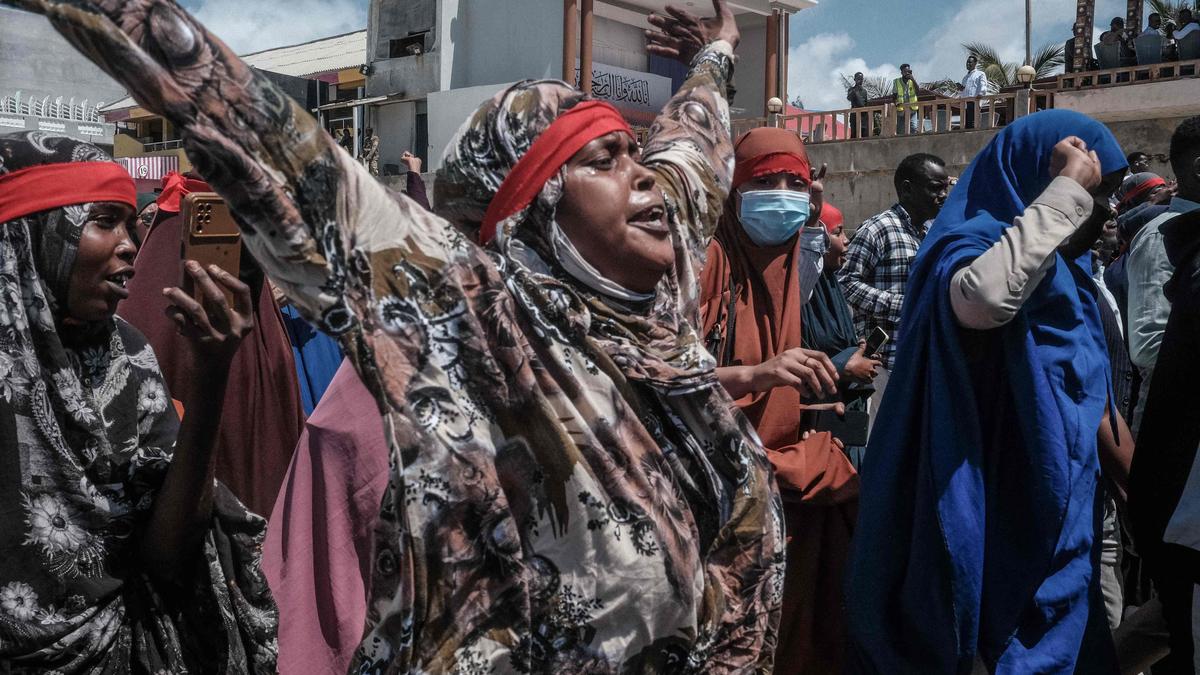
On August 2, a suicide bomber detonated an explosive device at the entrance to the Beach View Hotel on Lido Beach in Mogadishu, the capital of Somalia, which is often frequented by government officials, businesspersons and youth. Before the shock could abate, five attackers stormed the site and started shooting at civilians indiscriminately. By the time security officials had neutralised the attackers, at least 37 lives were lost and 210 were wounded. The strike was subsequently claimed by al-Shabaab, an affiliate of al-Qaeda, which has waged a war against the Somali government for the past 17 years.
Also Read: Ethiopian PM plays down fears of war with Somalia over a planned naval port
For al-Shabaab, this operation was just another leaf in its playbook, having conducted similar strikes in the Horn of Africa. In March, the group had laid siege to another hotel in Mogadishu killing 27 people, including three members of parliament and three soldiers. The deadliest attack in the country’s history was the double car bombing in October 2017 killing 358 people and injuring 228 in Mogadishu. The attacks have spilled over the border to Kenya too.
But as far as Somalia goes, al-Shabaab is merely a chapter in the nation’s history that is fraught with authoritarianism, clan war, famine, piracy, corruption and resource crunch, all of which had prompted the U.S. based-The Fund for Peace to call the country in 2011, a failed state for a fourth year in a row. That is slowly changing with the UN stating in 2021 that the former failed state is on a fragile path to progress.
On forming the state of Somalia
From the seventh to the 19th century, Somalia and neighbouring regions were ruled by a series of Sultanates, with Islam’s Sunni subsect being the primary religion. The 19th century witnessed the arrival of colonial powers, and the region was shared between British, Italian and French forces — the first two taking up the lion’s share of the area.
Upon the withdrawal of British and Italian forces from the northern and southern regions in 1960, the two regions came together and formed modern-day Somalia. Democracy prevailed for a brief time until 1969 when Siad Barre came to power through a military coup.
Siad Barre propounded an administrative policy called ‘scientific socialism’ through which he nationalised banks and insurance companies, promoted literacy and strengthened ties with the Soviet Union. Despite Somalis being a largely homogenous group, different clans had ruled the roost. However, Barre saw to it that loyalty to major clans such as Isaaq, Darood, Dir and Hawiye remained outlawed.
Also Read: Somalia expels Ethiopia ambassador over ‘interference’
The first signs of the authoritarian leader’s downfall emerged with the Ogaden war that Somalia fought with its neighbouring Ethiopia in 1977.
The Ogaden war
Imperial European powers had gone into the Horn of Africa and drawn up arbitrary boundaries to carve out territories to suit their convenience. Much like what happened in other parts of the world, this process upended the lives of the natives, who were plucked from their societies and cultures and thrust into alien living conditions. Ogaden was no different. A portion of the region, which fell under the Christian-majority Ethiopia, was home to many Muslim Somalis.
Additionally, notwithstanding colonial legacy, a second factor contributed to the region’s complicated history — the area was a breeding ground for Cold War politics. The conflict began in July of 1977 with Ethiopia acting as a U.S. ally and Somalia backed by the USSR.
But by the time the war ended in March 1978, Ethiopia and Somalia were receiving assistance from the USSR and the U.S. respectively.
Despite the initial gains, the war proved costly for Somalia as it had to retreat from the Ogaden region and grapple with the influx of Ogaden Somali refugees.
Depleted of finances and resources, Barre began to lose his grip on the country’s administration. Certain policies did not sit well with some clans, who turned against each other. By 1991, Barre fled Somalia following an uprising by clans supported by Libya and Ethiopia. The northern part of the country proclaimed independence as Somaliland; and clan wars were rife, killing close to 3,00,000 Somalis in a year.
Whatever international food aid came Somalia’s way was siphoned off by local gangsters and militia leaders.
Also Read: Fight for survival: On Somalia’s fight against terror
The U.S., the UN and other international troops took turns coming into the country to fix the situation but to little effect. In October 1993, U.S. Marines tried to arrest the officers of one of the clan leaders, leading the militiamen to shoot down two U.S. Black Hawk Helicopters (depicted in the 2001 film Black Hawk Down). Trying to retrieve the helicopter crew cost 18 U.S. lives and led to 300 Somalian deaths.
Efforts to establish transitional governments also proved futile, so much so that by 2004, at least 14 attempts had been made to establish a central governing authority. Although a parliament came to power and elected Hassan Sheikh Mohamud as President in 2012, this did little to improve people’s lives. Somalia follows a federal system of governance making the loyalty of clan leaders crucial. The hostility between the clans made it impossible to govern the country. The role of Ethiopia too has not gone unnoticed. It has been accused of meddling in Somalia’s affairs trying to protect its interests.
The rise of al-Shabaab
As a famine started spreading in many parts of the country, al-Shabaab, a militant group preaching the Salafist version of Islam, had spread its roots in Somalia by seizing Mogadishu in 2006.
Its origins can be traced back to the al-Ittihad al-Islamiya (AIAI), a militant group that gained prominence in the 1990s after the fall of Barre’s regime. Its chief members were trained in West Asia and funded by the al-Qaeda.
However, hardline younger members of the AIAI sought a stricter Sharia rule and swore allegiance to the Islamic Courts Union, ultimately becoming its armed wing, al-Shabaab.
To win back Mogadishu from al-Shabaab, Ethiopia’s help was sought by Somalia’s transition government in 2006. Though the city was eventually retrieved, al-Shabaab’s numbers started to swell because the operation was perceived as an invasion by a foreign force — a narrative that would be peddled by al-Shabaab in the future to rally support. Despite carrying out suicide attacks and terror strikes inside Somalia as well as in Kenya, Ethiopia and Uganda, al-Shabaab draws legitimacy by positioning itself as an alternate form of governance for the people of its home country. The militant group has stepped in to fill the void left behind by a government machinery rife with corruption.
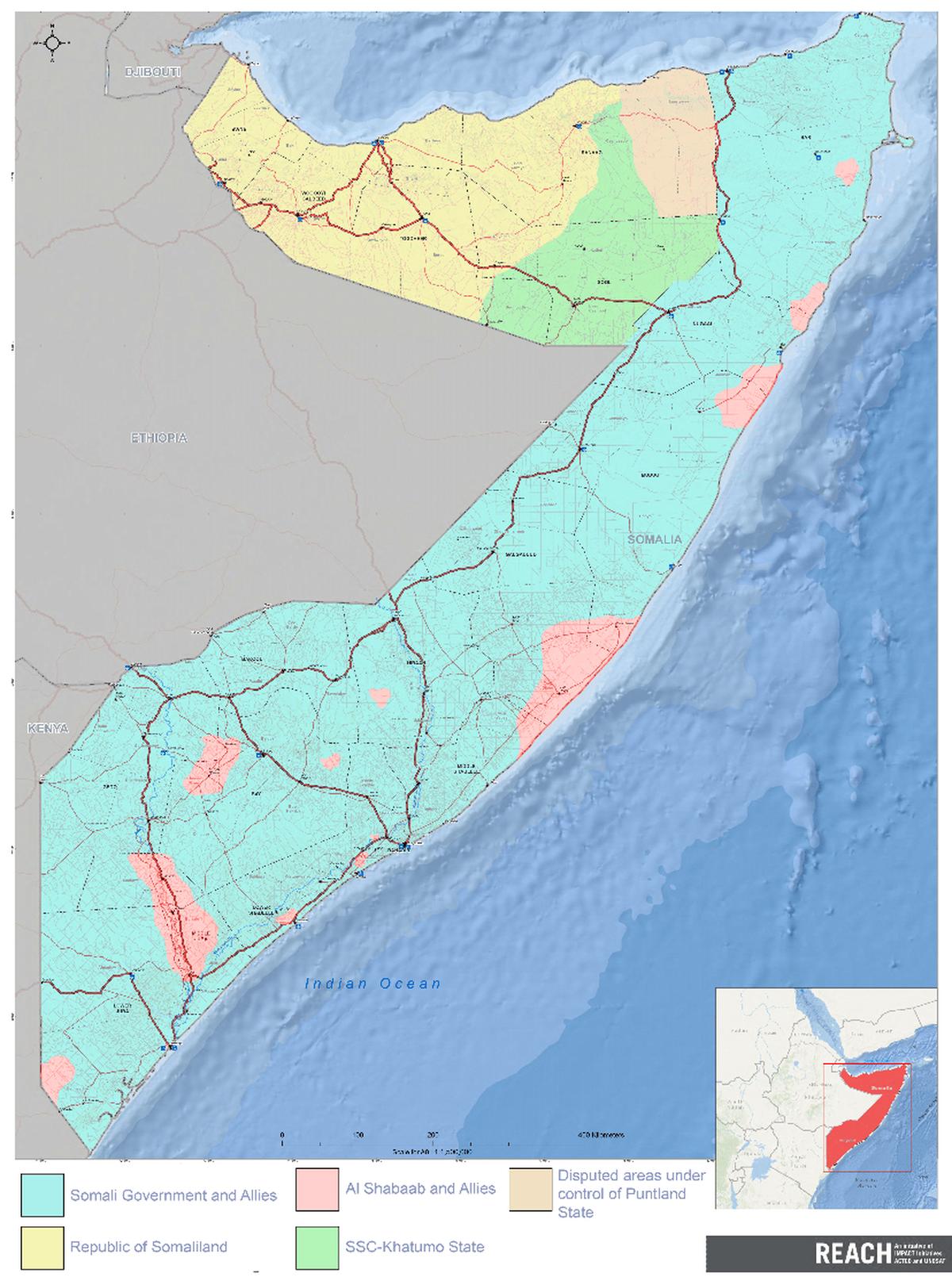
The Somali government, with the help of the African Union Mission in Somalia (AMISOM) and the Somali National Army (SMA), managed to drive away al-Shabaab from Mogadishu and other port cities such as Kismayo and Barawe.
With the southern city of Jilib as its defacto capital, al-Shabaab relocated to the south and has now focused its activities in rural areas of Somalia where it offers protection services and plays mediator to disputes.

The terror group also obtains revenue from illicit charcoal trade.
The curtailed nature of al-Shabaab’s activities and its confinement to rural areas have been largely hailed as victories of the armed forces. Even then, the occasional attacks planned by them cost 4,000 lives between 2010 and 2020, making it surpass Boko Haram as Africa’s biggest terror threat.
More importantly, these attacks land a psychological blow to a population that has not tasted peace in a long time.