




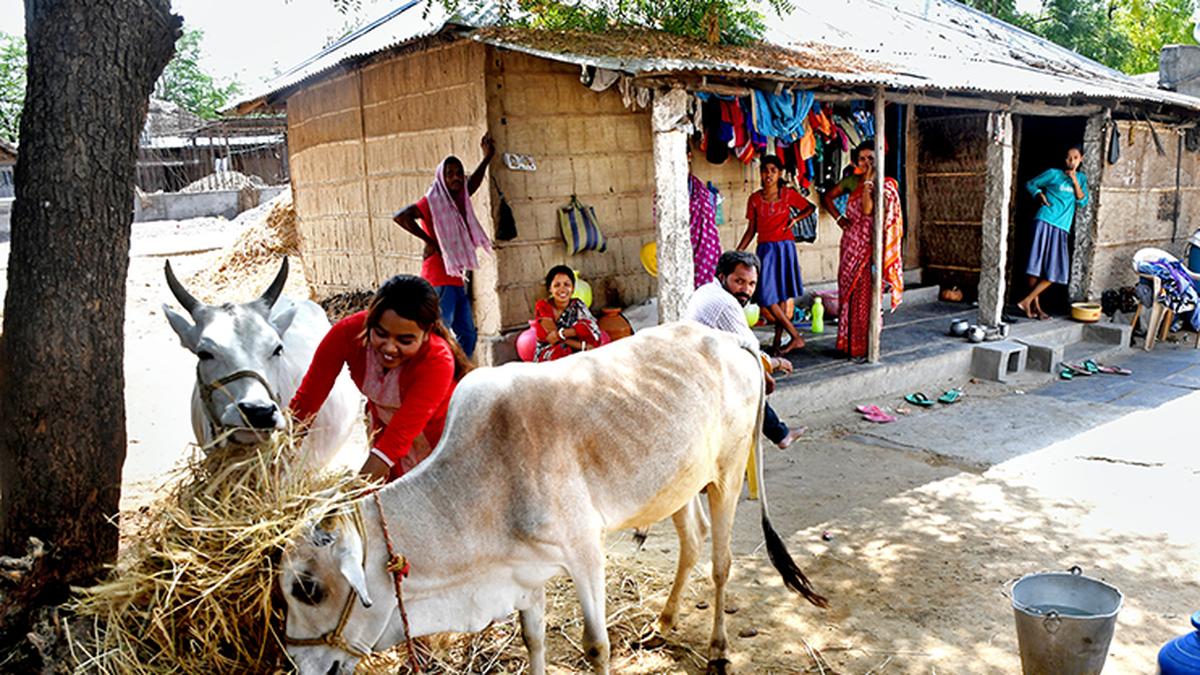
A file photo of the ‘Bangla camp’ at Sindhanur in Raichur district.
| Photo Credit:
After living in India for decades, five Hindu Bangladeshis residing in the ‘Bangla camp’ at Sindhanur in Raichur district, about 400 km from Bengaluru, were naturalised as citizens last week — the first in Karnataka after the Citizenship Amendment Act, 2019, came to force. While about 300 applications are currently pending, citizenship given to five persons is expected to spur more people to apply.
The application process commenced in May after the notification of new rules in March, and the applications, it is learnt, went through vigorous checks, including from the Intelligence Bureau. The district-level committee comprising officials from the Central government departments, including Postal and Telegraph, Income Tax, and Railways, vetted the applications, mainly documents to trace ancestry in Bangladesh and interviewed the applicants before recommending their names.
The first ones
Vijaykumar Bhavikatti, Director of Census Operation and Citizen Registration in Karnataka, issued the citizenship certificate to Biprodas Goldar, Sukumar Mandal, Ramakrishna Adhikary, Adwait Sarkar, and Jayanth Mandal last week.
“I am happy that finally I could get citizenship. For various reasons I had not applied earlier,” 85-year-old Mr. Sarkar, who earlier worked as an agriculture labourer, told The Hindu over the phone. A native of Khulna district in the then East Pakistan, Mr. Sarkar arrived in India in 1964, but arrived at Sindhanur camp in 1970. He has been given citizenship based on the Relief Eligibility Certificate or what was locally termed as “border slip” issued by the Indian authorities at the border when he crossed over to India. The certificate was given to those migrating from East Pakistan after January 1, 1964, to seek assistance from the Indian government.
Problems persist for many
For Mr. Sarkar, his citizenship does not solve the problem. None of his five children, including three daughters, who were all born in India, have citizenship. Amal Sarkar, his third child born in 1981, does not have a birth certificate as his mother gave birth to him near a field.
“Though I qualify to become an Indian citizen because I was born in India before 1987, I do not have any Bangladeshi document or an Indian birth certificate. Since I did not go to school, I don’t even have school documents. Now that my father has received citizenship, I am hopeful of getting it for myself,” he said.
According to Pranav Bala, also a Bangladeshi Hindu and an advocate, who is assisting people to apply online, of an estimated 20,000 population in the Bangla camp (2011 Census figure had 15,000), there could be an estimated 2,000 to 3,000 people without citizenship documents.
“Several people do not have birth certificates to prove that they were born in India. We do not have an accurate number since no survey has been done.” The Indian government stopped granting citizenship in 1982 and many like Mr. Adwait Sarkar, who had come before 1982, had failed to apply though they had proper documents.
No problem till 2003
He said, “We did not have any problem till 2003 when an amendment was brought to the Citizenship Act to prevent illegal migration. Many also did not feel the need. All of us have Indian documents such as Aadhaar. However, many do not have documents tracing back their ancestry to Bangladesh that has been made mandatory,” Mr. Bala said.
For many, who have waited decades to secure citizenship, a mismatch in the spelling of names between Aadhaar and the Bangladeshi document has proved problematic. Mr. Bala confirmed that many such applications have been kept pending. “Several applicants have made multiple attempts to rectify the mismatch over the past couple of months. Hopefully, it will be resolved.”
While many born before 2004 qualify to become citizens, they have technical problems if both their parents are not citizens. Citizenship are given to those whose one parent at least is a citizen.


