



Skip to content
  • Facebook
  • X
  • Linkedin
  • WhatsApp
  • Associate Journalism
  • About Us
  • Privacy Policy
  • 033-46046046
  • editor@artifex.news
Artifex.News

Artifex.News

Stay Connected. Stay Informed.

  • Breaking News
  • World
  • Nation
  • Sports
  • Business
  • Science
  • Entertainment
  • Lifestyle
  • Toggle search form
  • First In 17 Years! Yuzvendra Chahal Touches Major Milestone With 200th IPL Wicket Sports
  • Inter Milan Dish Out Derby Destruction To Claim Serie A Summit Sports
  • T20 World Cup Group D Preview: Bangladesh-Sri Lanka Battle Resumes, South Africa Aim To Impress Sports
  • Supreme Court To Hear Plea By 6 Disqualified Himachal Pradesh MLAs On March 18 Nation
  • Rupee rises 10 paise to 83.13 against U.S. dollar Business
  • Shubman Gill Ruled Out Of 2nd T20I Against Sri Lanka. Suryakumar Yadav Reveals Reason Sports
  • Israel-Palestine conflict | Minister of State for External Affairs V. Muraleedharan says Indians stranded in Israel can contact embassy for help Nation
  • President Accepts Advice To Remove Woman MLA Chandira Priyanga From Puducherry Ministry Nation

Endangered Charles Darwin’s frog exhibits unique upside-down spawning behaviour

Posted on July 29, 2024 By admin


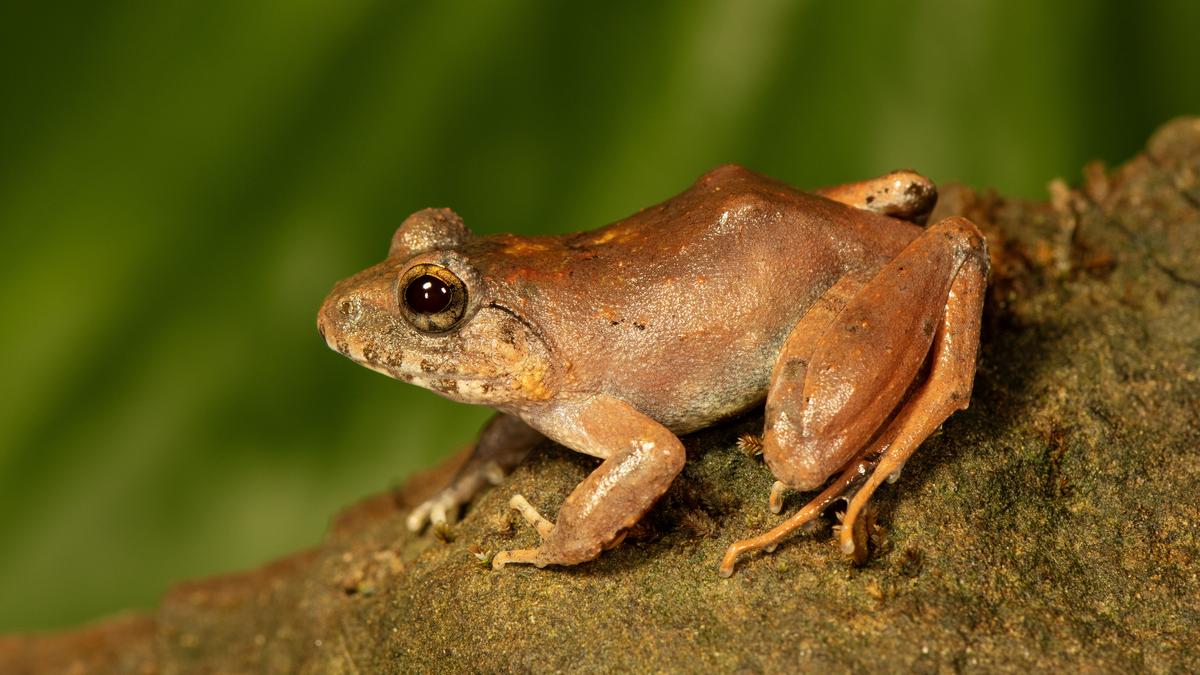
Charles Darwin’s frog
| Photo Credit: S.D. Biju

In a pioneering study featured in the Harvard Museum of Comparative Zoology’s journal Breviora, an Indo-American team of biologists has discovered an extraordinary reproductive behaviour in the Charles Darwin’s frog (Minervarya charlesdarwini), an endangered species endemic to the Andaman Islands.

This discovery not only highlights the rare mating ritual, but also raises concerns about the loss of natural habitats, leading the species to thrive in human trash in forests disturbed by anthropogenic activities.

The research, undertaken by biologists from the University of Delhi, Zoological Survey of India, Harvard University, and the University of Minnesota, reveals that the Charles Darwin’s frog exhibits an unparalleled reproductive behaviour: upside-down spawning. Unlike other frogs, this species deposits its eggs in a vertical, upside-down position on the inner walls of water-filled tree cavities or root buttresses. Once laid, the eggs eventually fall into the water below, where they develop into tadpoles.

Unique reproduction

“This is a remarkable frog and its reproductive behaviour is unique for a number of reasons. No other frog lays terrestrial eggs in an upside-down position within tree holes,” explains Professor S.D. Biju from the University of Delhi, who led the study, and is currently a fellow at the Harvard Radcliffe Institute and an Associate of the Harvard’s Museum of Comparative Zoology.

“Such specialised traits also yield insights into the evolution of reproductive modes and behaviours among anuran amphibians. This discovery is crucial for understanding the species’ interaction with its environment and its essential habitats.”
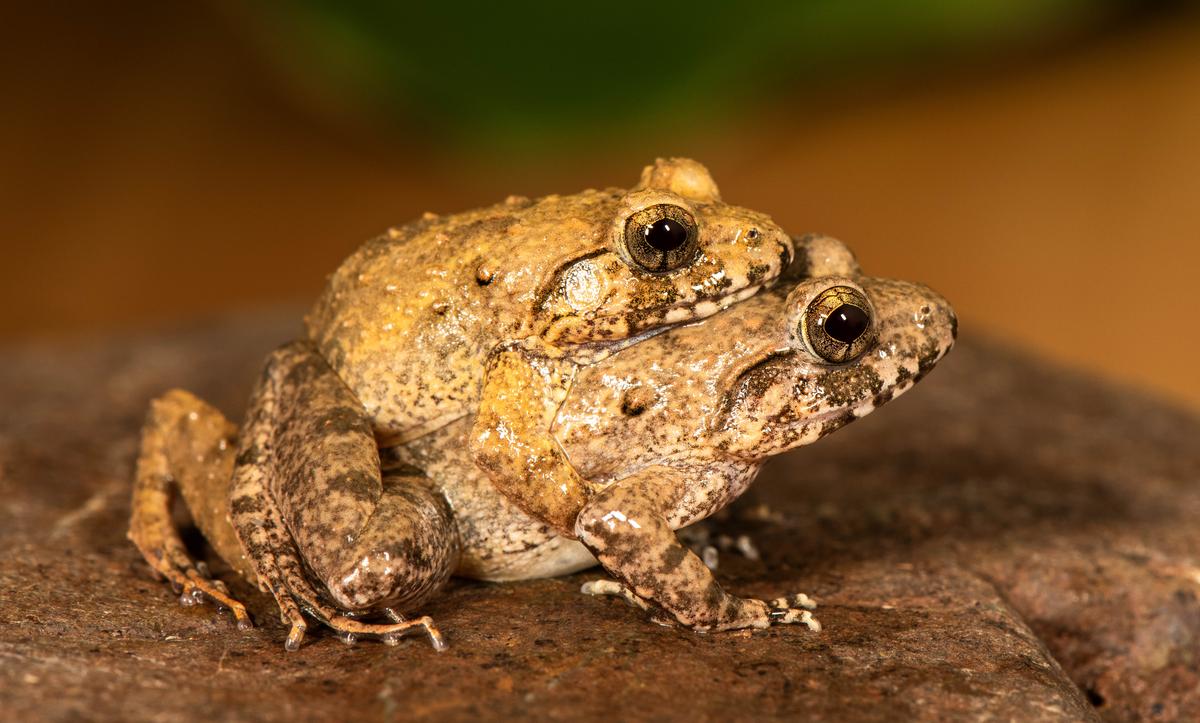
Amplexus (breeding) pair of Charles Darwin’s frog moving towards a tree hole.  

Amplexus (breeding) pair of Charles Darwin’s frog moving towards a tree hole.  
| Photo Credit:
S.D. Biju

Complex behaviour

The study also delves into the complex vocal behaviour of male Charles Darwin’s frogs, who use intricate calls to attract females. These calls include three distinct types: advertisement calls, aggressive calls, and combat calls. In cases where vocalisations fail to deter rival males, physical confrontations ensue. Males engage in fierce battles involving kicking, boxing, and biting, competing intensely for mating opportunities.

When a male successfully mounts a female, unpaired males often attempt to disrupt the mating pair, leading to aggressive skirmishes. The mating pair’s upside-down position may serve as a defensive adaptation, preventing rival males from displacing them and disrupting the egg-laying process.

Adding to the study’s significance, researchers observed that the frogs are increasingly breeding in artificial and discarded containers such as plastic and metal trash. This shift is attributed to habitat loss and competition for natural breeding sites. “The frogs’ use of trash for breeding is both surprising and worrying,” notes Sonali Garg, a biodiversity postdoctoral fellow at Harvard’s Museum of Comparative Zoology, who co-led the study.

“We now need to know its causes and long-term consequences, and devise ways to protect the natural breeding sites that are critical for the survival of the species,” she added.

Charles Darwin’s frog is classified as ‘Vulnerable’ by the International Union for Conservation of Nature (IUCN).
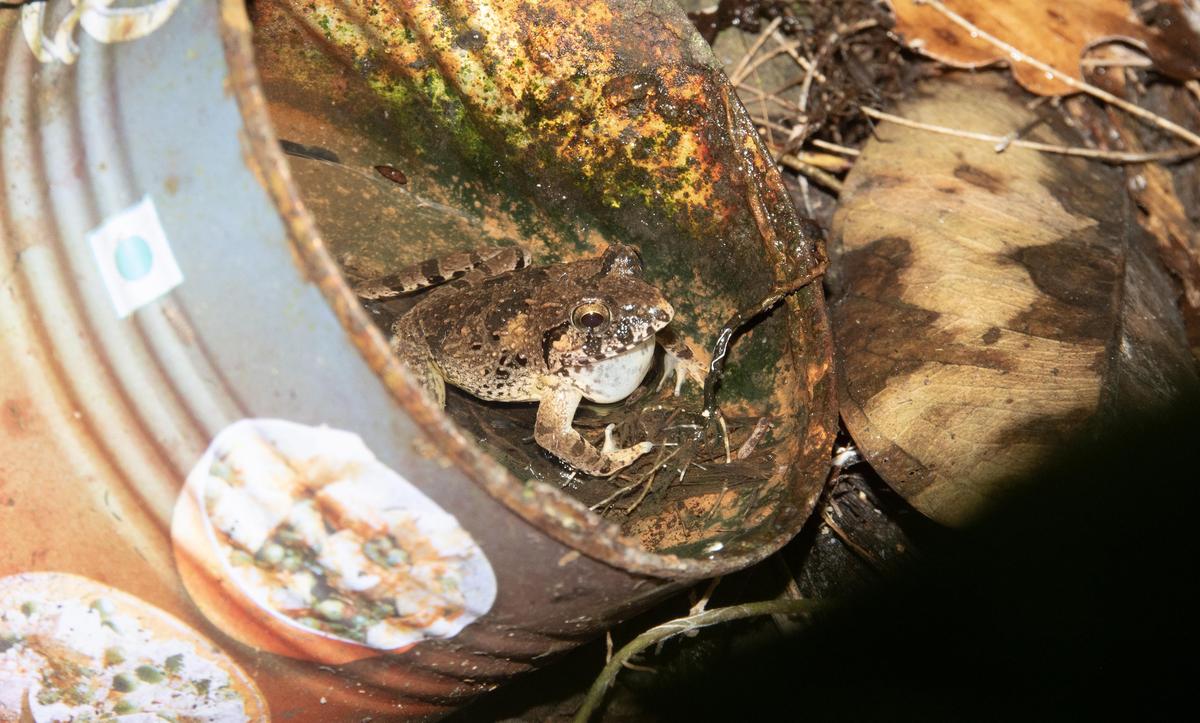
 A male Charles Darwin’s frog calling from an unnatural breeding site inside a metal food tin littered in the forest.  

 A male Charles Darwin’s frog calling from an unnatural breeding site inside a metal food tin littered in the forest.  
| Photo Credit:
G. Gokulakrishnan

Fieldwork for this study, spanning over three years, involved more than 55 nights of observation during the monsoon season across the Andaman archipelago.

David C. Blackburn, an expert in frog behaviour and developmental biology, emphasises the significance of such detailed field research. “There are more than 7,700 known species of frogs, but just because a species has a scientific name, it does not mean that we know much about its biology,” he points out.

The curator of herpetology at the Florida Museum of Natural History also underscores the pertinent questions raised by the study about how human disturbances, including loss or alterations of habitats, can impact the characteristic features of poorly known species.



Source link

Science

Post navigation

Previous Post: Kamala Harris’ Presidential Campaign Raises $200 Million In A Week
Next Post: Maldives President Mohamed Muizzu Thanks India For Debt Relief, Hopes For Free Trade Deal

Related Posts

  • Climate change has made the Hajj pilgrimage more risky Science
  • Sci-Five | The Hindu Science Quiz: On Radioactivity Science
  • Hundreds of tests planned, working to get crew module from outside India: ISRO’s Somanath on Gaganyaan Science
  • If anxiety is in my brain, why is my heart pounding? A psychiatrist explains the neuroscience and physiology of fear Science
  • How the Widal test is clouding India’s sense of its typhoid problem | Explained Science
  • How much salt should you take every day? Science

More Related Articles

‘Not considering women pilots for first Gaganyaan flight huge missed opportunity’ Science
Draft patent amendment rules undermine pre-grant opposition Science
Karnataka CM Siddaramaiah visits ISRO, felicitates Chairperson S. Somnath Science
Panel suggests booster shot of BCG vaccine to fight TB Science
Second spaceport of ISRO to be set up in Tamil Nadu Science
What scientists find when they find nothing Science
SiteLock

Archives

  • July 2024
  • June 2024
  • May 2024
  • April 2024
  • March 2024
  • February 2024
  • January 2024
  • December 2023
  • November 2023
  • October 2023
  • September 2023
  • August 2023
  • July 2023
  • June 2023
  • May 2023
  • April 2023
  • March 2023
  • February 2023
  • January 2023
  • December 2022
  • November 2022
  • October 2022
  • September 2022
  • August 2022
  • July 2022
  • June 2022
  • May 2022

Categories

  • Business
  • Nation
  • Science
  • Sports
  • World

Recent Posts

  • Former India Cricketer Anshuman Gaekwad Dies After Long Battle With Cancer
  • On discarding indexation for long-term capital gains | Explained
  • Uddhav Thackeray To Devendra Fadnavis
  • Shah Rukh Khan In Heated Chat With Punjab Kings Owner In IPL Meeting. Report Makes Big Claim
  • Mumbai May Lose Over 10% Land By 2040 Due To Rising Sea Level: Study

Recent Comments

  1. TpeEoPQa on UP Teacher Who Asked Students To Slap Muslim Classmate
  2. xULDsgPuBe on UP Teacher Who Asked Students To Slap Muslim Classmate
  3. KyJtkhneiLmcq on UP Teacher Who Asked Students To Slap Muslim Classmate
  4. mOyehudovB on UP Teacher Who Asked Students To Slap Muslim Classmate
  5. GFBvgSrWPcsp on UP Teacher Who Asked Students To Slap Muslim Classmate
  • In 1st Phase, Voters To Decide Fate Of Nitin Gadkari, Karti Chidambaram Nation
  • Meet Canada’s Danielle McGahey, Who Is Set To Become First Transgender To Play International Cricket Sports
  • Why Men Wear Sarees, Jewellery On Holi In This Andhra Village Nation
  • Not Yashasvi Jaiswal Or Shubman Gill. Sikandar Raza Says This Move Helped India Beat Zimbabwe By 10 Wickets Sports
  • Sirens sound in Tel Aviv for the first time in months as Hamas says it fired rockets from Gaza World
  • Harmanpreet Kaur Moves To 12th, Shafali Verma 15th In ICC T20 Rankings Sports
  • World breached 1.5° Celsius limit for entire year for first time: European climate agency Science
  • Gautam Gambhir’s Intriguing “Bowlers Win You Tournaments” Post As India Hammer England By 100 Runs Sports

Editor-in-Chief:
Mohammad Ariff,
MSW, MAJMC, BSW, DTL, CTS, CNM, CCR, CAL, RSL, ASOC.
editor@artifex.news

Associate Editors:
1. Zenellis R. Tuba,
zenelis@artifex.news
2. Haris Daniyel
daniyel@artifex.news

Photograher:
Rohan Das
rohan@artifex.news

Artifex.News offers Online Paid Internships to college students from India and Abroad. Interns will get a PRESS CARD and other online offers.
Send your CV (Subjectline: Paid Internship) to internship@artifex.news

Links:
Associate Journalism
About Us
Privacy Policy

News Links:
Breaking News
World
Nation
Sports
Business
Entertainment
Lifestyle

Registered Office:
72/A, Elliot Road, Kolkata - 700016
Tel: 033-22277777, 033-22172217
Email: office@artifex.news

Editorial Office / News Desk:
No. 13, Mezzanine Floor, Esplanade Metro Rail Station,
12 J. L. Nehru Road, Kolkata - 700069.
(Entry from Gate No. 5)
Tel: 033-46011099, 033-46046046
Email: editor@artifex.news

Copyright © 2023 Artifex.News Newsportal designed by Artifex Infotech.