



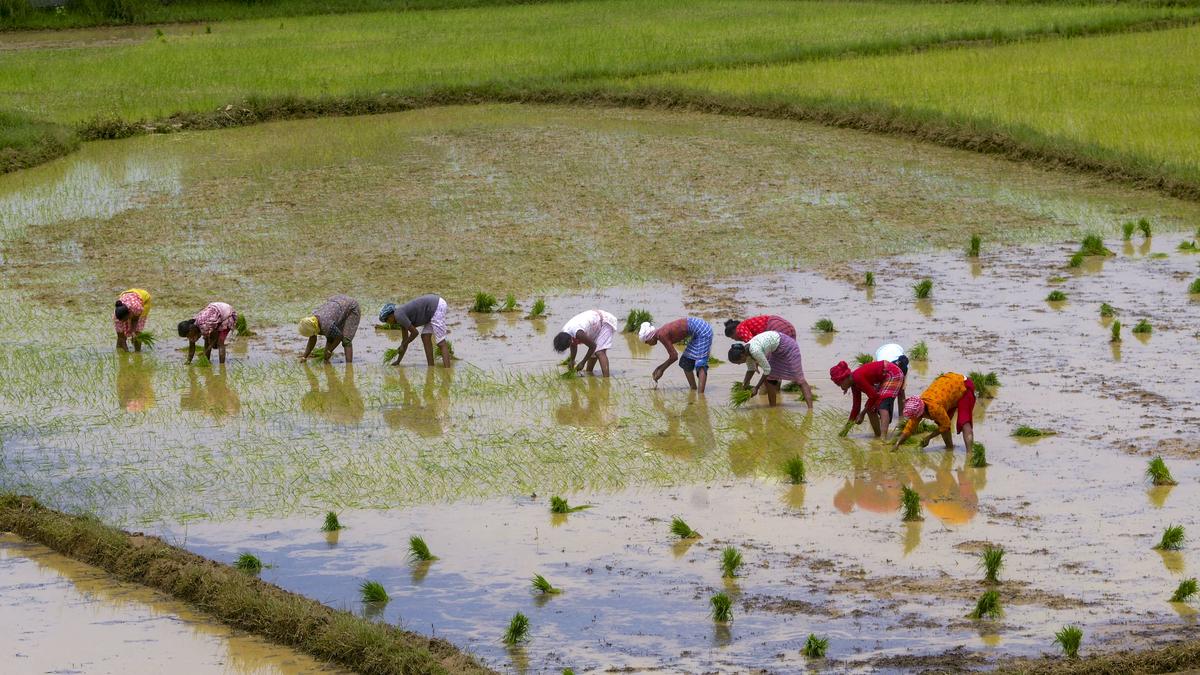
Farm workers sow paddy saplings at an agricultural field in Ranchi on July 26, 2024.
| Photo Credit: PTI
The story so far: In her Budget proposals for 2024-25, Union Finance Minister Nirmala Sitharaman announced that in the next two years, one crore farmers across the country will be initiated into natural farming supported by certification and branding. Implementation will be through scientific institutions and gram panchayats, adding that 10,000 need-based bio-input resource centres will be established.
What is the mission?
As part of the National Mission on Natural Farming (NMNF), the government intends to motivate farmers to adopt chemical-free farming and draw them towards adopting natural farming willingly on the system’s merit. The government believes that the success of the NMNF will require a behavioural change in farmers to shift from chemical-based inputs to cow-based, locally-produced inputs. The natural farming scheme under the ‘Bharatiya Prakritik Krishi Paddhati’ has a total outlay of ₹4,645.69 crore for six years (2019-20 to 2024-25).
Budget 2024: What’s in it for agriculture?
What is natural farming?
In natural farming, no chemical fertilizers and pesticides are used. It promotes traditional indigenous practices which are largely based on on-farm biomass recycling with a stress on biomass mulching, use of on-farm cow dung-urine formulation; managing pests through diversity, on-farm botanical concoctions and exclusion of all synthetic chemical inputs directly or indirectly. The emphasis is on improving natural nutrient cycling and increasing organic matter in the soil. Grounded in agro-ecology, it is a diversified farming system that integrates crops, trees and livestock, allowing the optimum use of functional biodiversity. Those advocating natural farming believe that it holds the potential to enhance farmers’ income while delivering many other benefits, such as restoration of soil fertility and environmental health, and mitigating and/or reducing greenhouse gas emissions.
What are the challenges and concerns?
Agriculture and food experts have their reservations surrounding a large-scale transition from chemical farming to natural farming in a country like India, which has a huge population. Catering to its food-growing needs isn’t an easy task, they point out. Recently, an academic paper titled, ‘Zero Budget Natural Farming (ZBNF): Implications for Sustainability, Profitability, and Food Security’, published by the National Bank for Agriculture and Rural Development and the Indian Council for Research on International Economic Relations, pointed out the “sheer disparity” in the outcomes of the two different experiments surrounding ZBNF (now renamed as Bhartiya Prakritik Krishi Paddhati), one conducted by the Centre for Economic and Social Studies (CESS) and Institute for Development Studies Andhra Pradesh, and the other by the Indian Council of Agricultural Research (ICAR) and the Indian Institute of Farming Systems Research (IIFSR).
Sandip Das, Mahima Khurana and Ashok Gulati write in the paper the importance of long-term experimentation before declaring natural farming as a nationwide agriculture practice. The paper, which delves into the promising yet contentious realm of natural farming, navigates through contrasting findings from the two studies, revealing divergent perspectives on ZBNF. While Andhra Pradesh emerges as a forerunner in adopting ZBNF with encouraging results, the IIFSR study raises concerns about the sustainability and yield (productivity) potential of this farming method.
For instance, the paper notes the CESS study has found that in the case of a variety of crops, lower cost of biological inputs suggested under ZBNF has led to improved yields of crops and farmers’ incomes, thus increasing the food and nutritional security of farmers practising ZBNF. However, findings of agro-scientists of the ICAR-IIFSR, a government institute, show a 59% decline in wheat yields and a 32% decline in basmati rice yield compared to integrated crop management, adversely impacting food supply.
What are the lessons from Sri Lanka?
It’s vital that before launching a large-scale transition from chemical to natural cultivation, extensive studies and assessments are conducted. A couple of years ago, neighbouring Sri Lanka went through economic and political turmoil after it decided to turn completely organic, and banned the import of chemical fertilizers. The government’s policy shift had severe consequences with farmers struggling to get natural fertilizers; they faced a reduction in yields of key crops including rice, the staple, putting the country’s food security at risk. A sharp price escalation was witnessed in the country, resulting in huge protests and unrest.
What is the way forward?
Noted economist and former professor at the Ludhiana-based Punjab Agricultural University, M.S. Sidhu, asserts that natural farming could be beneficial at a localised level, but in a populous country like India, adopting natural farming at a large scale may not be a successful model. “Food security is a major concern. If we adopt natural farming for cereals, which are mostly staples, we shall be able to feed only around one-third of our population. Wheat and rice are our staple foods, growing these crops through natural farming could result in lower yields, and hence it’s not advisable unless scientific studies are conducted on yields”. Supplementary foodstuffs may be grown through natural farming, he points out. “Rigorous scientific tests of natural farming, especially surrounding the crop yields should be held before its nationwide implementation to fend off the fear of potential risk to national food security,” says Prof. Sidhu.