Skip to content
  • Facebook
  • X
  • Linkedin
  • WhatsApp
  • Associate Journalism
  • About Us
  • Privacy Policy
  • 033-46046046
  • editor@artifex.news
Artifex.News

Artifex.News

Stay Connected. Stay Informed.

  • Breaking News
  • World
  • Nation
  • Sports
  • Business
  • Science
  • Entertainment
  • Lifestyle
  • Toggle search form
  • Avalanche Hits Himachal Village, 650 Roads Closed Due To Rain, Snowfall Nation
  • England Great Wants Yashasvi Jaiswal To Open In Super 8s, Says ‘Not Bothered With Virat Kohli…’ Sports
  • Court Directs Delhi Jail To Take AAP MP Sanjay Singh To Parliament For Rajya Sabha Oath Nation
  • BJP Plans Two-Day Organisational Meet, Focus On Next Round Of Assembly Polls Nation
  • Paramilitary Jawan Injured After Being Hit By Speeding Car In Mumbai: Cops Nation
  • Asia Cup 2023 Final | Got a message from trainer to stop Siraj, says Rohit Sharma Sports
  • Companies in India likely to give 9.8% salary raise in 2024, highest in APAC: Report Business
  • US Blacklists 14 Russian Oil Tankers To Enforce Price Cap World

For the social sector, it is old wine in an old bottle

Posted on July 23, 2024 By admin


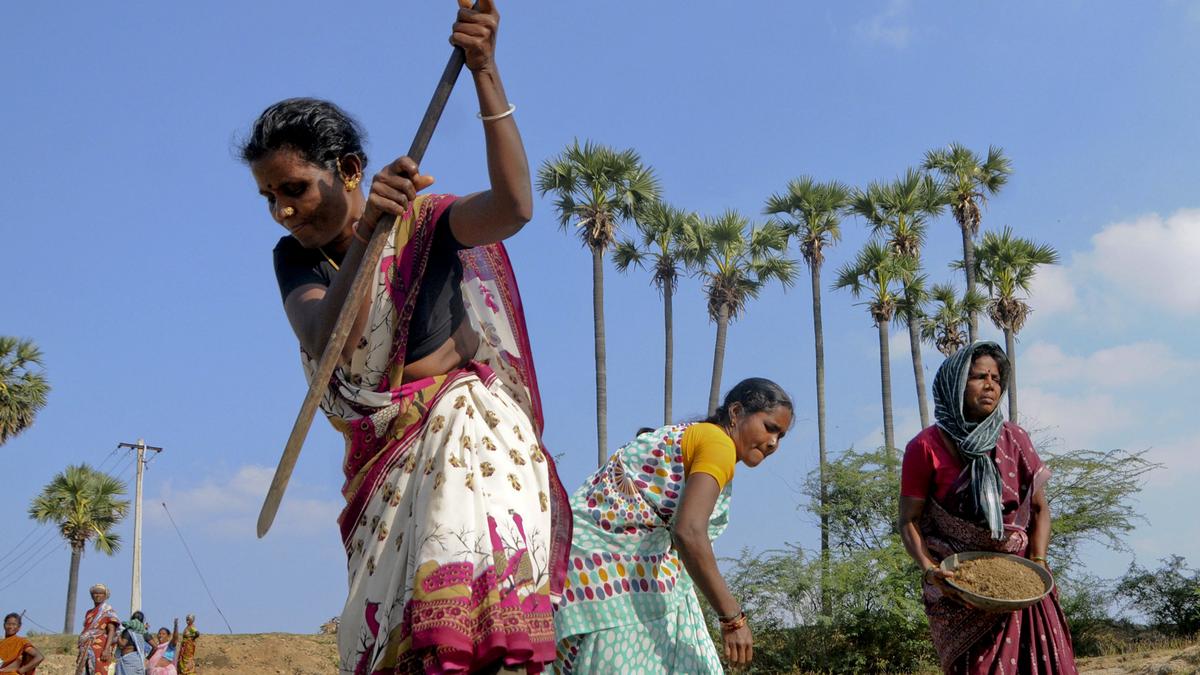
File photo of MGNREGA work in Villupuram district, Tamil Nadu.
| Photo Credit: The Hindu

Budget 2024 is no different from previous years as far as allocations for the social sector are concerned. This is despite the fact that the youth, farmers, women, and the poor are identified as the main focus groups. The Economic Survey has a chapter called ‘Social Sector: Benefits that Empower’, which states, “India’s high and sustained economic growth in recent years is being accompanied by social and institutional progress, underpinned by transformational and effective implementation of Government programmes with an empowering edge that has become the hallmark of a transformed approach to welfare”. It seems as if this approach is characterised by decreasing allocations in the Budget for a number of social sector schemes (in real terms).

Disappointing allocations

The allocation for school education has increased by a nominal ₹5,000 crore and that for higher education has seen a minor increase of ₹3,000 crore. In both cases, the estimated ‘recoveries’ are substantially higher compared to previous years, indicating higher fees and self-financing schemes in educational institutions. The allocation for the Department of Health and Family Welfare has barely increased by ₹1,500 crore compared to last year. The allocations for MGNREGA is the same as the revised estimates (RE) for last year. Although this is a demand-driven scheme, the allocation gives a message to the States on how much is available. The availability of work on the ground gets calibrated accordingly. There is hardly an increase in food subsidy too, despite the need for expanding coverage to current population levels (the PDS continues to use 2011 Census population figures) as well as the anticipated increase in the economic costs of foodgrains.

Smaller, yet critical, schemes that address vulnerable populations also have not got much attention. There is a slight increase from BE 2023-24 of ₹11,600 crore to ₹12,467 crore for the POSHAN scheme (school mid-day meal). This is, however, less than the actual expenditure on this scheme in 2022-23 (₹12,681 crore). The Saksham Anganwadi scheme for children under six years, pregnant and lactating women, and adolescent girls has got a budgetary allocation of ₹21,200 crore (BE 2023-24 was ₹20,554 crore). There is clearly no hope for higher salaries for Anganwadi workers (which have not been revised since 2018), or for higher honorarium for mid-day meal cooks, or for higher allocations for the supplementary nutrition given to children.

The allocation for Samarthya, which includes maternity entitlements (Pradhan Mantri Matru Vandana Yojana, PMMVY) and the creche schemes, has reduced to ₹2,517 crore compared to BE 2023-24 of ₹2,582 crore. The PMMVY is known to exclude at least half the eligible women, and the amount of ₹5,000 per pregnant woman has remained unchanged since the inception of the scheme in 2017. The budget for the National Social Assistance Programme (NSAP), which gives social security pensions to the elderly, single women, and disabled, remains unchanged at ₹9,652 crore. Once again, this is a reduction in real terms and does not leave any room for either increase in coverage or in the amount to even adjust for inflation. The central contribution to these social security pensions has been ₹200 per person per month since 2009.

To be clear, these reductions cannot be justified on account of better schemes having taken their place. If at all, for some of these benefits, the focus of the government seems to be shifting more to contributory schemes, such as the Atal Pension Yojana in the case of pensions. In other instances, such as in the case of education or health, the shift is towards privatisation and commercialisation with a greater emphasis on ‘cost-effectiveness’ in social spending, which the Economic Survey calls one of the “pillars of the new approach to welfare”. Such an approach does not adequately take into account either the problems with applying market principles to these social services or the returns to the economy in the long run of improving human development outcomes. Importantly, equity considerations are ignored.

The employment challenge

On the other hand, there is a lot of expectation from the private sector to respond to the employment challenge. The ‘Prime Minister’s Package for Employment and Skilling’ includes government-sponsored internships, formalisation of jobs through incentives for EPFO enrolments, and skill-development programmes. These schemes do not seem very impressive when one looks at the budgetary allocations. This entire package has an allocation of ₹2 lakh crore over a period of five years, with much of it linked to the response of the industry. Further, the private sector is required to spend money towards this package from CSR funds. By allowing this, the CSR funds through which companies contribute back to society in some minimal way, are now mandated to be used towards subsidising wages for themselves.

Rather than discussing dampened demand, stagnant wages, and what can be done to revive employment, the announcement only includes supply-side schemes towards incentivising the private sector to increase employment. Different versions of this have been tried earlier and have failed. Whether this package will be any different remains to be seen.

Dipa Sinha is a development economist


Source link

Business Tags:budget 2024, Budget allocation for social sector schemes, Union Budget 2024

Post navigation

Previous Post: The rationale for the tax proposals
Next Post: Can the Prime Minister’s employment package work?

Related Posts

  • Journalists not employees under Unfair Labour Practices Act as they enjoy special status: Bombay High Court Business
  • Shapoorji Pallonji Group sells Gopalpur Port in Odisha to Adani Ports for ₹3,350 crore Business
  • Retail investors’ F&O play for quick profits a worry; short-termism biggest risk to growth: CEA Business
  • Rupee rises 38 paise to 82.75 against U.S. dollar in early trade Business
  • G-20 members stressed on need to increase climate finance to help farmers take up adaption measures: Agriculture secretary Business
  • Thorny clause in ripening India-European Free Trade Association deal may hit generic drug industry Business

More Related Articles

Explained | What were Claudia Goldin’s observations about female participation in the labour force which earned her the Nobel Prize? Business
Stock markets extend gains for fifth day; Sensex revisits 66,000 mark Business
Infosys CEO settles insider trading case with Sebi; pays ₹25 lakh Business
NCLAT chairperson calls for developing robust mechanism to regulate digital markets Business
Budget 2023 | Senior citizen scheme limit doubled to ₹30 lakh Business
India, U.K. to continue FTA negotiations till August-end Business
SiteLock

Archives

  • July 2024
  • June 2024
  • May 2024
  • April 2024
  • March 2024
  • February 2024
  • January 2024
  • December 2023
  • November 2023
  • October 2023
  • September 2023
  • August 2023
  • July 2023
  • June 2023
  • May 2023
  • April 2023
  • March 2023
  • February 2023
  • January 2023
  • December 2022
  • November 2022
  • October 2022
  • September 2022
  • August 2022
  • July 2022
  • June 2022
  • May 2022

Categories

  • Business
  • Nation
  • Science
  • Sports
  • World

Recent Posts

  • ‘Reviews of I-T Act, Customs may be ready by next Budget’
  • 1,000 French Police To Secure Israel-Mali Olympics Football Game
  • US Sanctions China-Based Network For Supporting North Korea
  • Thought It Was Something Crunchy
  • Streets turned into rivers as Typhoon Gaemi blows past Philippines

Recent Comments

  1. ywdVpqHiNZCtUDcl on UP Teacher Who Asked Students To Slap Muslim Classmate
  2. bRstIalYyjkCUJqm on UP Teacher Who Asked Students To Slap Muslim Classmate
  3. GkJwRWEAbS on UP Teacher Who Asked Students To Slap Muslim Classmate
  4. xreDavBVnbGqQA on UP Teacher Who Asked Students To Slap Muslim Classmate
  5. aANVRzfUdmyb on UP Teacher Who Asked Students To Slap Muslim Classmate
  • Injured Pakistan Opener Fakhar Zaman, Fever-Hit Salman Agha Unavailable For Australia Game Sports
  • PM Should Meet Fasting Activist, Resolve Maratha Quota Issue: Uddhav Thackeray Nation
  • Sharad Pawar’s Dig At Eknath Shinde On Maratha Quota Nation
  • Uddhav Thackeray Indulging In Appeasement Politics Nation
  • IPL 2024: Kolkata Knight Riders Name Phil Salt As Replacement For Jason Roy Sports
  • Shreyas Iyer Cites Injury To Miss Ranji Trophy Game. NCA Provides Contradicting Update: Report Sports
  • RCB vs CSK: Faf Du Plessis Out Or Not Out? RCB Skipper Furious After Controversial Umpiring Decision In IPL Game Sports
  • If A Firecracker Goes Off in Bengal, CBI, NSG Come To Probe Nation

Editor-in-Chief:
Mohammad Ariff,
MSW, MAJMC, BSW, DTL, CTS, CNM, CCR, CAL, RSL, ASOC.
editor@artifex.news

Associate Editors:
1. Zenellis R. Tuba,
zenelis@artifex.news
2. Haris Daniyel
daniyel@artifex.news

Photograher:
Rohan Das
rohan@artifex.news

Artifex.News offers Online Paid Internships to college students from India and Abroad. Interns will get a PRESS CARD and other online offers.
Send your CV (Subjectline: Paid Internship) to internship@artifex.news

Links:
Associate Journalism
About Us
Privacy Policy

News Links:
Breaking News
World
Nation
Sports
Business
Entertainment
Lifestyle

Registered Office:
72/A, Elliot Road, Kolkata - 700016
Tel: 033-22277777, 033-22172217
Email: office@artifex.news

Editorial Office / News Desk:
No. 13, Mezzanine Floor, Esplanade Metro Rail Station,
12 J. L. Nehru Road, Kolkata - 700069.
(Entry from Gate No. 5)
Tel: 033-46011099, 033-46046046
Email: editor@artifex.news

Copyright © 2023 Artifex.News Newsportal designed by Artifex Infotech.