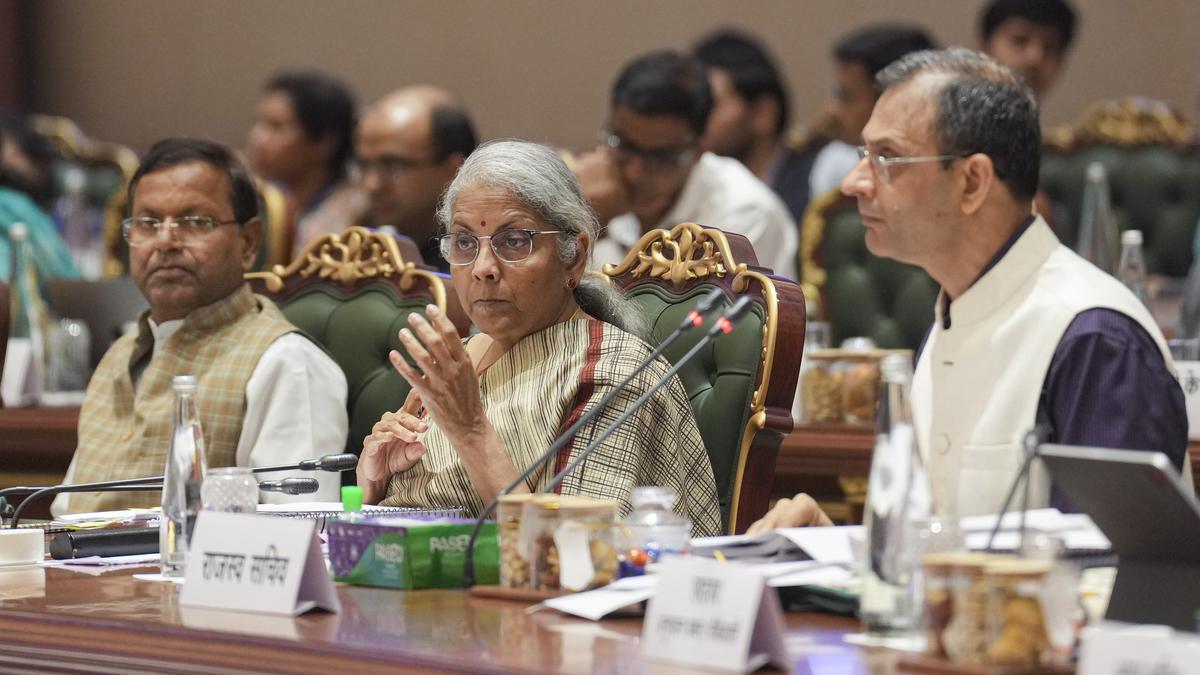





Just before Nirmala Sitharaman presented her seventh consecutive Budget as Union Finance Minister of a coalition led by the Bharatiya Janata Party (BJP), which managed to gain power for the third time on an underwhelming mandate, signals from the government seemed to suggest what its thrust may be. The Economic Survey 2023-24 made clear that while India’s industrialists and business elite were “swimming in excess profits”, the priority of the government was not to tax away that excess for developmental purposes, but to ease the burden of regulation on business and goad the private sector into generating productive jobs out of “enlightened self-interest”. Business must lead the march to Viksit Bharat 2047, and the job of the government is to persuade the private sector not to shy away from leadership.
Outside government, speculation was rife on two matters. The first concerned the possible response of the National Democratic Alliance (NDA) to the signal from the parliamentary elections that the strategy of sidestepping core economic problems — varying from rural distress and widespread unemployment to inflation, especially food price inflation — could prove costly. The second related to the scale and the structure of the pay-off to allies, the Telugu Desam Party (TDP) and the Janata Dal (United), or the JD(U), from Andhra Pradesh and Bihar, respectively, who are crucial to keep the post-election coalition government led by the minority NDA in power.
Initiatives and their slotting
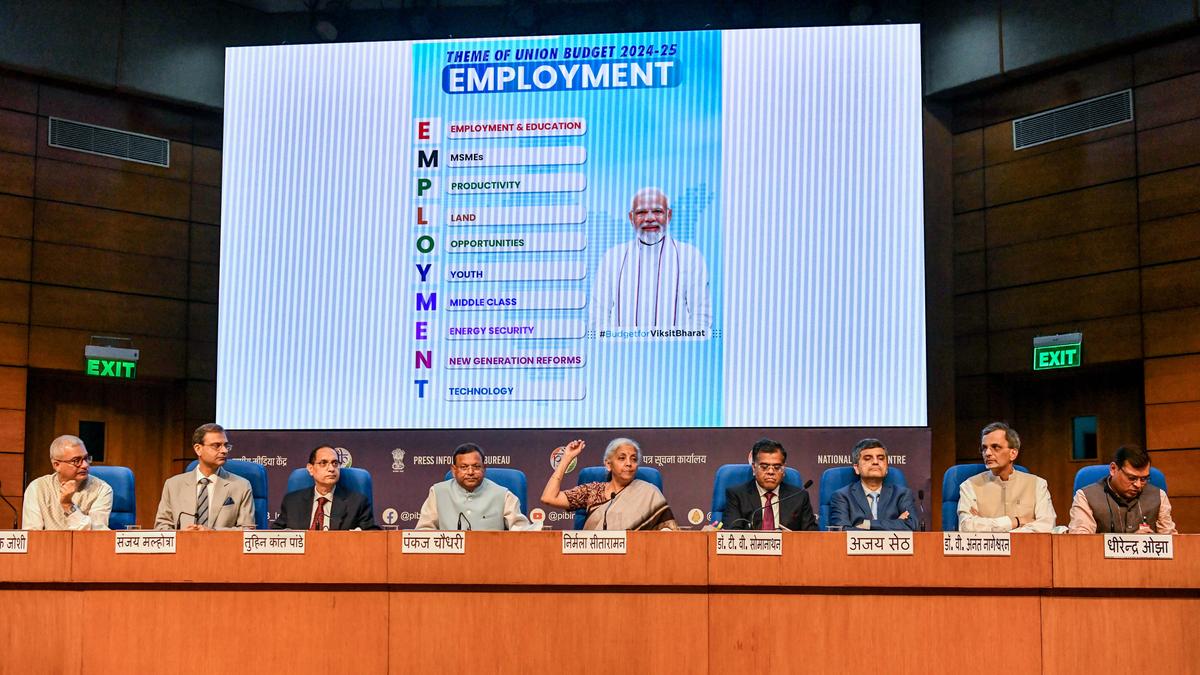
The speech did not disappoint by sidestepping these issues, though the beneficiaries of the schemes meant to address them are likely to be disappointed by their scale and efficacy. Embarrassed perhaps by the hordes applying for the few half-decent jobs available, Part A of the Budget speech spent much time on the means to increase employment, especially for the educated unemployed. Multiple initiatives were announced, which broadly fell in two buckets.
One contained schemes that amounted to providing employment subsidies, either directly or indirectly to employers. The scheme to provide ₹15,000 in three instalments to all new employees with salary up to ₹1 lakh a month appears to be directed to those employed in the formal sector. But it is more than likely that the availability of this benefit would influence the compensation package offered by companies attempting to internalise that subsidy. Another set of subsidies, such as the ₹3,000 a month contribution for two years to be made by the government against provident fund subscriptions, accrues directly to employers.
A second bucket consists of schemes, varying from subsidised internships and interest subvention for educational loans, which attempt to ‘skill’ workers largely at state expense, in ways that are expected to make them more employable. The assumption is that it is not inadequate and inappropriate growth, but a skill set mismatch between what job aspirants have to offer and industry needs, that is responsible for unemployment.
Combine this with direct tax concessions for foreign firms and indirect tax adjustments to favour domestic manufacturing, and the picture that emerges is that the unemployment problem is sought to be tackled by persuading private capital with transfers to hire the unemployed in “productive” jobs. The underlying perception, which misses why high growth does not deliver more jobs is that business wants to hire but finds the available labour force too expensive or unsuited, skill-wise.
This mismatch between the problem at hand and what the Budget offers is even more stark when it comes to agriculture. While peasants unable to make both ends meet because crop production is economically unviable have been demanding procurement at a legally guaranteed minimum support price, the Budget promises to implement a long-term programme to raise productivity and production. Farmers who have been on the streets for years now are unlikely to be impressed.
What the key allies have got
The disappointment is likely to be greater among the NDA’s allies. The JD(U) in Bihar has been promised a combination of sundry transport, power, education, sports and religious tourism infrastructure as an implicit quid pro quo for political support, which is a far cry from the large sums that it was expected to receive if granted the special status it demands, but has been denied. The TDP has been offered support to build its new capital at Amravati, on which Chief Minister N. Chandrababu Naidu has staked his prestige and fortunes. But what is shocking is that these promises have not been backed up by significant financial support from the Centre, with much or almost all of the spending to be financed with borrowing, especially from the multilateral development banks (MDBs), facilitated by the Centre. Why the MDBs should listen to the NDA leaders is not clear. But even if they do so, this would only increase the debt burden of these States. Moreover, given the restrictions that have been placed on borrowing by the States, it is unclear how debt for these purposes could be “additional” to what the State may have in any case chosen to incur.
Preoccupied with propaganda aimed at concealing the little that has been done in these politically-sensitive areas, the government in its first year in power has chosen to completely ignore the welfare schemes it made much of in the run-up to the election. Thus, total expenditure for the National Social Assistance Programme covering pensions and disability benefits, which stood at ₹9,652 crore in 2023-24 as per the revised estimates, has been allocated exactly the same amount in the Budget for 2024-25. That is the fate of the National Rural Employment Guarantee Programme, as well, where the allocation for 2024-25 is exactly the same as the revised estimate for expenditure in 2023-24. Despite the extension of the free foodgrain allocation under the National Food Security Act, the food subsidy is budgeted to fall from ₹2,12,332 crore (RE 23-24) to ₹2,05,250 crore (BE 24-25). It is only in the case of the Pradhan Mantri Awas Yojana (PMAY) that there is evidence of backing grandiose statements in the Budget with some increase in allocation.
The ‘secret source’ of funds
So, is there any larger ambition reflected in the Budget? There are two elements that stand out. One is the obsession with fiscal consolidation, with the fiscal deficit expected to come down from 4.9% of GDP in 2023-24 to 4.5% this year, and a promise of staying on that path subsequently. The other is the claim now made every year that the BJP-led government is taking capital expenditure to new heights, especially on infrastructure. Capital expenditure that rose from ₹7,40,025 crore in 2022-23 to ₹9,48,506 crore in 2023-24, is budgeted to rise further to ₹11,11,111 crore in 2024-25. With tax revenues not expected to register any special buoyancy, how are these conflicting targets expected to be achieved? The well known ‘secret source’ is once again dividends and surpluses from the Reserve Bank of India and leading public financial institutions, which, having risen from ₹39,961 crore in 2022-23 to a huge ₹1,04,407 crore in 2023-24, are budgeted to spike again to ₹2,32,874 crore in 2024-25. But even these funds garnered through transfers within the state are not available for welfare spending or meaningful support for allies on whom the government depends. Prime Minister Narendra Modi and his advisers have either not learnt their lessons or believe there is none to be learnt.
C.P. Chandrasekhar is Senior Research Fellow, Political Economy Research Institute, UMass, Amherst, U.S.