


Skip to content
  • Facebook
  • X
  • Linkedin
  • WhatsApp
  • Associate Journalism
  • About Us
  • Privacy Policy
  • 033-46046046
  • editor@artifex.news
Artifex.News

Artifex.News

Stay Connected. Stay Informed.

  • Breaking News
  • World
  • Nation
  • Sports
  • Business
  • Science
  • Entertainment
  • Lifestyle
  • Toggle search form
  • Adani Green Energy becomes first Indian company with 10,000 MW renewable energy capacity Business
  • U.S. drone sale to India proceeds to next phase World
  • Nepal PM Wins Parliamentary Vote Of Confidence, 3rd In 14 Months World
  • Ram Temple Construction In Ayodhya Symbol Of Patience Of Indians: PM Modi Nation
  • After Sunil Gavaskar’s ‘Maybe Virat Kohli Will Miss IPL Too’ Comment, AB de Villiers’ Major Hint Sports
  • Chief Justice Of India DY Chandrachud Fulfills Promise, Interacts With Media In Press Lounge Nation
  • Cheating Case, Marriage, False Marriage Promise, Supreme Court: Marriage Proposal “Not Reaching Desired End” Not Cheating: Supreme Court Nation
  • Australia vs Bangladesh Live Streaming T20 World Cup Live Telecast: Where To Watch Match Live Sports

Data from all-civilian crew details health effects of space travel

Posted on June 13, 2024 By admin


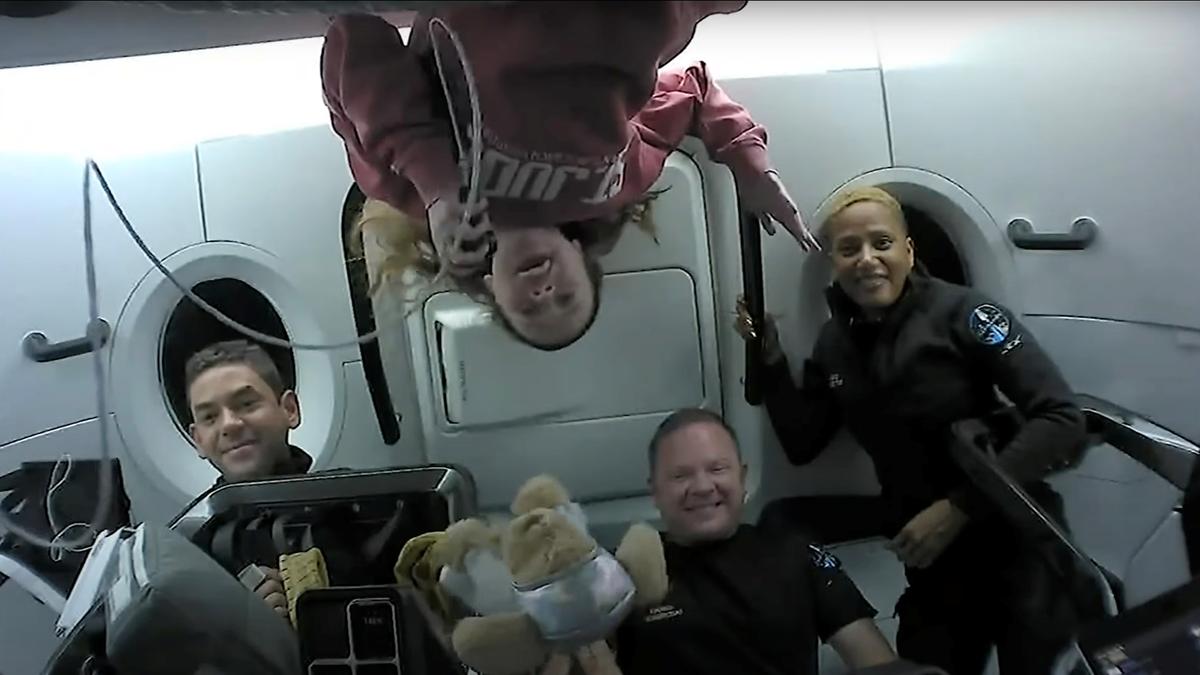
Inspiration4 crew Jared Isaacman, Sian Proctor, Hayley Arceneaux, and Chris Sembroski chatting with St. Jude patients from space in this handout photo released on September 17, 2021.
| Photo Credit: Reuters

When pediatric cancer survivor Hayley Arceneaux and a trio of crewmates spent three days in space in 2021 as part of SpaceX’s Inspiration4 mission, they made history not only as the first all-civilian team to orbit Earth. They also provided the most in-depth data on record regarding the effects of space travel on the human body.

New research based on this data details changes in the brain, heart, muscles, kidneys and skin, immune regulation and stress levels and a breakdown in the activity of subcellular structures called mitochondria amid the microgravity environment, increased radiation and other factors in space.

More than 95% of the biomarkers tracked in the research returned to preflight levels in the months after the crew returned to Earth, though some abnormalities including in the mitochondria persisted, the researchers said. But the data indicated that spaceflights – at least short-duration ones – do not pose significant health risks, they concluded.

“We did not see anything that was worrisome, thankfully,” said Chris Mason, a professor of physiology and biophysics at Weill Cornell Medicine in New York who helped lead the research, with studies published on Tuesday in Nature and other journals. “This bodes well for other groups of civilians planning to live and work in space.”

“We did see some evidence of brain-associated proteins in the blood after the mission, which we had also seen once before in the Twins Study (a 2019 study based on retired NASA astronauts and twins Scott and Mark Kelly), and we think is evidence of brain stress during the mission,” Mason added.

Mason said this might be explained by findings in experimental mice flown to space that experienced disruptions in the blood-brain barrier, a layer of cells protecting the brain. Cognitive function in the Inspiration4 crew, as measured by the University of Pennsylvania’s Mathias Basner, was not affected, Mason noted.

Arceneaux, a physician assistant at St. Jude Children’s Research Hospital in Memphis and the mission’s medical officer, and her crewmates – aerospace data engineer Chris Sembroski, geoscientist Sian Proctor and billionaire entrepreneur Jared Isaacman – were monitored before, during and after the flight. They underwent extensive testing and provided blood, saliva and other samples – including skin biopsies that left a lasting mark.

“I love my space scar,” said Arceneaux, who was 29 at the time and became the youngest American to orbit Earth, adding that the crew “really wanted to make a scientific impact.”

The research encompassed data from the two women and two men from Inspiration4 as well as information from 64 astronauts who participated in longer stints aboard the International Space Station (ISS) and other missions. Inspiration4 flew at roughly 370 miles (590 km) above Earth, higher than the ISS, meaning the crew faced higher radiation levels.

“So far, females seem to return to baseline (preflight status) faster than males, but our numbers are too small for this to be definitive,” Mason said.

The onset of a “second Space Age” characterized by commercial missions has heightened the urgency to understand health risks, according to bioinformatician Afshin Beheshti of the Blue Marble Space Institute of Science in Seattle, another leader of the research.

The amount of time spent in space is considered a key factor in the health effects, with greater concern over long-duration missions.

“The longer the duration in space, the greater the increase in health risks observed,” Beheshti said.

Beheshti said data from Inspiration4 and Japan’s space agency, along with Earth-based experiments, detailed the significant impact of spaceflight on mitochondrial function and immune regulation.

“Previous publications have touched on these issues, but the new findings indicate that microgravity and space radiation systematically affect the body, leading to dysfunction at the cellular level that impacts multiple organs, including muscles, kidneys, heart, skin, and CNS-related (central nervous system) tissues,” Beheshti said.

“The systemic response observed in spaceflight has been shown to contribute to increased frailty in humans. Space is known to accelerate aging and many human diseases, and the research underscores this by identifying key health risks that can be targeted for countermeasures,” Beheshti added.

The research pointed to potential paths to mitigate damage caused by space radiation. It found that certain molecules involved in regulating gene activity were inhibited in space.

“This research demonstrates that targeting these key factors can rescue the immune and inflammatory pathways dysregulated in space,” Beheshti said.

The researchers are taking a forward-looking approach.

“If humans are going to be living and working in space, or living on the moon and Mars, we need to set a baseline data of metrics for how the body responds to space,” Mason said.

Source link

Science Tags:data from Spacex inspiration4 mission, effects of travelling in space, space travel, spacex inspiration4 mission

Post navigation

Previous Post: GST Council to meet on June 22: What will be the agenda?
Next Post: Fires ravage Brazil wetlands, incinerating snakes and monkeys

Related Posts

  • Sci-Five | The Hindu Science Quiz: On the world’s smallest cat Science
  • Does evolution of adaptation always take hundreds of years? Science
  • The Science Quiz | Spacetime continuum Science
  • Chandrayaan-3 | Not just sons of Tamil Nadu but State’s soil itself contributed to Moon mission Science
  • Scientists surprised by source of largest quake detected on Mars Science
  • Iceland’s ‘Mammoth’ raises potential for carbon capture Science

More Related Articles

Ganga Hospital Chairman ranked among top 2% of world scientists Science
Gaganyaan astronauts | The chosen four Science
More than a third of urban Chinese living in sinking cities, study finds Science
Northern Lights: Severe solar storm triggers rare auroral arc in Ladakh sky Science
If there’s a theory of AI, computer science is unlikely to provide it Science
How subpar treatment options allow sickle cell disease to persist | Explained Science
SiteLock

Archives

  • July 2024
  • June 2024
  • May 2024
  • April 2024
  • March 2024
  • February 2024
  • January 2024
  • December 2023
  • November 2023
  • October 2023
  • September 2023
  • August 2023
  • July 2023
  • June 2023
  • May 2023
  • April 2023
  • March 2023
  • February 2023
  • January 2023
  • December 2022
  • November 2022
  • October 2022
  • September 2022
  • August 2022
  • July 2022
  • June 2022
  • May 2022

Categories

  • Business
  • Nation
  • Science
  • Sports
  • World

Recent Posts

  • Jasprit Bumrah Snubbed As Sunil Gavaskar Picks India’s Standout T20 World Cup Performer
  • Andhra Pradesh CM Chandrababu Naidu presses enhanced financial aid for debt-ridden State to Union Finance Minister Nirmala Sitharaman
  • From Crumbling NHS To Economic Crisis, Why Rishi Sunak Lost UK Election
  • Out On Parole, Amritpal Singh, Engineer Rashid Take Oath As Lok Sabha MPs
  • Watch: Rishi Sunak concedes defeat

Recent Comments

  1. GkJwRWEAbS on UP Teacher Who Asked Students To Slap Muslim Classmate
  2. xreDavBVnbGqQA on UP Teacher Who Asked Students To Slap Muslim Classmate
  3. aANVRzfUdmyb on UP Teacher Who Asked Students To Slap Muslim Classmate
  4. YQCyszVBmIP on UP Teacher Who Asked Students To Slap Muslim Classmate
  5. aiXothgwe on UP Teacher Who Asked Students To Slap Muslim Classmate
  • Sri Lanka’s Tamils face arrest as they remember the dead World
  • India vs Pakistan, ODI World Cup 2023: Bowlers Set It Up, Rohit Sharma Finishes Off One-Sided Contest vs Pakistan Sports
  • U.N. chief Guterres meets Nepal PM Prachanda, Deputy PM Khadka World
  • Kate Middleton Cancer Announcement Video Has An Editors Note On Getty. Here’s Why World
  • On Israel’s “Tactical Pause” In Gaza, Hamas Chief Ismail Haniyeh Says This World
  • Badminton At Asian Games: Indian Women Sail Into Team Quarterfinals Sports
  • A New Titanic Expedition Is Planned, But US Opposing It. Here’s Why World
  • North Korea sends 600 more trash-filled balloons over border to South World

Editor-in-Chief:
Mohammad Ariff,
MSW, MAJMC, BSW, DTL, CTS, CNM, CCR, CAL, RSL, ASOC.
editor@artifex.news

Associate Editors:
1. Zenellis R. Tuba,
zenelis@artifex.news
2. Haris Daniyel
daniyel@artifex.news

Photograher:
Rohan Das
rohan@artifex.news

Artifex.News offers Online Paid Internships to college students from India and Abroad. Interns will get a PRESS CARD and other online offers.
Send your CV (Subjectline: Paid Internship) to internship@artifex.news

Links:
Associate Journalism
About Us
Privacy Policy

News Links:
Breaking News
World
Nation
Sports
Business
Entertainment
Lifestyle

Registered Office:
72/A, Elliot Road, Kolkata - 700016
Tel: 033-22277777, 033-22172217
Email: office@artifex.news

Editorial Office / News Desk:
No. 13, Mezzanine Floor, Esplanade Metro Rail Station,
12 J. L. Nehru Road, Kolkata - 700069.
(Entry from Gate No. 5)
Tel: 033-46011099, 033-46046046
Email: editor@artifex.news

Copyright © 2023 Artifex.News Newsportal designed by Artifex Infotech.