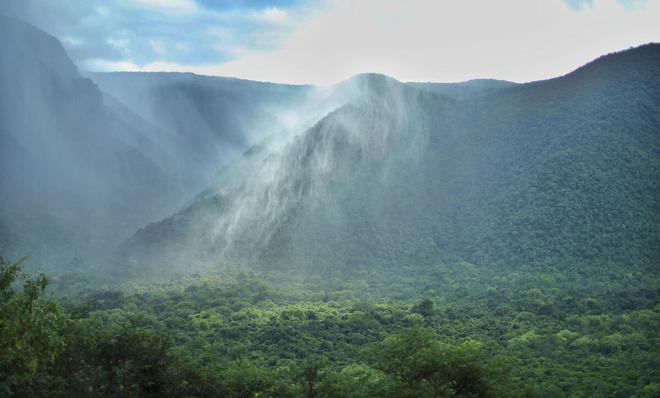







Six of the world’s eight baobab species are indigenous to Madagascar, where the distinctive trees with giant trunks have historically grown in huge forests. But these forests are threatened by slash-and-burn agriculture – 4,000 hectares of baobab forest in Madagascar are destroyed every year.
| Photo Credit: The Hindu
Six of the world’s eight baobab species are indigenous to Madagascar, where the distinctive trees with giant trunks have historically grown in huge forests. But these forests are threatened by slash-and-burn agriculture – 4,000 hectares of baobab forest in Madagascar are destroyed every year. Baobab trees can live for 1,000 years and one hectare of land can support eight fully grown baobab trees. But many have been left orphaned – standing alone in barren areas with no contact with the wild animals that spread their seeds, helping the baobabs to reproduce.
Tropical ecologist Seheno Andriantsaralaza has been researching the seed dispersal of baobab trees in Madagascar since 2009. She is the president of the Group of Specialists Passionate about Baobabs of Madagascar and a founder and principal investigator of the Assessment-Research-Outreach Baobab Project. She explains how the project works with women to replant baobab seedlings and harvest the fruit of existing trees sustainably.
 Why are baobab trees so important in Madagascar?

Baobab trees are symbols of our landscape, profoundly significant to our ecosystem and cultural heritage. They are valuable to rural women who pick their fruit and sell it to companies for use in food and cosmetic products. Baobab trees can save impoverished communities in periods when they most need the money.
Madagascar is also the home of the world’s rarest baobab, Adansonia perrieri. Unfortunately, our baobab populations are under severe threat. The most pressing issue is deforestation, driven by slash-and-burn agriculture. Some communities live in such extreme poverty that they need to clear land with fire so that they can plant crops. They cannot be blamed for that.
Another significant problem for the baobab forests is the loss of large-bodied animals such as giant lemurs or giant tortoises. These animals played a crucial role in spreading the seeds of baobab trees in their dung. But they became extinct about 500 years ago. Without these animals, baobab seeds are not spread as effectively.
Climate change has made the situation worse. Increased dryness and irregular weather patterns negatively affect the growth and survival of baobab trees. As a result, it is now very rare to find a 20-year-old baobab seedling in the wild in Madagascar. It takes about 50 years for a baobab seedling to grow into a fruit-bearing tree.
How does your research aim to save the baobab forests?
In 2019, I co-founded the Group of Specialists Passionate about Baobabs of Madagascar – dedicated Malagasy baobab experts and researchers who combine scientific research with practical conservation actions.
In 2020, a researcher from Berkeley University and I initiated the ARO Baobab Project, funded by the PEER USAID programme. This aimed to restore and conserve baobab forests through a combination of scientific research and community engagement.
To bring local communities into baobab conservation, we set up a trade contract for them with a company. We agreed on ways that communities would sustainably harvest enough fruit to sell, while leaving behind enough fruit to generate baobab tree seeds.
We then spent two and a half years trying to see if any animals would disperse baobab seeds in their dung, helping seedlings to grow. Micro lemurs, Microcebus cannot break the baobab fruit open to release the seeds as their teeth are not strong enough. The larger lemurs, Eulemur rufifrons, can disperse baobab seeds but we found that they were no longer living in former baobab forest areas.
Giant tortoises, Aldabrachelys gigantea, loved the fruit. We found baobab seeds in their faeces about 15 days after they’d eaten the fruit, and these seeds later germinated well, growing into healthy seedlings. We also discovered that a small rodent, Eliurus myoxinus, carried fallen baobab fruit over long distances. In transporting the fruit, this rodent dispersed and scattered the seeds.
However, we concluded these animals would not be able to do enough to restore the baobab forests alone. People would have to help, by growing baobab seedlings and physically planting them.
In 2021, we set up two nurseries to grow seedlings to revive baobab populations and their habitats in Andranopasy, western Madagascar. About 40% of the plants we grew were baobab seedlings and 60% were indigenous trees that used to be found in the baobab habitat, which provide fruit for a number of animals. Our aim was to restore the whole habitat of baobabs – all the animals and plants that make their reproduction possible.
Did the replanting work well?
Yes. We set up two nurseries made of low wooden greenhouses in partnership with communities. Together we transplanted more than 50,000 baobab and other seedlings in February 2023. Our data showed a seedling survival rate of 70% after replanting, which is incredibly high considering the dryness in forests.
We were able to partner with EOS Data Analytics, a company that specialises in using artificial intelligence to monitor the health of forests. They used satellite footage, algorithms and remote sensing to see how the seedlings were doing.
Comparing the same area with footage from 2020 revealed that since February 2023, plant and tree health has been significantly higher than in previous years. The positive effects of seedling transplantation appeared within months.
What role do women play in baobab reforesting?
Women play critical roles in our nurseries, the physical planting and also in leadership positions in the project. Before the project, it was sad to see that women – the main people collecting and selling baobab fruit to feed their children – were sidelined and had no voice in the future of the baobab trees. We have started another project for local women to lead conservation action. We aim to start a women’s association that will maintain the tree nurseries and grow indigenous plants as a way of generating an income.
This article is republished from The Conversation under a Creative Commons license. Read the original article.