
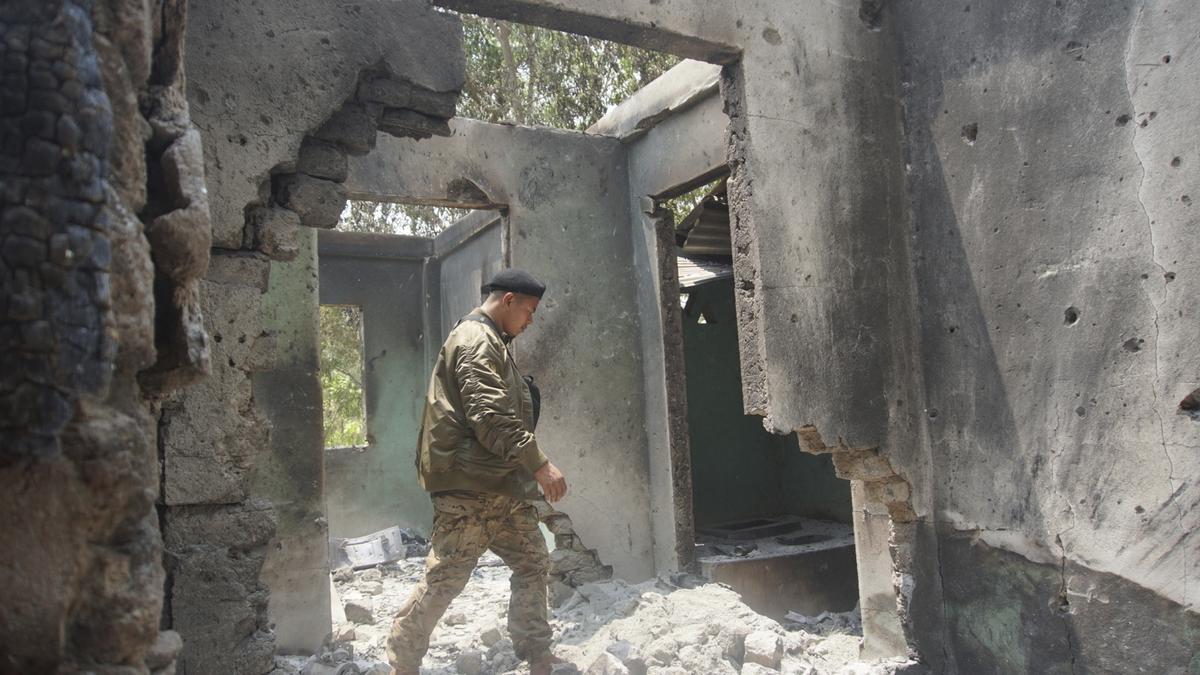
Six months into an offensive against Myanmar’s military government, opposition forces have made massive gains, but civilian casualties are rising sharply as regime troops increasingly turn toward scorched-earth tactics in the Southeast Asian country’s bitter civil war.
There is pressure on all fronts from powerful militias drawn from Myanmar’s ethnic minority groups and newer resistance forces. Troops are retaliating with air, naval and artillery strikes on hospitals and other facilities where the opposition could be sheltered or aided.
“When the mass of people rise up against them, I think it terrifies them,” said Dave Eubank, a former U.S. Special Forces soldier who founded the Free Burma Rangers, a humanitarian aid organization that has provided assistance to both combatants and civilians in Myanmar since the 1990s.
“They know that hospitals, churches, schools and monasteries are important places for human care, and gathering, and symbols — and they hammer them,” said Eubank. “That’s new.”
Military forces now control less than half the country but are holding on tenaciously to much of central Myanmar including the capital, Naypyidaw — recently targeted by drone attacks — and largest city, Yangon, and is far better armed than the resistance forces, with support from Russia and China.
“People have been saying that the regime was on the brink of collapse since two weeks after the coup,” in February 2021, said Morgan Michaels, an analyst with the International Institute of Strategic Studies who runs its Myanmar Conflict Map project.
“On the other hand, obviously the regime is weaker than it’s ever been…. so there’s no doubt that it’s in serious, serious trouble,” he said.
Thet Swe, a spokesman for the military government, denied that troops were targeting buildings and areas where civilians were sheltering, blaming their destruction instead on the opposition forces, without citing evidence.
“The military never harmed hospitals, churches and civilians in our country,” he told The Associated Press in an email. “They did not use that strategy and are fighting the rebels only for the sovereignty of our country.”
As the fighting has moved into more populated areas, about 1 million people have been forced to flee their homes since the start of the offensive in October, contributing to the more than 3 million internally displaced people in the country of some 56 million, according to the U.N.’s humanitarian aid agency.
With the collapse of its health care system and food supplies dwindling, 18.6 million people are in need, up 1 million from a year ago, including 6 million children, the agency said.
Opposition in Myanmar, also known as Burma, had been growing since the army seized power from the elected government of Aung San Suu Kyi in February 2021, but it gained new momentum in October when major militias known collectively as the Three Brotherhood Alliance launched a joint offensive.
Together, the Arakan Army, the Myanmar National Democratic Alliance Army and the Ta’ang National Liberation Army — among the most powerful militias formed by Myanmar’s ethnic minorities — made quick advances.
As they captured huge swaths of territory largely in the north and northeast, including economically important border crossings with China and several major military bases, other ethnic armed groups sensed momentum and joined the fighting.
At the same time, People’s Defense Forces — armed resistance groups that support the shadow National Unity Government, which views itself as Myanmar’s legitimate administration — have been increasing in number and launching their own attacks, often supported and trained by the ethnic armed militias.
Both sides claim they have inflicted heavy tolls. And the military government under Senior Gen. Min Aung Hlaing has acknowledged it is under pressure, recently reintroducing conscription to increase its ranks.
That has pushed some young people into the resistance. Many more have fled to rural areas or neighbouring countries to avoid fighting.
With the violence across its border, China helped broker a cease-fire in Myanmar’s north in January with the Three Brotherhood Alliance. But the alliance’s Arakan Army continues to fight in its home Rakhine state in the west and has made significant gains, while PDFs and other ethnic armed groups continue their own attacks elsewhere.
The fiercest fighting in recent weeks has been in the southeast, where the main ethnic Karen fighting force, the Karen National Liberation Army, claimed in early April to have seized all the military bases in Myawaddy, the main town on the border with Thailand in Kayin state, also known as Karen state.
One army battalion clung to a position beside one of Myawaddy’s two bridges, assisted by the Border Guard Force, a rival Karen group that had been in charge of border area security for years, conducting lucrative business by protecting area casino resorts with links to organised crime.
The force, which declared itself neutral in January, now controls the town with military government administrators still in place, highlighting how some militia groups still prioritize their own interests.
“This is not a black-and-white situation. This is not the regime reconquering and reconsolidating control,” Michaels said of the fighting in the area. “This is the regime hanging on, keeping a foothold by the razor’s edge.”
Meanwhile, the military has pushed KNLA and People’s Defense Forces out of Kawkareik, a strategically important town along the road that connects Myawaddy with the rest of the country.
Thousands of civilians have fled Myawaddy and Kawkareik. But many civilians haven’t managed to escape.
At least 1,015 civilian deaths have been documented from Nov. 1 through May 1, according to the Assistance Association for Political Prisoners, a watchdog group that tracks political arrests, attacks and casualties. It says 4,962 civilians have been killed overall since the military took power three years ago.
The watchdog blamed the deaths on the military’s increasing use of scorched-earth tactics and fighting moving into more populated areas.
“The military has increasingly lost areas of control in recent months, which has only increased their use of this strategy, responding with airstrikes, shelling and so on in civilian areas,” the AAPP said in an email.
The group added that the number of civilian deaths in the recent months of fighting is likely double what it reported, if not more, but that it can’t document the numbers due to the intensification of the conflict.
Kyaw Zaw, a spokesperson for the shadow National Unity Government, said the military had destroyed 343 hospitals and clinics since it took power, and that those attacks had accelerated in the last two months, though he didn’t have specific details.
Eubank, with the Free Burma Rangers, said he and his teams operating near the front lines have witnessed the military, known as the Tatmadaw, fighting with a “ speed and force and a viciousness that we’ve never seen.”
But in fighting a common enemy, the resistance is showing growing unity, he said.
“The Burma army is still stronger than any of these resistance groups, and if they want to bring a division or two to bear, they will win the battle, but they’re not stronger than everybody else together,” he said.
Whether that unity will continue if the regime falls, and if the disparate resistance forces can agree on a common path ahead for Myanmar, is an open question, Michaels said.
“On one hand, Myanmar is not Syria — there is a common cause in fighting the regime,” Michaels said. “But at the same time, as the regime has receded from some areas, there are at least indicators of potential future conflicts between groups.”
He noted an incident in the northern Shan state last month in which troops from two members of the Three Brotherhood Alliance — the Myanmar National Democratic Alliance Army and the Ta’ang National Liberation Army — traded fire over a territorial dispute. One person was injured.
The groups quickly agreed to stand down, but the incident illustrates that territorial tension is real, Michaels said.
An opposition politician still inside the country, speaking on condition of anonymity for his own safety, said Myanmar’s people have a common desire for peace and stability, but the various factions still pursue their own interests.
“It is hard to predict what is ahead, and they still don’t have a single political direction or goal. I think there is quite a problem in this situation,” he said.
“Myanmar is now at a crossroads.”