






A big open problem in cosmology is the Hubble tension. There are two equally valid ways to measure how fast the universe is expanding, but they have yielded two very different estimates. No amount of rechecking and refining calculations has made this tension go away.
In a study published recently in Monthly Notices of The Royal Astronomical Society (MNRAS), scientists from Germany and the U.K. led with a radical explanation for the tension: our model used to understand the universe is wrong.
This model is called Λ cold dark matter, or “lambda CDM”. It’s currently the simplest model that explains various features of the universe, including radiation leftover from the Big Bang, the arrangement of galaxies in the universe, and the fact that the universe is expanding.
But cosmologists are also looking for a new, better model that can explain some things the Λ CDM model can’t, such as the Hubble tension. Repeated measurements and computations have ascertained the Hubble tension exists and that it’s not some aberration in the data.
In a paper published after the MNRAS one in The Astrophysical Journal Letters, a different group disproved a flaw some scientists had suspected in one of the two ways to measure the universe’s expansion – meaning the tension is real.
For now, the model does seem to be the problem.
These results also come against the backdrop of a meeting this week in London, where cosmologists will gather to discuss whether this model has become outdated for other reasons as well.
Is our universe open, closed or flat?
Our universe started to expand after the Big Bang event around 14 billion years ago. It may continue to expand unabated forever. If it does, it will be an open universe. But if at some point the expansion stops, because of the gravitational forces exerted by the galaxies, say, the universe could collapse and become closed.
A closed universe is said to have a positive curvature of space – like a sphere. Such a universe will be finite even if it has no bounds. That is, in this universe, we can travel forever without falling off an ‘edge’.
In an open universe, space will warp in the opposite direction. That is, it will have a negative curvature, resembling a saddle.
There is another possibility between these assumptions: that the universe will continue to expand forever, but the rate of expansion, which is currently increasing, will eventually start decreasing thanks to the gravitational forces. The rate will take an infinite amount of time to drop to zero, so the universe will keep expanding, just slower and slower.
This special approximation leads to a flat universe. And according to many cosmologists, this is the state of our universe at this time.
That the universe is flat doesn’t mean it’s like a 2D sheet of paper. Instead, flatness means if you start to draw two parallel lines in space and you keep drawing them, they will remain parallel no matter how far you go. (In a spherical or a saddle-like space, the lines will intersect somewhere.)

The Big Bang’s afterglow
Cosmologists deduced this based on studying the cosmic microwave background (CMB). This is a sea of photons, the particles of light, present throughout the universe. They are leftover from the Big Bang, its afterglow. Scientists have measured temperature changes in the CMB and studied its large-scale properties using complicated trigonometry. And they found that it has nearly zero curvature.
The Wilkinson Microwave Anisotropy Probe (WMAP), BOOMERanG, and ’Planck’ are three telescopes in space. They study the CMB and their data is clear: the observable universe is flat with a 0.4% margin of error. In 2021, researchers with the Atacama Cosmology Telescope reported based on astronomical data that they could find no evidence that the space of our universe is non-flat.
Based on these studies, cosmologists have estimated space to be expanding at around 68 kilometres per second per megaparsec ((km/s)/Mpc). That is, an object one megaparsec (3.26 million lightyears) away is moving away at 68 km/s.
The cosmic distance ladder
The CMB is one way to study the universe’s expansion. The other is called the cosmic distance ladder – a set of techniques used to measure the distance to objects that are close, further away, and very far away from the earth. One object in particular is the Cepheid variable star.
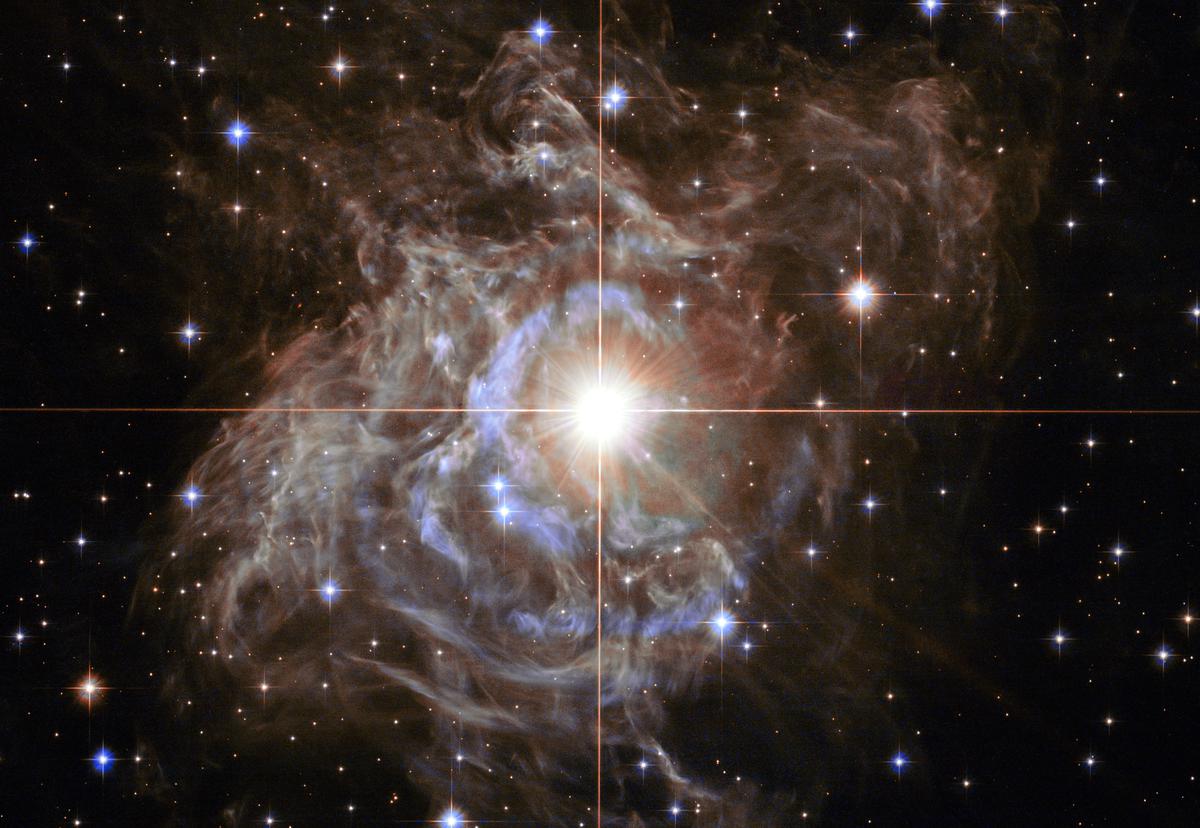
The Cepheid variable star RS Puppis as imaged by the Hubble space telescope in 2010.
| Photo Credit:
NASA
The Cepheid variables have a unique feature: their brightness varies in a predictable way over time. Based on how bright a Cepheid variable is, scientists can estimate how far away it is. Using this, cosmologists have estimated based on various Cepheid variables (and other such objects) is 73 (km/s)/Mpc.

Hubble versus JWST
The best way to follow these stars is using the near-infrared radiation they emit. Unlike visible light, such radiation can pass through intervening dust clouds and reach us. Cepheid variable stars may also be crowded in some places.
Fortunately, NASA’s James Webb Space Telescope (JWST) can track both near-infrared radiation and has instruments good enough to distinguish between radiation from two Cepheid variable stars close to each other in the sky.
In the study published in The Astrophysical Journal Letters, researchers checked a concern that the data collected by NASA’s previously best space telescope, the Hubble, had some flaws in its readings that gave rise to the Hubble tension.
They analysed more than a thousand sharp observations of Cepheid variables recorded by JWST. “The superior resolution of JWST negates crowding noise, the largest source of variance in the near-infrared [brightness] relations measured with the Hubble space telescope,” they wrote.
In the end, they found “no significant difference” in estimates of the stars’ distance based on Hubble telescope and JWST data, even after correcting for “local crowding” and “choice of filters”.
In sum, the Hubble tension is real and its origins remain a mystery.
Qudsia Gani is an assistant professor in the Department of Physics, Government Degree College Pattan, Baramulla.