






Indians are among the unhappiest people in the world. The observation comes from the annual World Happiness Report, a measure of global life satisfaction across parameters of health, economy and freedom. Out of 143 countries, India ranked 126 — a marginal dip from last year’s 125th position — falling behind the war-torn Palestine and Ukraine, and neighbours like Pakistan and Nepal. The quest for happiness is also eluding most countries, the report finds. Welfare is a concern among the young, and the ‘happiness inequality’ gap is growing almost everywhere.
The report was a collaborative effort between Gallup, the U.N. Sustainable Development Solutions Network and Oxford Wellbeing Research Centre. Researchers analysed global datasets assessing six factors: healthy life expectancy, GDP per capita, social support, freedom, generosity and perception of corruption. They also measured people’s life satisfaction, through a self-assessed evaluation tool called the Cantril ladder. “Think of a ladder with steps numbered from 0 at the bottom to 10 at the top. The top represents the best possible life for you, the bottom is the worst possible scenario. Which step do you personally feel you stand at this time?”
The world, on average, is unhappier than before. “For the first time, happiest nations no longer include any of the world’s largest countries,” the authors said. The U.S. didn’t earn a spot in the top 20 countries, a first in 12 years of the report’s publication. Finland, on the other hand, managed to occupy the top spot for the seventh year in a row. The bottom end of the list names Afghanistan, which has seen the sharpest decline in happiness since 2006-10, the report noted. The country is in the midst of humanitarian, climate and economic crises, since the Taliban regained control in 2020.
This was the first edition that looked at the intersectionality of life satisfaction with age and generations: happiness for the world’s young and old diverges into two different arcs. The younger (under 30) are happier in Central and Eastern European countries; the reverse is true for countries like the U.S. and Canada, where life satisfaction was highest among those 60 and above. “…this has not always been the case. Between 2006 and 2010, young people in Northern America and Australia/New Zealand were just as happy as old people. Their life satisfaction has declined sharply since then…” the report notes. Among those born after 1980, happiness reportedly falls with each passing year. The authors noted that “the relationship that we knew existed between age and happiness is far more nuanced than previously thought, and it is changing”.
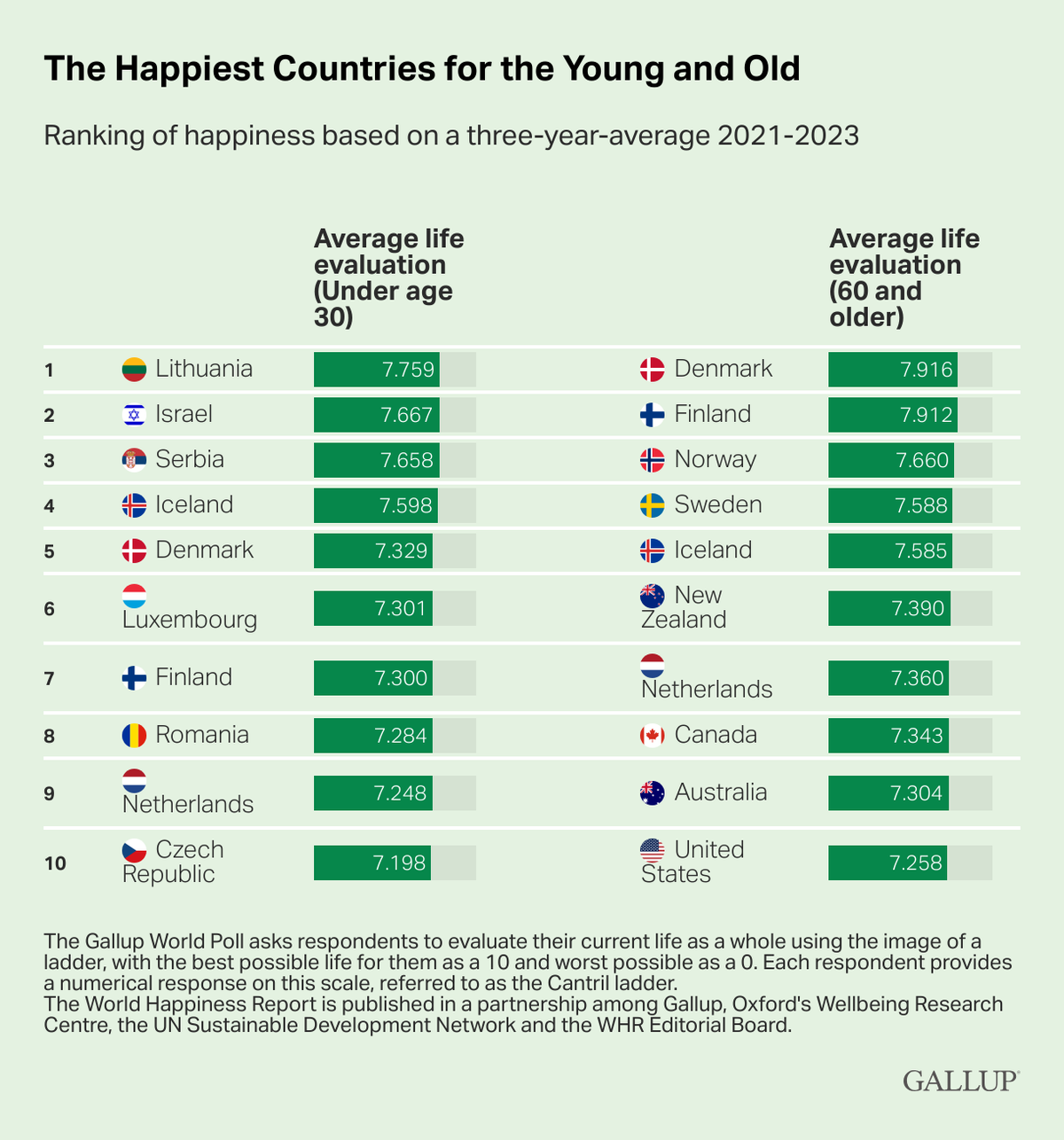
Photo Credit: Gallup
Are Indians happy?
India is an anomaly. Here, life satisfaction was found to be higher among the older people. At 140 million, India’s older population is the second largest in the world and growing steadily, with the average growth rate “three times higher than the overall population growth rate”. The researchers relied on the Longitudinal Aging Study in India (LASI, 2017-19) dataset and analysed the following metrics: satisfaction with living arrangements, perceived discrimination and self-rated health. Education, wealth, access to healthcare, support systems and social acceptance were also analysed. To their surprise, and a departure from scholarly research, older age in India was associated with higher life satisfaction. The opposite was believed to be true to so far. Age and life satisfaction go hand-in-hand only in high-income countries; the experiences of India’s old people were also defined by childhood, financial status, lack of social support, physical frailty, and feelings of loneliness.

A dissection of this trend makes visible caste and gender-based discrepancies. Older Indians who belonged to privileged castes, and “never experience[d] discrimination or ill-treatment” were “more satisfied with their lives”. Experiences of discrimination and ill-treatment, on the other hand, contributed “significantly to the caste-based discrepancies in life satisfaction”, the research showed. Caste backgrounds governed if one was able to access education, social services, health care or financial safety. People with secondary or higher education, and those of higher social castes, evidently reported higher life satisfaction than those without access to formal education and those from Scheduled Castes and Scheduled Tribes. Regionally, older adults from Western parts of India were much happier than those living in north-eastern or central regions.
The verdict on gender was more ambiguous. On average, older women in India reported lower life satisfaction than older men, but the trends reversed when other measures, such as social support were taken into account. “Women, in general, possess wider and more diverse social networks, including a greater number of friends and confidants, which likely translates into not only more social support but diverse forms of it,” the researchers explained. Previous research shows age compounds the gender and economic precarity of India’s older women: they are vulnerable to abuse, alienation and abandonment. They are also more likely to be excluded from the formal labour force, lack financial savings and access to pension schemes, and are more prone to health issues in comparison to older men.

Happiness among the youth squared with global trends. “Young adults are being hit from all sides by a toxic combination of government policy, a housing affordability crisis, stagnating wages, and a high cost of living… No wonder their generation is experiencing unprecedented levels of mental ill-health as their futures look so bleak,” the Intergenerational Foundation charity told The Guardian. A high rate of unemployment continues to mar the experiences of educated youth in India, data shows. Gender dimensions play out here too: women were more likely to experience “negative emotions” than men, more frequently in women in South Asia in comparison to the rest of the world between 2021-2023. This gap widened with age.
Moreover, this age group is more likely to feel lonely and perceive an absence of social support, despite increased social interaction, the survey found. On the contrary, the ‘boomers’ and those in the earlier generations, despite engaging less with their neighbours or community, felt “more socially supported and less lonely”. The perception of greater social support explains “why life satisfaction so often rises after middle age even as the frequency and seriousness of health problems increases.
In 2018, when India was ranked 133rd on the index, President Pranab Mukherjee attributed India’s position to a “narrow-vision focus on economic development”. “[It] may have given us a better GDP and increase in per capita income — but moved our focus from environmental sustainability, social welfare, emotional and mental wellbeing of our people.” The International Monetary Fund, in response to this year’s survey, concurred that while GDP per capita is a “significant predictor of happiness, it’s not the only factor”. “Variables including social support, life expectancy, freedom, generosity, and the absence of corruption” explain why some countries are happier than others.
External Affairs Minister S. Jaishankar dismissed the ranking last year. “You should actually tell everybody to come to Bengaluru – you can see which is the world’s happiest place, particularly on a Friday night,” he said in an interaction with college students in Bengaluru.
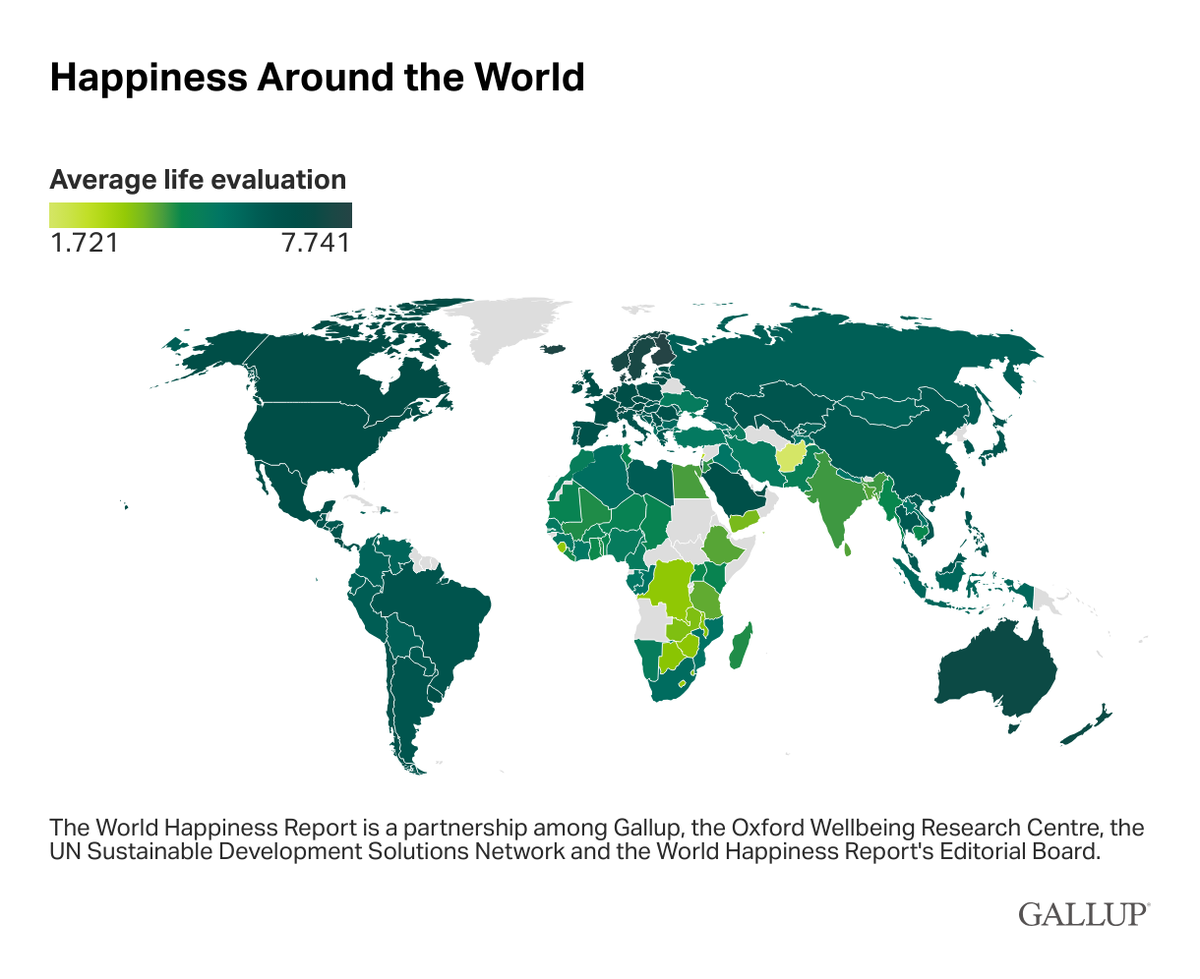
Photo Credit: Gallup
Worsening happiness inequality
There are two caveats to the study findings. It uses “happiness” and “life satisfaction” interchangeably, thus tying happiness scores with one’s access to economic and social resources. Moreover, “life satisfaction in our study is self-reported, thus there always lingers the possibility of misreporting due to the fear of social stigma”, the authors note.
The most severe and sober takeaway: Happiness is not distributed equally. Happiness inequality is widening in every region except Europe, increasing by more than 20% over the past dozen years. The “worrying trend” reflects inequalities in “income, education, health care, social acceptance, trust, and the presence of supportive social environments at the family, community and national levels,” the authors said. The sharpest increase in inequality was registered in sub-Saharan African regions across all age groups. Inequality has also grown in South Asian countries, including India.
“This increase matters because research shows such inequality has a bigger effect on overall happiness than income inequality does. And, people are happier living in countries where happiness equality is greater,” the researchers said.
Does income inequality correlate with happiness inequality? Is wealth a determinant of happiness? These questions are being probed and prodded globally, but unhappiness is not an easy conundrum to crack. “The opposite of happiness here isn’t just sadness, it is loneliness,” Suresh Menon wrote in The Hindu earlier.

There is a sliver of hope. The survey also measured “benevolence” levels globally — how likely people are to help others in need — as feelings of social support factor into life satisfaction. There is a post-COVID increase in how benevolent people are across all generations; the largest bump recorded among those born after 1980, the Millennials and Generation Z “who are even more likely than their predecessors to help others in need”.
The current survey offers a sobering peek into the what, when, why, where and how of happiness. It leaves room for more, the authors say, reinforcing “why it is important to keep asking people how they feel, and to keep digging deeper”.