





Skip to content
  • Facebook
  • X
  • Linkedin
  • WhatsApp
  • Associate Journalism
  • About Us
  • Privacy Policy
  • 033-46046046
  • editor@artifex.news
Artifex.News

Artifex.News

Stay Connected. Stay Informed.

  • Breaking News
  • World
  • Nation
  • Sports
  • Business
  • Science
  • Entertainment
  • Lifestyle
  • Toggle search form
  • “Everything Is Fake”: Rohit Sharma Denies T20 World Cup Meeting Report Claiming Focus On Hardik Pandya Sports
  • Copper becomes unexpectedly hard under extreme strain rate Science
  • Asia Cup 2023: Samarawickrama, Shanaka star in Sri Lanka’s victory against Bangladesh Sports
  • Bankrupt Sri Lanka gets China’s tentative agreement on debt restructure World
  • Gujarat Titans vs Mumbai Indians, IPL 2024: Match Preview, Fantasy Picks, Pitch And Weather Reports Sports
  • Israel Hamas War Qatar Says Mediation Will Lead To Release Of Hamas Hostages “Very Soon” World
  • India vs Pakistan: Full House At Hotels And Kandy Stadium Ahead Of Asia Cup 2023 Clash Sports
  • No proposal to resume sale of subsidised rice for ethanol production: Centre Nation

Stone tools in Ukraine offer oldest evidence of humans in Europe

Posted on March 8, 2024 By admin


This photo provided by researcher Roman Garba shows a heavily weathered flake artifact at the Korolevo I archaeological site in western Ukraine in August 2023. Stone tools found in the area are the earliest evidence of early human presence in Europe, dating back to 1.4 million years ago, according to research published in the journal Nature on Wednesday, March 6, 2024.
| Photo Credit: AP

A dating method based on cosmic rays has identified stone tools found in western Ukraine as the oldest-known evidence of human occupation in Europe – 1.4 million years ago – showing that the peopling of the continent occurred hundreds of thousands of years earlier than previously known.

Researchers said on Wednesday the stone tools – the most primitive kind known – were initially unearthed in the 1970s near the town of Korolevo in the Carpathian foothills along the Tysa river, close to Ukraine’s borders with Hungary and Romania. But their age had remained unclear.

The new method determined the age of the sediment layer containing the stone tools, making this site critical for understanding how humans first spread into Europe during warm spells – called interglacial periods – that interrupted the Ice Age’s grip on the continent.

The researchers concluded that the maker of the tools likely was Homo erectus, an early human species that arose roughly 2 million years ago and spread across Africa, Asia and Europe before disappearing perhaps 110,000 years ago.
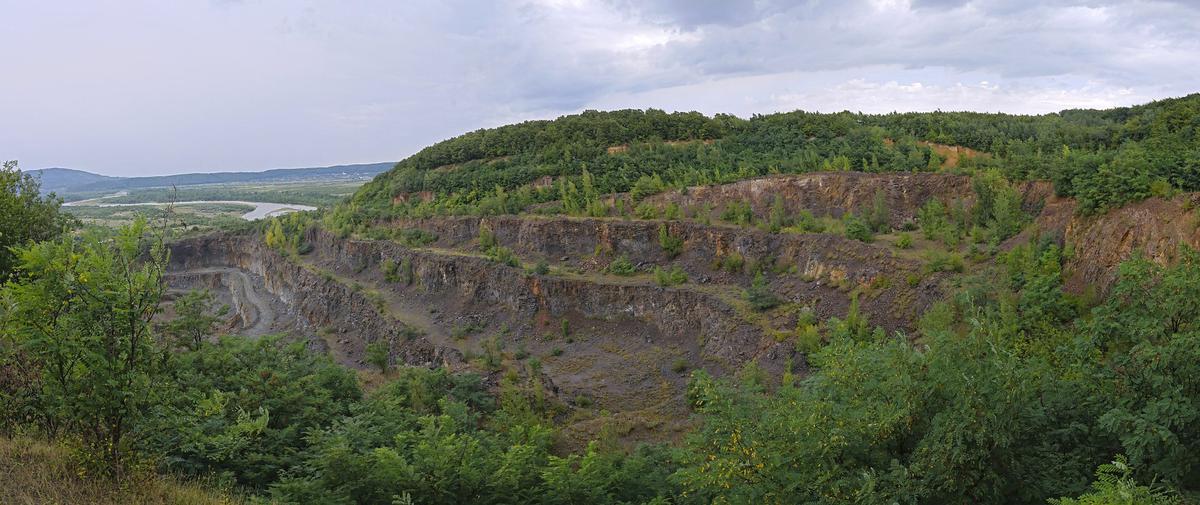
This photo provided by researcher Roman Garba shows the Gostry Verkh area of the Korolevo I archaeological site in western Ukraine in August 2023, with the Tisza River at background left. Stone tools found in the area are the earliest evidence of early human presence in Europe, dating back to 1.4 million years ago, according to research published in the journal Nature on Wednesday, March 6, 2024.

This photo provided by researcher Roman Garba shows the Gostry Verkh area of the Korolevo I archaeological site in western Ukraine in August 2023, with the Tisza River at background left. Stone tools found in the area are the earliest evidence of early human presence in Europe, dating back to 1.4 million years ago, according to research published in the journal Nature on Wednesday, March 6, 2024.
| Photo Credit:
AP

“No bones were found at Korolevo, only stone tools. But the age suggests that Homo erectus was the only possible human species at the time. We know very little about our earliest ancestors. They used stone tools for butchery and probably used fire,” said Czech Academy of Sciences archeologist Roman Garba, lead author of the research published in the journal Nature.

Homo erectus was the first member of our evolutionary lineage with body proportions similar to our species, Homo sapiens, though with a smaller brain.

The tools, made of volcanic rock, were fashioned in what is called the Oldowan style. While quite simple – flaked tools such as choppers, scrapers or basic cutting instruments – they represent the dawn of human technology.

Until now, the oldest-known evidence of humans in Europe was about 1.2-1.1 million years old from a site called Atapuerca in Spain.

The Korolevo findings provide insight into the route of the first human expansion into Europe. Homo erectus fossils from 1.8 million years ago are known from a Caucasus site in Georgia called Dmanisi. Coupled with Korolevo, this suggests Homo erectus entered Europe from the east or southeast, migrating along the Danube river, Garba said.
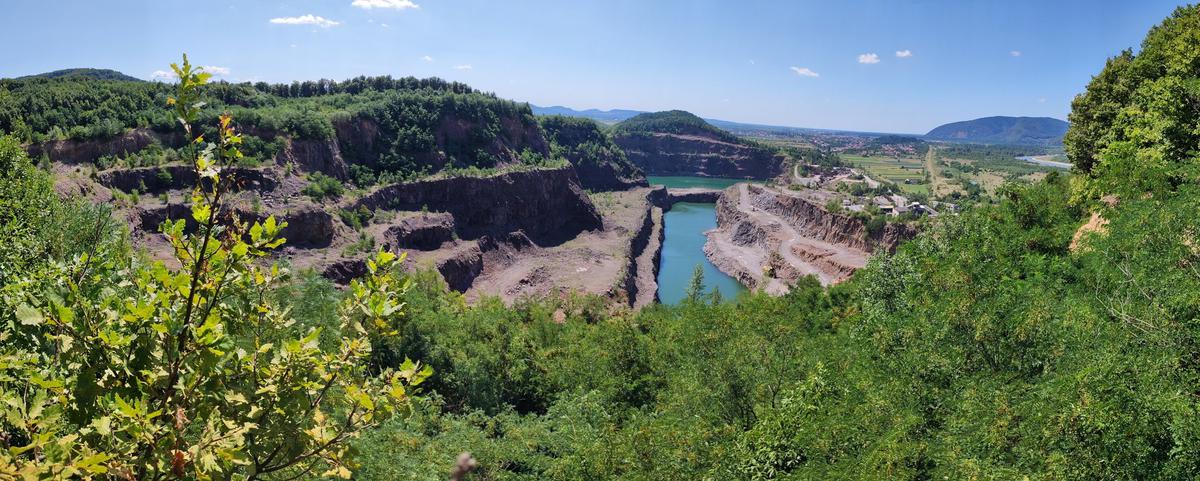
A panoramic view of the Korolevo quarry in western Ukraine, surrounded by archaeological sites is pictured in Korolevo, Ukraine, August 12, 2021. Korolevo stone artefacts dating to about 1.4 million years ago are considered the earliest-known evidence of human presence in Europe.

A panoramic view of the Korolevo quarry in western Ukraine, surrounded by archaeological sites is pictured in Korolevo, Ukraine, August 12, 2021. Korolevo stone artefacts dating to about 1.4 million years ago are considered the earliest-known evidence of human presence in Europe.
| Photo Credit:
Reuters

“Korolevo is the northernmost outpost found so far of what we presume to be Homo erectus and is testimony to the intrepidness of this ancestor,” Czech Academy of Sciences geoscientist and study co-author John Jansen added.

It has been notoriously difficult to determine the age of Paleolithic sites like Korolevo. The study dated the tools, left by their makers on a river bed, by determining when the layer bearing the artifacts was buried under overlaying sediment.

“Earth is constantly bombarded by galactic cosmic rays. When these rays – mainly protons and alpha particles – penetrate Earth’s atmosphere, they generate a secondary shower of particles – neutrons and muons – that, in turn, penetrates into the subsurface,” geoscientist and study co-author Mads Knudsen of Aarhus University in Denmark said.

These particles react with minerals in rocks to produce radioactive nuclides, a class of atoms. The sediment was dated based on the ratio of two nuclides, thanks to their differing pace of radioactive decay.

Europe was later colonized by other now-extinct human species including Homo heidelbergensis and Neanderthals. Homo sapiens evolved in Africa roughly 300,000 years ago, arriving in significant numbers in Europe perhaps around 40,000-45,000 years ago.

The Homo erectus pioneers encountered a Europe inhabited by large mammals including mammoths, rhinos, hippos, hyenas and saber-toothed cats.

“Most likely they were scavengers, looking for carcasses left by hyenas or other predators, but what attracted them to Korolevo was a source of high-quality volcanic rock, very good for making stone tools,” Garba said.

The researchers suspect evidence of European human occupation even older than Korolevo will turn up.

“The question is not ‘if’ but ‘when’ we will find a site of similar or older age somewhere else in Ukraine, Romania, Bulgaria or Serbia,” Garba said.




Source link

Science Tags:archaeology news, Oldest evidence in Europe, oldest evidence of humans in Europe, science news, ukraine archaeology

Post navigation

Previous Post: IND vs ENG fifth Test | Rohit and Gill’s tons, Padikkal and Sarfaraz’s fifties have England reeling
Next Post: Rohit Sharma’s Hilarious Reaction Goes Viral After Umpiring Blunder In Dharamsala Test – Watch

Related Posts

  • As El Niño starts flip to La Niña, Latin America asked to be on alert Science
  • TIDCO bets big on space sector, signs MoU with IN-SPACe Science
  • The Science Quiz: Know your gut beyond digestion Science
  • No Indian industry in Board of revamped National Research Foundation Science
  • Paper-based platform for rapid detection of antibiotic-resistant bacteria Science
  • Libya dam collapse: engineering expert raises questions about management Science

More Related Articles

NASA names chief of UFO research; panel sees no alien evidence Science
Can heavy snowfall and rain contribute to some earthquakes? Science
A star party in the mountains Science
Sci-Five | The Hindu Science Quiz: On Frogs Science
India’s space economy has potential to reach $44 billion by 2033 with about 8% global share Science
DNA remnants found in fossil of 6 million year old turtle Science
SiteLock

Archives

  • July 2024
  • June 2024
  • May 2024
  • April 2024
  • March 2024
  • February 2024
  • January 2024
  • December 2023
  • November 2023
  • October 2023
  • September 2023
  • August 2023
  • July 2023
  • June 2023
  • May 2023
  • April 2023
  • March 2023
  • February 2023
  • January 2023
  • December 2022
  • November 2022
  • October 2022
  • September 2022
  • August 2022
  • July 2022
  • June 2022
  • May 2022

Categories

  • Business
  • Nation
  • Science
  • Sports
  • World

Recent Posts

  • Maruti Suzuki shares drive markets higher
  • PM Narendra Modi Hails Russia As India’s ‘All-Weather Friend’, Lauds Vladimir Putin’s Leadership
  • After Leaving India Job, Rahul Dravid Linked To Replace Gautam Gambhir At KKR: Report
  • Rescuers search for dozens buried in an Indonesian landslide that killed at least 17 people
  • Chinese scientists identify super moss able to ‘survive’ in Mars

Recent Comments

  1. ywdVpqHiNZCtUDcl on UP Teacher Who Asked Students To Slap Muslim Classmate
  2. bRstIalYyjkCUJqm on UP Teacher Who Asked Students To Slap Muslim Classmate
  3. GkJwRWEAbS on UP Teacher Who Asked Students To Slap Muslim Classmate
  4. xreDavBVnbGqQA on UP Teacher Who Asked Students To Slap Muslim Classmate
  5. aANVRzfUdmyb on UP Teacher Who Asked Students To Slap Muslim Classmate
  • Pakistan’s T20 World Cup Squad Announced; Mohammad Amir, Imad Wasim Included Sports
  • RBI issues fresh guidelines asking banks, NBFCs not to levy penal interest on borrowers in case of default  Business
  • India Rejects Canada PM Justin Trudeau’s Charge Nation
  • Ahead of election, President Vladimir Putin’s programmes occupy most of TV shows in Russia World
  • US military airlifts embassy personnel from Haiti, bolsters security World
  • Brick Thrown At Japan’s Embassy In China Over Fukushima Water Release World
  • Will One Nation, One Election Law Tweaks Need States Approval, See Details Nation
  • SC dismisses plea challenging new criminal laws Nation

Editor-in-Chief:
Mohammad Ariff,
MSW, MAJMC, BSW, DTL, CTS, CNM, CCR, CAL, RSL, ASOC.
editor@artifex.news

Associate Editors:
1. Zenellis R. Tuba,
zenelis@artifex.news
2. Haris Daniyel
daniyel@artifex.news

Photograher:
Rohan Das
rohan@artifex.news

Artifex.News offers Online Paid Internships to college students from India and Abroad. Interns will get a PRESS CARD and other online offers.
Send your CV (Subjectline: Paid Internship) to internship@artifex.news

Links:
Associate Journalism
About Us
Privacy Policy

News Links:
Breaking News
World
Nation
Sports
Business
Entertainment
Lifestyle

Registered Office:
72/A, Elliot Road, Kolkata - 700016
Tel: 033-22277777, 033-22172217
Email: office@artifex.news

Editorial Office / News Desk:
No. 13, Mezzanine Floor, Esplanade Metro Rail Station,
12 J. L. Nehru Road, Kolkata - 700069.
(Entry from Gate No. 5)
Tel: 033-46011099, 033-46046046
Email: editor@artifex.news

Copyright © 2023 Artifex.News Newsportal designed by Artifex Infotech.