
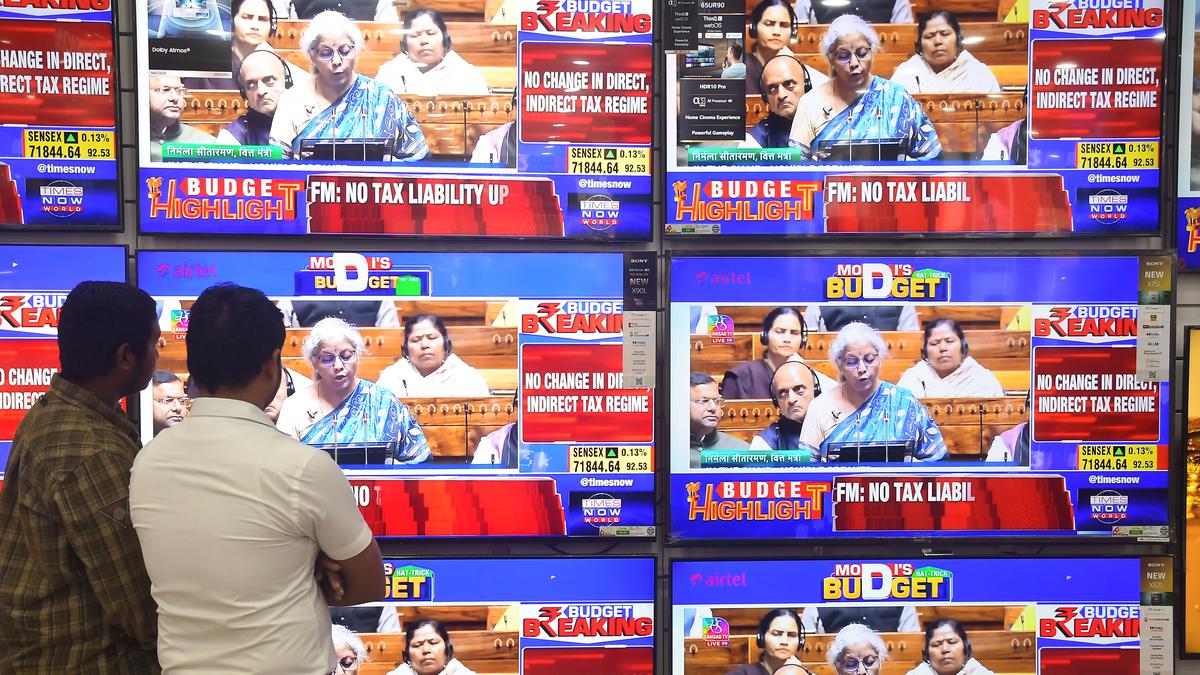
Well before Finance Minister Nirmala Sitharaman rose to present the Interim Budget for 2024-25, there were indications as to what its focus would be. Doubts that this would be anything more than a vote-on-account had been settled when Prime Minister Narendra Modi publicly declared that “when polls are this close, the government presents an interim budget” — and went on to say with confidence of a victory in the polls, “we will bring a full budget when a new government is formed”.
Meanwhile, an ‘interim Economic Survey’, innocuously titled “The Indian Economy: A Review”, has presented a survey of post-Independence economic development, with a periodisation that divides those years into the pre- and post-Modi government eras. In language reflective of an electioneering pamphlet, peppered with the Prime Minister’s own assessments of his government’s record, the document concludes that the decade 2014-24 was one of “transformative growth”. Periods of significant or even high episodes of growth prior to that transformative decade are identified as wanting, on the grounds that such growth either left structural challenges unaddressed or was the result of an unsustainable credit boom that damaged the banking sector.
A eulogy
Given this background, it was to be expected that the Budget speech would be a vocal expression of this eulogy of the two governments of the last 10 years. For years, Part A of the Budget speech has been a tiresome recounting of policies already adopted, and to be adopted, many of which have little to do with the issues of resource mobilisation and allocation and the strategy they signal, which must be the actual concern. That has been true of this year’s Interim Budget as well, which focused on all the “welfare” schemes, in areas varying from housing to food, which have been largely attributed to the Prime Minister. It is another matter that the Prime Minister has in the past dismissed such schemes as representative of a “revdi” (sweet gifts) culture when implemented by non-Bharatiya Janata Party (BJP) State governments.
Interim Budget 2024 | Highlights
With the Interim Budget being identified as a mere vote-on-account, Part B of the speech was a declaration that while pursuing consolidation in the sense of achieving periodically revised fiscal deficit to GDP ratios, the government will be stepping up spending on infrastructure and welfare. In the circumstances, what can be assessed from the detailed Budget documents is the fiscal performance of the Centre in the current (rather than next) financial year, 2023-24. Even that exercise is fraught with difficulty because the practice of presenting Budgets on February 1 adopted in recent years has meant that “revised estimates” for the financial year incorporate projections relating to most of the last quarter of the financial year extending to March 31.
CGA data sheds more light
The only substantial figures at hand are the estimates of actual expenditure under different broad heads for the first three quarters of 2023-24 provided by the Controller General of Accounts (CGA), which can be compared with the estimates for the whole year provided in the Budget. This is, in certain areas, quite revealing. For example, if we take the estimates for the Department of Rural Development, under which the all-important Mahatma Gandhi National Rural Employment Guarantee Act (MGNREGA) scheme falls, as compared to budgeted expenditures of ₹1,57,545 crore for 2023-24, the revised estimates are placed at a much higher ₹1,71,069 crore. That points to a significant step up relative to that budgeted, despite claims that the NREGA scheme is being inadequately funded, wages are in arrears and job card holders are being excluded from work because wage payments are to be linked to Aadhaar.
Editorial | Poll posture: On the 2024 Interim Budget
But a comparison of revised and budgeted expenditures conceals what is actually occurring. The actual expenditure on the MGNREGA scheme was ₹1,11,170 crore in the COVID-19 year 2020-21 and ₹98,468 crore in 2021-22. That came down to ₹90,806 crore in 2022-23 and the revised estimate projects spending on the programme in 2023-24 at an even lower ₹86,000 crore. The figures clearly do not match the government’s pro-poor rhetoric. Interestingly, the CGA reports that expenditure of the Department of Rural Development till December 2023 amounted to only ₹1,07,912 crore or 63% of the total projected in the revised estimates. So, more than a third of the estimated expenditure for the financial year is projected to occur in the last quarter of the year.
That deviation between revised expenditures over the financial year and the actual till December 2023 is even larger in the case of the Department of Agriculture and Farmers Welfare, under which the much-touted Pradhan Mantri Kisan Samman Nidhi (PM-KISAN) scheme of transfers falls. The budgeted expenditure for 2023-24 for that department was placed at ₹1,15,532 crore and the revised estimate is projected at ₹1,16,789 crore. The actual till December is placed at ₹70,797 crore by the CGA, or 61% of the revised estimate. Spending on the PM-KISAN scheme alone, which amounted to ₹66,825 crore in 2021-22, fell to ₹58,254 crore in 2022-23 and is projected at ₹60,000 crore in 2023-24.
There are two ways in which such deviations between actual spending till December and the revised estimates in the Budget can be interpreted. One could be that the Finance Minister has chosen to inflate revised estimates of spending to back her claim that the government has provided massive support to farmers and rural workers. The other could be that, despite tardy spending till December, the government plans to launch a pre-election spending blitz in areas where it believes it can swing votes in favour of the BJP. Being election season, the latter is a possibility. But trends of the kind noted with regard to spending on the MGNREGA scheme suggest that the government believes that rhetoric can be a substitute for actual allocations. Thus, despite claims that free rations for 80 crore people are a huge expansion of food support under the National Food Security Act, the total food subsidy has fallen from ₹5,41,330 crore in 2020-21 to ₹2,88,060 crore in 2021-22 and a projected ₹2,87,194 crore (RE) in 2023-24.
Estimates and projections
At the macroeconomic level, the Budget’s claim is that in 2023-24, the central government has managed to ensure that its receipts other than borrowing are almost equal to that budgeted. This is because it has met budgetary expectations with respect to tax revenues as well as expects to raise its non-tax revenue receipts by 25% relative to budget. The explanation for that hefty increase is that income from dividends and profits is slated to rise from ₹99,913 crore in 2022-23 to ₹1,54,407 crore in 2023-24 (RE). This is because, as compared with a budgeted ₹48,000 crore to be received as dividend/surplus from the Reserve Bank of India and nationalised financial institutions, the revised estimates suggest that the actual inflow will be more than twice that figure at ₹1,04,407 crore, largely because of transfers from the central bank. This has more than made up for a projected fall in miscellaneous capital receipts, consisting of receipts from disinvestment from a budgeted ₹61,000 crore to ₹30,000 crore. It is not clear whether even the figure of ₹30,000 crore can be realised, since the CGA estimates that ‘other non-debt capital receipts’, consisting of disinvestment proceeds, just crossed ₹10,000 crore by December.
Estimates and projections of this kind allow the Finance Minister to claim that even while ensuring total expenditure in line with the budgeted, she has managed to keep the fiscal deficit, at 5.8% of GDP, marginally below the budgeted level, hoping to please financial markets with her government’s prudence. Whether it would please voters to give the National Democratic Alliance a “resounding victory”, as she hopes, is yet to be seen.
C.P. Chandrasekhar is an economist and columnist based in New Delhi