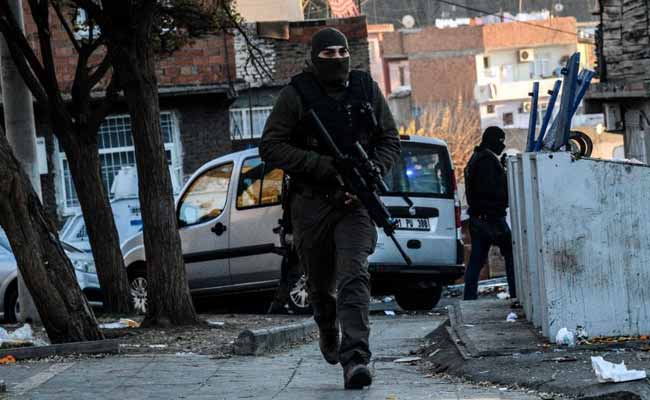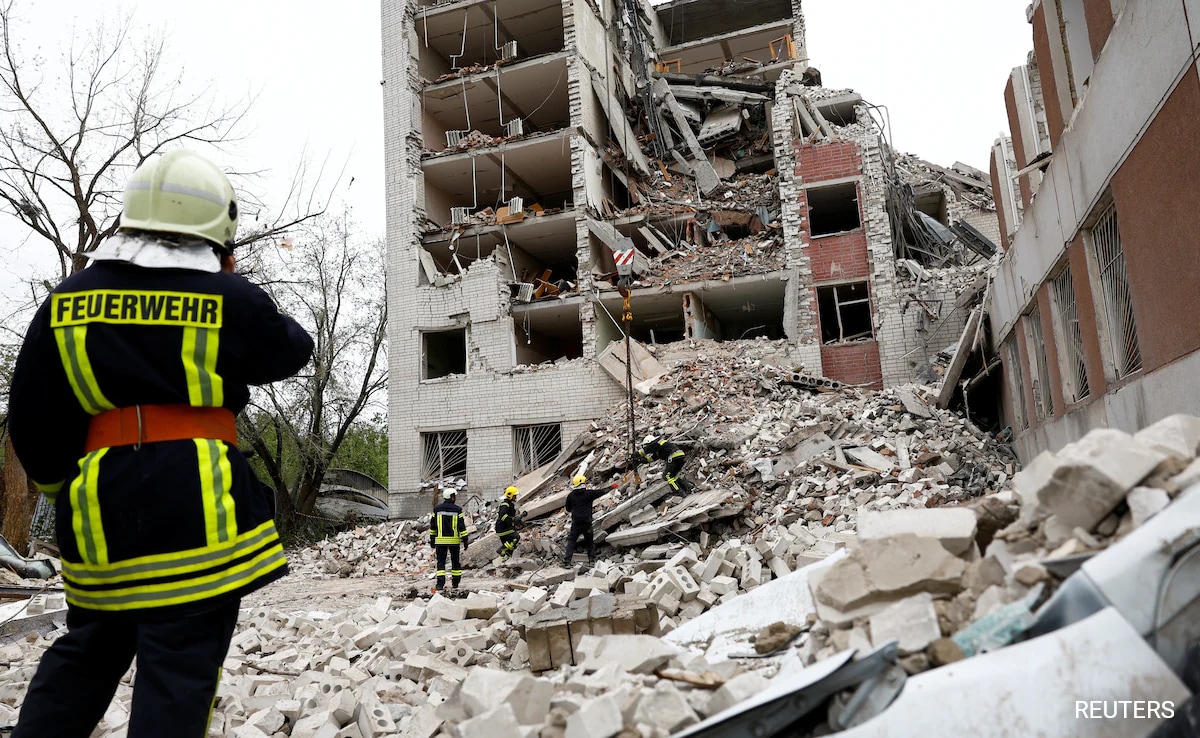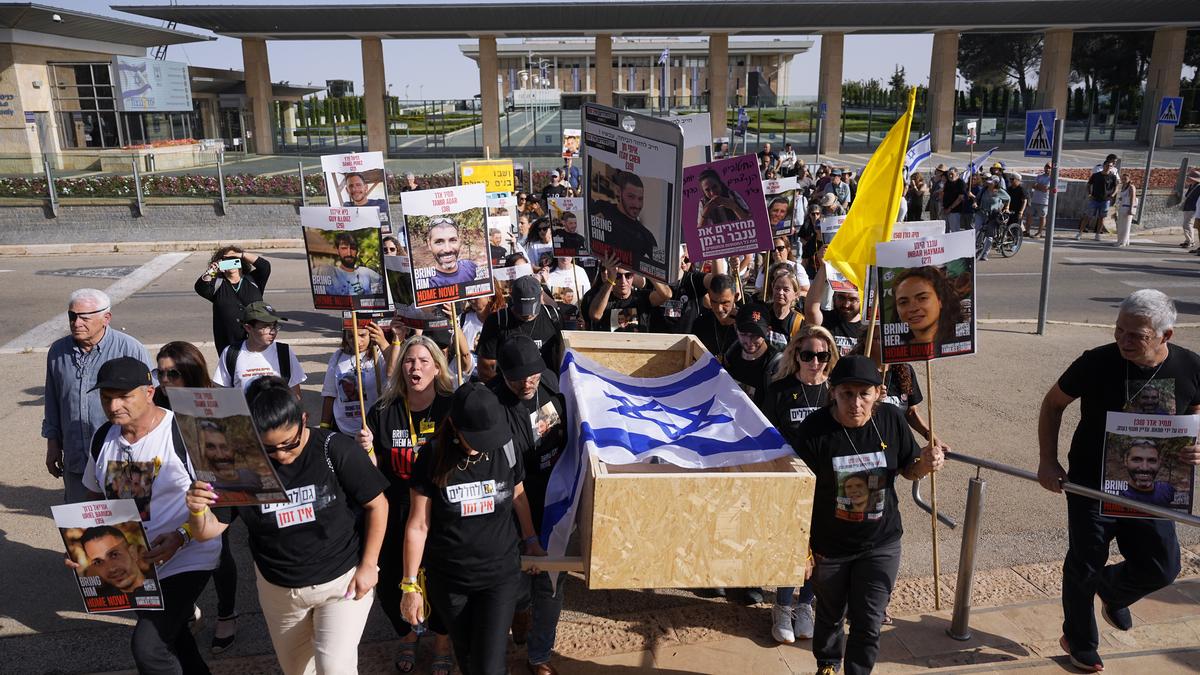




An Israeli soldier at Kibbutz Beeri in southern Israel on October 14, 2023 walks next to bullet holes, in the aftermath of a mass infiltration by Hamas gunmen from the Gaza Strip.
| Photo Credit: Reuters
The story so far: On October 7, a Jewish Sabbath day, Hamas launched a surprise attack into southern Israel, raiding its military bases and residential areas, killing at least 1,300 people and injuring thousands more. The Hamas attack has triggered a massive military response from Israel, which has been pounding Gaza ever since, using missiles, jets and dangerous munitions, including, what Human Rights Watch says, white phosphorus. Some 1,900 Gazans have been killed in strikes, and Israel has also asked some 1.1 million people living in northern Gaza to move towards the south within 24 hours, while it is preparing for a ground attack.
Why did Hamas launch the attack?
One explanation is that Hamas wanted to break the status quo. Over the years, the Israelis had built a security model that allowed them to keep the Palestinians under check while the occupation continued. Israel has a network of extensive checkpoints and barriers in the West Bank. Israel also saw that the Palestine issue was no longer a hindrance to improving ties with other Arab countries. When the UAE signed a normalisation agreement in 2020, Israel gave no concessions to the Palestinians. Similarly, Saudi Arabia and Israel were in advanced stage of talks until last week. So, from an Israeli point of view, the status quo allowed them to treat the Palestinian problem as a security nuisance that can be managed without major consequences. Hamas, on October 7, shattered this model — it not just drilled holes into Israel’s perceived sense of security but also brought Palestine back to the fore of West Asia’s geopolitical cauldron.
What was the status quo before Hamas’s attack?
The contested Palestinian territories include three parts of historical Palestine — the West Bank, East Jerusalem (both were captured by Israel from Jordan in 1967) and Gaza strip (captured in the same year from Egypt). There’s no geographical contiguity between the West Bank (which is on the western bank of the Jordan River) and the Gaza strip, a tiny enclave sandwiched between Israel and the Mediterranean Sea. Since then, the West Bank has been under Israel’s military occupation. In 1980, Israel passed the Jerusalem law, declaring unified Jerusalem as its capital, effectively annexing the eastern half of the city, including the Old City, which hosts the Al-Aqsa Mosque, the Wailing Wall and the Church of the Holy Sepulchre. Since the 1970s, Israel has also encouraged Jewish settlements in the West Bank and East Jerusalem, which together now have close to 7,00,000 Jewish settlers. Gaza was under Israeli occupation and had Jewish settlers until 2005 when Israel, faced with Hamas’s violent resistance, announced a unilateral disengagement from the enclave.
Watch | What does the Hamas attack mean for Israel, Palestine and West Asia?
Currently, East Jerusalem is under Israel’s total control, though a vast majority of Arabs of the city are not Israeli citizens; the West Bank is under Israel’s direct occupation (the Palestinian Authority, a provisional self-governing body established as part of the 1993 Oslo Agreement, has very limited powers in limited areas of the West Bank) and Gaza is under Israel’s blockade. The Islamist Hamas has been running Gaza since 2007, while the secular Fatah, the backbone of the Palestinian Liberation Organisation (PLO), has been running the Palestinian Authority since its formation — except for a brief interregnum in 2006 when Hamas swept the parliamentary elections. There is no peace process, no united or organised Palestinian movement and no international push for the two-state solution.
What would be the impact of the attack?
By carrying out the largest attack by a non-state actor in Israel’s history, Hamas has taken a huge risk. It was certain that Israel’s response would be much more forceful this time than its past attacks on Gaza. Hamas’s attack, from a strategic and humanitarian sense, has put the life of millions of Palestinians in further danger. Hamas has also put itself on the line. The Islamist group, which had carried out suicide attacks in the 1990s and early 2000s, had shown signs of moderation in recent years — it came up with a new charter in 2017 that had expunged the anti-Semitic language of its original charter and promised a lasting ceasefire (hudna) with Israel if it withdraws to the 1967 border. But the October 7 attack, in which Israeli civilians were indiscriminately targeted, suggests that Hamas hasn’t evolved much when it comes to using terror as a means. Hamas is now likely to face a long phase of military attacks from Israel.
Is there a risk of wider regional war?
Since 1973, no Arab country has gone to war with Israel. On the contrary, six Arab countries reached normalisation agreements with Israel ever since, even when the occupation continued and deepened. But Israel faces at least three non-state rivals (Hezbollah, Hamas and the Islamic Jihad) and one conventional rival (Iran). Hamas and the Islamic Jihad, both based in Gaza, were part of the Sabbath attack. Hezbollah, the Shia militia-cum-political party of Lebanon, had fired rockets into Lebanon’s contested Shebaa Farms, which are occupied by Israel, showing solidarity with the Palestinians, and Israel has retaliated with strikes on southern Lebanon. Hezbollah says it’s ready to fight Israel when the time comes, but doesn’t show any immediate inclination to join Hamas’s war. Iran, which has close ties with Hamas and the Islamic Jihad, has issued a statement saying it supports Palestinian resistance, but is unlikely to join a direct war with Israel, unless it comes under direct attack. So, as of now, the chances for a regional spillover are slim.
What does this attack mean for Netanyahu?
If Hamas took a huge risk and put the Gazans and itself in further jeopardy by carrying out the Sabbath attack, Israel’s Prime Minister Benjamin Netanyahu also doesn’t have easy options. He has promised to crush Hamas. But Hamas, unlike the transnational, pan-Islamist jihadist outfits such as al-Qaeda and the Islamic State, has deep roots in the Palestinian nationalist cause and is popular among the Palestinians.
Israel’s own past military operations against non-state actors show a complicated history — Israel had won the battles many times, but failed to make long-term strategic gains or peace. It fought Hezbollah for 18 years in southern Lebanon but the Shia militant group today is as powerful as ever. If Israel’s deterrence against Hamas had worked, the Sabbath attack wouldn’t have occurred in the first place. So here, the question before Israel is whether it wants to carry out a short-term operation in Gaza and retreat or reoccupy the enclave of 2.3 million people and bring them under Israel’s direct control. The first option would allow Hamas to regroup in the long term, and the second option could trigger a long urban war of attrition in one of the world’s most densely populated areas. Mr. Netanyahu himself will have to answer questions once the initial shock and hubris settle. The Likud leader’s long-term promise was that only he could ensure Israel’s security. Yet, Israel’s biggest security crisis unfolded on his watch.