







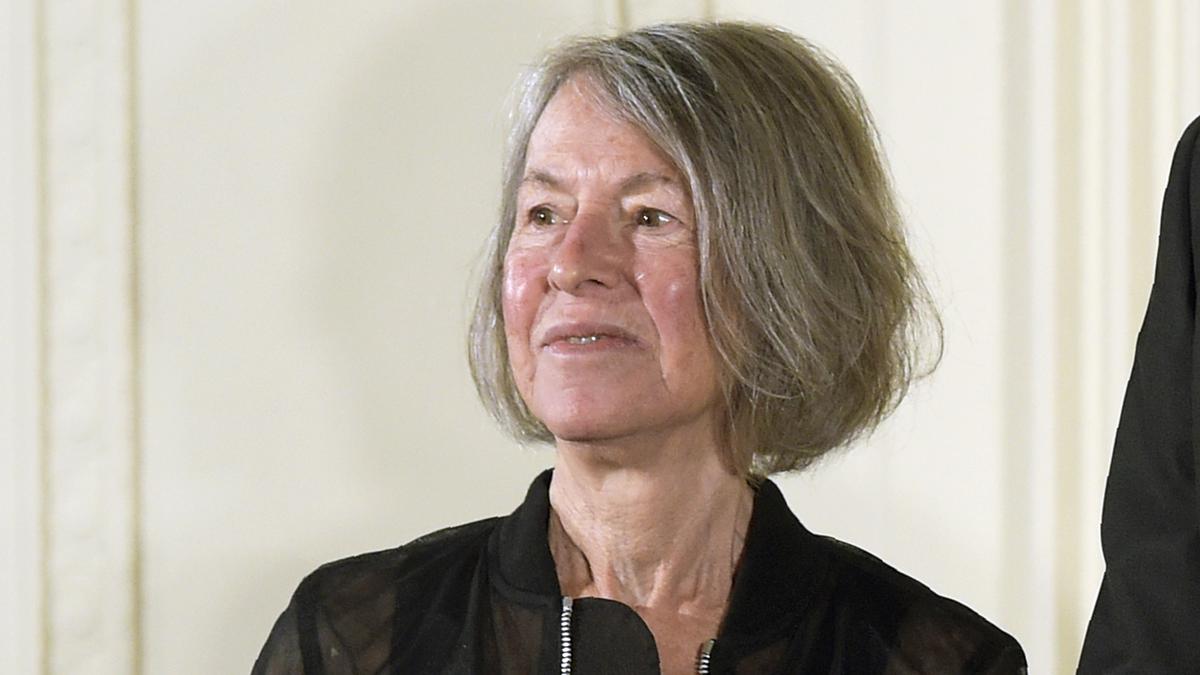
Nobel laureate Louise Glück, a poet of unblinking candour and perception who wove classical allusions, philosophical reveries, bittersweet memories and humorous asides into indelible portraits of a fallen and heartrending world, has died at 80.
Glück’s death was confirmed Friday by Jonathan Galassi, her editor at Farrar, Straus & Giroux. She died of cancer at her home in Cambridge, Massachusetts, according to her publisher. A former student of Glück’s, the Pulitzer Prize-winning poet Jorie Graham, said that the author had only recently been diagnosed.
“I find it very much like her that she only learned she had cancer a few days before dying from it,” Graham said. “Her whole sensibility — both on and off the page — was cut that close to the spine of time.”
In a career spanning more than 60 years, Glück forged a narrative of trauma, disillusion, stasis and longing, spelled by moments — but only moments — of ecstasy and contentment. In awarding her the literature prize in 2020, the first time an American poet had been honored since T.S. Eliot in 1948, Nobel judges praised “her unmistakable poetic voice that with austere beauty makes individual existence universal.”
Glück’s poems were often brief, a page or less in length, exemplars of her attachment to “the unsaid, to suggestion, to eloquent, deliberate silence.” Influenced by Shakespeare, Greek mythology and Eliot among others, she questioned and at times dismissed outright the bonds of love and sex, what she called the “premise of union” in her most famous poem, “Mock Orange.” In some ways, life for Glück was like a troubled romance — fated for unhappiness, but meaningful because pain was our natural condition — and preferable to what she assumed would follow.
“The advantage of poetry over life is that poetry, if it is sharp enough, may last,” she once wrote.
In her poem Summer, the narrator addresses her husband and remembers “the days of our first happiness,” when everything seemed to have “ripened.”
Then the circles closed. Slowly the nights grew cool;
the pendant leaves of the willow
yellowed and fell. And in each of us began
a deep isolation, though we never spoke of this,
of the absence of regret.
We were artists again, my husband.
We could resume the journey.
Poet Tracy K. Smith, a Pulitzer winner, said in a statement Friday that Glück’s poetry had “saved” her many times.
“I think constantly of these lines from ‘The Wild Iris’: ‘At the end of my suffering / there was a door.’ And of these lines from ‘The House on Marshland’: ‘The darkness lifts, imagine, in your lifetime.’ It is as if her spare, patient syntax forms a path into and through the weight of living,” she wrote.
Glück published more than a dozen books of poetry, along with essays and a brief prose fable, “Marigold and Rose.” She drew upon everything from Penelope’s weaving in “The Odyssey” to an unlikely muse, the Meadowlands sports complex, which inspired her to ask: “How could the Giants name/that place the Meadowlands? It has/about as much in common with a pasture/as would the inside of an oven.”
In 1993, she won the Pulitzer Prize for “The Wild Iris,” an exchange in part between a beleaguered gardener and a callous deity. “What is my heart to you/that you must break it over and over,” the gardener wonders. The god answers: “My poor inspired creation … You are/too little like me in the end/to please me.”
Her other books included the collections “The Seven Ages,“ ”The Triumph of Achilles,” “Vita Nova” and a highly acclaimed anthology, “Poems 1962-2012.” Besides winning the Pulitzer, she received the Bollingen Prize in 2001 for lifetime achievement and the National Book Award in 2014 for “Faithful and Virtuous Night.” She was the U.S. poet laureate in 2003-2004 and was awarded a National Humanities Medal in 2015 for her “decades of powerful lyric poetry that defies all attempts to label it definitively.”
Glück was married and divorced twice and had a son, Noah, with her second husband, John Darnow. She taught at several schools, including Stanford University and Yale University, and regarded her experiences in the classroom not as a distraction from her poetry, but as a “prescription for lassitude.” Students would remember her as demanding and inspiring, not above making someone cry, but also valued for guiding young people in search of their own voices.
“You would hand in something and Louise would find the one line that worked,” the poet Claudia Rankine, who studied under Glück at Williams College, told The Associated Press in 2020. “There was no place for the niceties of mediocrity, no false praise. When Louise speaks you believe her because she doesn’t hide inside of civility.”
A native of New York City who grew up on Long Island, New York, she was a descendant of Eastern European Jews and heir to an everyday creation not associated with poetry: Her father helped invent the X-Acto knife. Her mother, Glück would write, was the family’s “maid-of-all-work moral leader,” the one whose assessment of her stories and poems she looked to above all others. Glück was also the middle of three sisters, one of whom died before was she born, a tragedy she seemed to refer to in her poem “Parados.”
Long ago, I was wounded.
I learned
to exist, in reaction,
out of touch
with the world: I’ll tell you
what I meant to be –
a device that listened.
Not inert: still.
A piece of wood. A stone.
Describing herself as born to “bear witness,” Glück felt at home with the written word and regarded the English language as her gift, even her “inheritance.” But as a teenager, she was so intensely ambitious and self-critical that she waged war with her own body. She suffered from anorexia, dropped to 75 pounds (34 kilograms) and was terrorized by her mortality. Her life, creative and otherwise, was saved after she chose to see a psychoanalyst.
“Analysis taught me to think. Taught me to use my tendency to object to articulated ideas about my own ideas, taught me to use doubt, to examine my own own speech for its evasions and excisions,” she recalled during a 1989 lecture at the Guggenheim Museum. “The longer I withheld conclusion, the more I saw. I was learning, I believe, how to write, as well.”
Glück was too frail to become a full-time college student and instead sat in on classes at Sarah Lawrence College and Columbia University, finding mentors in the poets-teachers Leonie Adams and Stanley Kunitz. By her mid-20s, she was publishing poems in The New Yorker, The Atlantic Monthly and other magazines.
Glück’s debut book, “Firstborn,” was published in 1968, and preceded a long stretch of writer’s block that ended while she was teaching at Goddard College in the early 1970s. She had once believed that poets should avoid academia, but found the engagement with Goddard students so enriching she began writing poetry again, work she regarded as well beyond the “rigid performances” of “Firstborn.” Out of her silence she discovered a new and more dynamic voice.
Her second book, “The House on Marshland,” came out in 1975 and is considered her critical breakthrough. But she continued to suffer years of what she called “brutal punitive blankness,” when she tried everything from gardening to listening to Sam Cooke records to break out. Subsequent books such as “The Wild Iris” and “Ararat” became testaments to personal and creative reinvention, as if her older books had been written by someone else.
“I’ve always had this sort of magical-thinking way of detesting my previous books as a way of pushing myself forward,” she told the Washington Square Review in 2015. “And I realized that I had this feeling of sneaking-up pride in accomplishment. Sometimes I would just stack my books together and think, ‘Wow, you haven’t wasted all your time.’ But then I was very afraid because it was a completely new sensation, that pride, and I thought, ‘Oh, this means really bad things.’”