





Some of the most amazing phenomena in nature, from electromagnetic radiation and infrared vision to subatomic particles and cosmic rays, are invisible, and we get to know them only through their various applications. This is true of Lagrange points as well – points in space between celestial bodies where a spacecraft stays more or less stationary, as if held in place by some cosmic magic.
The ‘magic’, of course, owes itself to the unseen forces of gravity exerted by these bodies. Lagrange points are found along the plane of two objects in orbit around their common centre of gravity, where their gravitational forces cancel each other, so that a third body of negligible mass will remain at rest between them.
For example, the combined gravitational force between the sun and the earth equals the centrifugal force required by a satellite or an asteroid to orbit the sun-earth centre of gravity. At this Lagrange point, a satellite will keep its position constant relative to both the sun and the earth.
Maths instead of law
Planetary scientists are fascinated by Lagrange points because they offer the best ‘parking spots’ in space for satellites. That is, seen from the earth, Lagrange points appear to stay motionless, and this makes them ideal for controllers on the ground to communicate with spacecraft stationed there. No wonder these locations are home to several astronomical observatories that utilise their vantage position to have ringside views of the earth and the backyard of the Solar System, which would not be possible nearer to the planet.
Lagrange points exist throughout the Solar System due to this gravitational interaction between the sun and its retinue of planets and their moons.
The points were named after the Italian-French mathematician Joseph-Louis Lagrange, who was born January 25, 1736, in Turin, Italy. His parents wanted him to study law and enrolled him at the University of Turin. But as it happened, a 17-year-old Lagrange chanced upon an algebra paper by the English astronomer Edmond Halley and was so intrigued that he decided to become a mathematician instead.
He went on to excel in all fields of analytic number theory and celestial mechanics, and became one of the youngest and brightest mathematics professors of his time. He subsequently moved to Berlin, where his work on astronomy, mechanics and calculus resulted in several groundbreaking papers, including one on the moon’s orbital dynamics and another on perturbations of the orbits of comets.
The three-body problem
But Lagrange’s most important contributions were related to the so-called ‘three body problem’, which investigated the motion of three bodies (with mass) relative to each other in space – such as the sun, the earth, and the moon. The problem question itself is: if you know the starting positions of the sun, the earth, and the moon, can you predict their exact locations at a later date as they move under the influence of each other’s gravity?
Lagrange found that the problem could be solved if he assumed the third body was much smaller than the other two larger masses. This eventually led him to describe the famous five Lagrange points that we know today as L1, L2, L3, L4, and L5.
In any three-body system, three of these Lagrange points – L1, L2, and L3 – are unstable positions that lie along an imaginary straight line connecting the two larger bodies. The other two – L4 and L5 – are stable locations that form the apexes of two imaginary equilateral triangles with the two large celestial bodies at the vertices of each triangle.
The L1 Lagrange point is located 1.5 million km from the earth towards the sun. L2 is located 1.5 million km from the earth in the opposite direction.
| Photo Credit:
NASA/ESA, public domain
Points of accumulation
Objects stay undisturbed at L4 or L5 because of a ‘restoring force’ – a force acting against any displacement – that prevents them from being nudged away from the stable point. Because of their stability, however, L4 and L5 also tend to accumulate a lot of interstellar dust and asteroids called Trojans that zip around the points. Scientists have detected nearly 10,000 Trojans in the L4 and L5 points of the sun-Jupiter system alone, where gravitational and centrifugal forces prompt the space rocks to follow the giant planet’s revolution around the sun.
Astronomers have also found four Trojans at Lagrange points around Mars and eight Trojans in the L4 and the L5 points around Neptune. One of Saturn’s larger moons, Tethys, even has two moonlets at its Lagrange points.
On the other hand, an object positioned at one of the three unstable Lagrange points L1, L2, and L3 – can be easily de-orbited by even weak forces, and they will then drift off into space. That is to say: a spacecraft at, say, L3 needs only the slightest disruption to slip and fall from its orbit towards the sun or the earth, unless it frequently burns fuel via its thrusters, at the various moments of displacement, to adjust its orbital movement frequently.
Importance for space exploration
Without Lagrange points, space exploration would have been so restricted, with scientists struggling to find the best orbits and velocities for satellites, and reckoning with the challenges of orbital perturbations. To think that space efforts like the Aditya-L1 solar mission of the Indian Space Research Organisation (ISRO) would never have materialised had an Italian boy pursued a career in law, instead of being distracted by mathematics, in the 18th century!
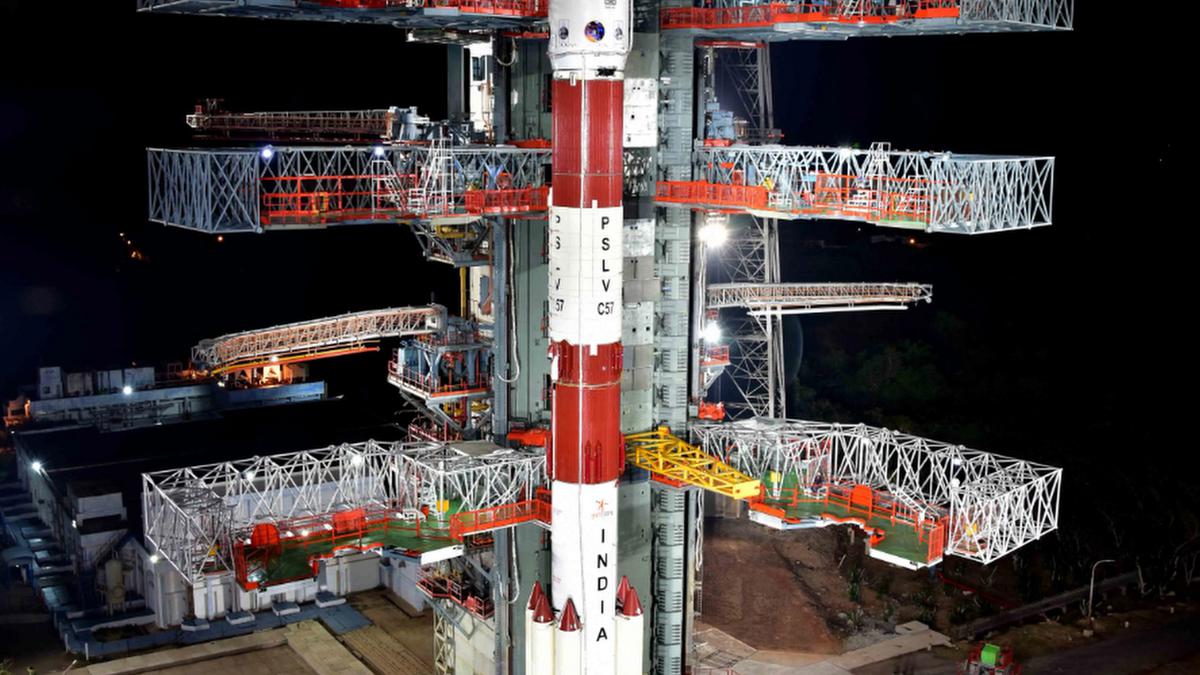
Aditya-L1 is a space-based observatory that ISRO launched on September 2. It is now en route to its designated parking slot at L1 in the sun-earth system. Once it reaches L1 – at a distance of 1.5 million km away from the earth – the probe will settle into a ‘halo’ orbit around L1 to acquire an unobstructed view of the Sun.
L1 is already home to four other robotic explorers: NASA’s Solar and Heliospheric Observatory Satellite, Deep Space Climate Observatory, Advanced Composition Explorer, and the Global Geospace Science Wind satellite. The point will get even more crowded when three U.S. probes – Interstellar Mapping and Acceleration Probe, Near Earth Object Surveyor, Space Weather Follow On-Lagrange 1 – and the European Vigil mission begin their Lagrangian journeys in the next few years.
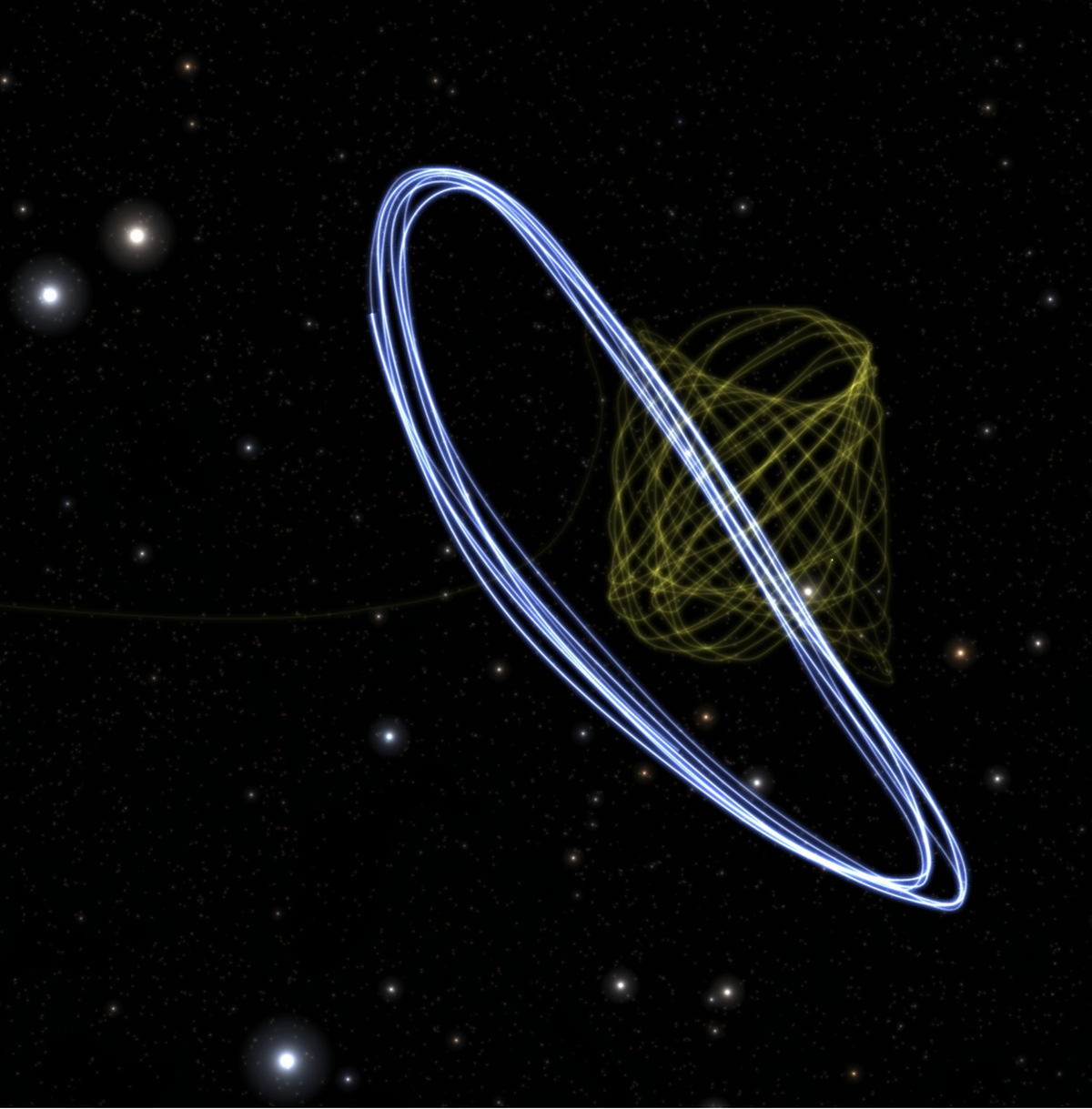
The orbits of the James Webb Space Telescope (halo orbit, blue) and the Gaia space telescope (Lissajous orbit, yellow) around the L2 Lagrange point.
| Photo Credit:
European Space Agency (CC BY-SA 3.0)
Sites of space colonies
Space scientists are also exploring the potential of the L4 and the L5 points to host space colonies in the future because these points are relatively close to the earth. At these locations, where gravitational forces cancel each other out, spacecraft will need very little fuel to remain in orbit or to launch to another planet, unlike launches from the earth that take up most of the fuel rockets carry. This, in theory, allows space engineers to build habitable space stations at L4 and L5 using resources mined from the moon or an asteroid.
A big space station built this way could be spun on its axis using rocket thrusters so that the artificial gravity thus created would help a large number of people to live and work on board the orbiting post permanently.
Prakash Chandra is a freelance science writer.