

The story so far: Last month, amid strong backlash from the public and neighbouring countries, Japan began the release of contaminated water from the Fukushima nuclear plant into the sea.
What happened?
On April 13, 2021, Japan’s government announced plans to release over one million tonnes of contaminated water from the Fukushima nuclear plant into the sea over the next 30 years. The wastewater is a byproduct of the catastrophic 2011 earthquake and tsunami, which disabled the Fukushima Daiichi nuclear power plant, leading to the release of radioactive materials. After more than a decade of storing this wastewater, Japan says they are running out of storage space, and allege that the, now treated water is safe for release.
However, since the announcement in 2021, a sizeable fraction of the public, both domestic and foreign, have been speaking out against this decision, claiming that mixing radioactive materials in the sea poses major health risks, especially since these countries rely heavily on seafood.
How is the water being treated?
The water is being treated by the Tokyo Electric Power Company (TEPCO), Japan’s largest electric utility firm. Since 2011, TEPCO has been in charge of decommissioning the Fukushima Daiichi power plant, and managing the waste. The water has been treated with multiple techniques, notably the Advanced Liquid Processing System (ALPS), which removes 62 types of radioactive materials.
However, it doesn’t remove tritium. TEPCO and the Japanese government argue that the concentration of tritium does not exceed international standards, in particular, those of the International Atomic Energy Agency (IAEA), the United Nations’ nuclear watchdog. According to TEPCO’s website, the radiation emitted by tritium is “extremely weak, and can be blocked with a single sheet of paper.” The concentration is also six times less than the limit for tritium in drinking water, set by the World Health Organization.
“You can’t remove tritium because it is identical to hydrogen. So removing it, chemically extracting it from wastewater becomes quite impossible,” explains Dr. Arun Vishwanathan, Associate Professor at the School of National Security Studies at Central University of Gujarat, Gandhinagar. “What they [have done], and what other nuclear plants … also do is mix it with water so that the tritium quantity reduces further, before it is actually released into the sea.”
How has the public responded?
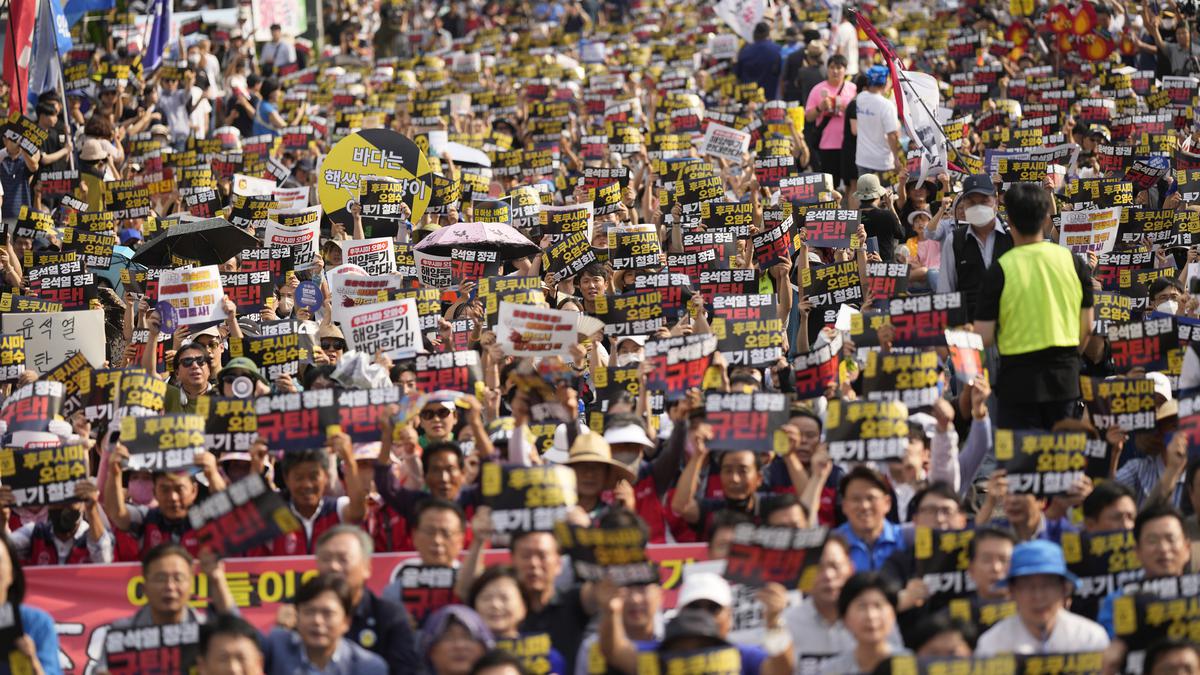
Fears persist within the majority. A poll conducted by Japan’s Jiji Press in September shows that 16.3% of respondents are opposed to the discharge of the treated water, and 30.8% were neither opposed nor in favour. Several protests have been held in Seoul against the release, and many hoarded seafood ahead of the discharge. Some surveys show that 80-85% of South Koreans oppose the water’s release. The Chinese government, which has been against Japan’s decision since the announcement was made, has already banned seafood from Japan.
“Countries have to balance what is the scientific truth, or what can be established, and the general perception of the public,” says Mr. Vishwanathan, adding that these fears always come up after such large-scale disasters.
Is the water safe?
M. V. Ramana, Professor and Simons Chair in Disarmament, Global and Human Security School of Public Policy and Global Affairs at the University of British Columbia, says that, although, scientifically, the levels of radiation in the wastewater are not so high as to cause panic, there is evidence showing that exposure to radiation, even at low levels, can harm the health of humans and the environment.
“[Tritium] is easily absorbed by the bodies of living creatures when it is in the form of tritiated water, and rapidly distributed throughout bodies via blood. Since tritiated water can pass through the placenta, it could lead to developmental effects in babies when ingested by pregnant women.” Chemically, he said there is no difference between tritiated water and water with tritiate. He also pointed out that the IAEA’s most important objective is to ‘seek to accelerate and enlarge the contribution of atomic energy.’ He said that “one should not be surprised that they underplay the risks involved”.
“Japan is trying to use the IAEA decision as a tool to release the water,” says Jagannath Panda, Head of the Stockholm Center for South Asian and Indo-Pacific Affairs (SCSA-IPA) and Editor of the Institute Security and Development Policy, which he says have somewhat brought public, political and social stakeholders to a consensus in Japan.
Mr. Vishwanathan further explains that there is no other option, besides releasing the water, partially because of space around the plant, but also because of potential leakages. “They don’t want to take this all over the country and store this — it increases the cost and the risk [of leaks] exponentially.” Besides, governments knew that the handling of this wastewater would have to be dealt with, since the earthquake hit.
How is this affecting regional politics?
Japanese Prime Minister Fumio Kishida and South Korean President Yoon Suk Yeol publicly ate seafood after the discharge began in order to strengthen public trust in the water treatment process. A key factor for Japan in maintaining relations with South Korea in particular, has been transparency over the treatment and release process. South Korea’s government, following repeated consolation by the IAEA, has told people that the water and the seafood is safe. They have also assured the public that they will continuously monitor the seawater and seafood, and that the 2011 ban on seafood from the water near Fukushima, would remain intact.
For Mr. Kishida and Mr. Yoon, the water may pose more geopolitical problems than health issues. Japan colonised the Korean peninsula in the early 20th century, and the tensions of that time continue to strain relations even now. But both leaders have been working toward forming friendlier relations, especially given the potential threats that their more aggressive neighbours, China and North Korea, present. Mr. Panda said that, although the South Korean government had opposed the water’s release, the IAEA’s approval was able to provide adequate reassurance.
Maintaining transparency on the risks and the measures being taken has helped Japan’s domestic and geopolitical standing. Mr. Vishwanathan explained that since 2021, Japanese authorities have met with their regional counterparts, like South Korea and China, and even Russia, to discuss the treatment and release plan. Although China and Russia were not on board at the time of the release, he said most other countries were comforted by such transparent communication.
What is the significance of China’s hardline response?
Mr. Vishwanathan said that China’s response must be seen through a wider geopolitical lens. Japan-Sino relations have fluctuated repeatedly in the recent past, especially as China grows its military presence in the South China Sea. This has evoked more nationalist sentiments from both sides, making this wastewater issue notable, but not necessarily new.
China is also watching South Korea and Japan’s strengthening relationship. “China, of course, is not comfortable about the growing bonhomie between South Korea and Japan. The Chinese government aims to make it an issue just to create further strategic fissures between South Korea and Japan,” explains Mr. Panda. “Though it appears at present to be a big issue, I don’t think that the Chinese government will succeed in politicising the issues to create a further divide between South Korea and Japan.”
What next?
Japan will release the treated wastewater over the next 30 years, and will continue to monitor the seawater’s radiation. The government is also setting aside 80 billion yen to compensate fishers who will lose business because of public fears. The government is looking to revive the country’s nuclear power plant industry, with the hopes to stabilise the energy sector. Before the 2011 earthquake, 30% of Japan’s electricity needs were met via nuclear reactors. In March, less than 10% of Japan’s power came from these facilities. “It appears to want to create the impression that the Fukushima accident is long over, whereas the reality is that it will be decades and decades before… the radioactive materials [are] at least segregated,” states Mr. Ramana.