





India’s decisions on economic development, growth, and related planetary boundary challenges have become all the more significant as it was declared the most populous country in the world, overtaking China just a few months ago. Additionally, India’s capital city Delhi is en route to becoming the world’s most populous urban agglomeration overtaking Tokyo by 2028. The nation’s 1.4 billion citizens, who are increasingly concentrated in cities, and have a young median age of 28.2 (nearly 10 years younger than China’s median age of 39), need appropriate economic development planning that is both equitable and sustainable.
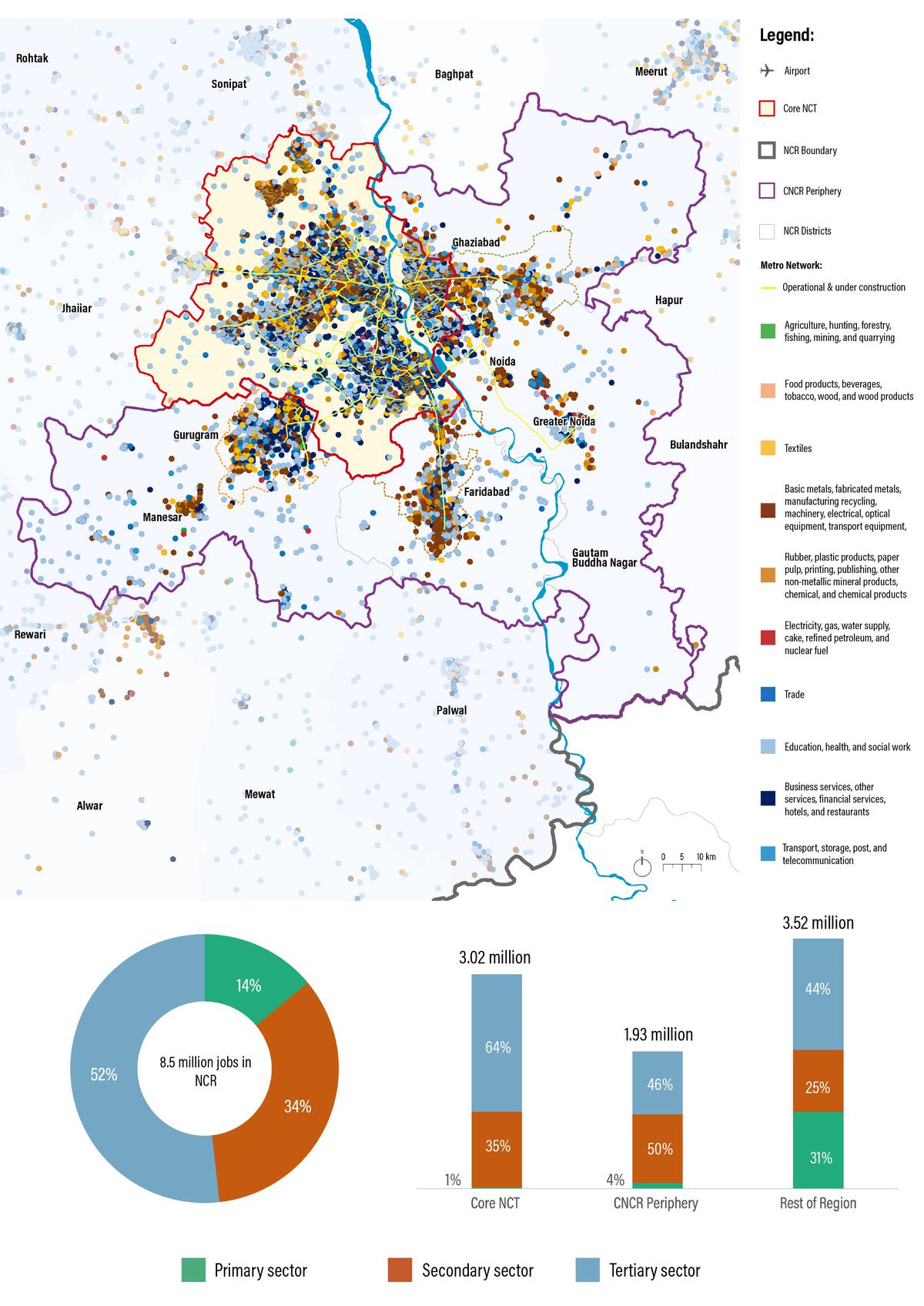
The layout of Delhi-NCR
The engines of India’s growth are the economies of its mega city-regions. While national and State-level policies are vital to the country’s economic development, they are not enough to meet the needs of such city-regions. A case in point is the Delhi National Capital Region (Delhi-NCR), whose extended urban agglomeration straddles several State and city jurisdictions, including Faridabad, Ghaziabad, Gurugram, and Noida. The expansion of the agglomeration has been greatly aided due to it being the national capital as well as various infrastructure investments such as the metro rail networks extending from the core to the periphery, and the proactive investments made by the contiguous States. However, the peripheral contiguous cities are categorised separately in the economic and population Censuses. Being rapidly urbanising suburbs, they lag behind the core of the Delhi National Capital Territory (Delhi-NCT) in terms of infrastructure.
Map: Establishments and employment in agricultural and non-agricultural activities in Delhi NCR in 2013–14
Only when we consider the data of this region spatio-economically can we recognise the whole agglomeration’s might, its labour pool, and its uneven development.
Economic geography of Delhi-NCR
Delhi-NCR has the highest concentration of jobs and people in the country, and generated a GDP of $370 billion in 2015. Its challenges include increasing land and infrastructure costs, growing income inequality, poor air quality, land and water pollution, the lack of natural resources, and institutional coordination barriers. In our recently released report, the ‘Morphology of Delhi National Capital Region’s Economic Geography and its Implications for Planning’, a study of sector-wise evolution of jobs in Delhi-NCR from liberalisation in 1991 up to 2013–14 shows that the core-periphery spatial system is in transition. The core has decentralised, as is evident from rapid horizontal built up area expansion, infrastructure development, and the peripheralisation of jobs and migrants. However, this has not been accompanied by a shift to a high-wage, knowledge-based economy in the core area. Informal work persists, unemployment rates have increased, and women’s participation in the workforce remains low. The region’s per capita income has tripled, and consumption levels have risen, and the peripheries attract investment from their respective State governments. Gurugram and Gautam Buddha Nagar for example are the districts with the highest per capita income in Haryana and U.P. respectively.
The density of jobs moving outward from the centre of Delhi NCT
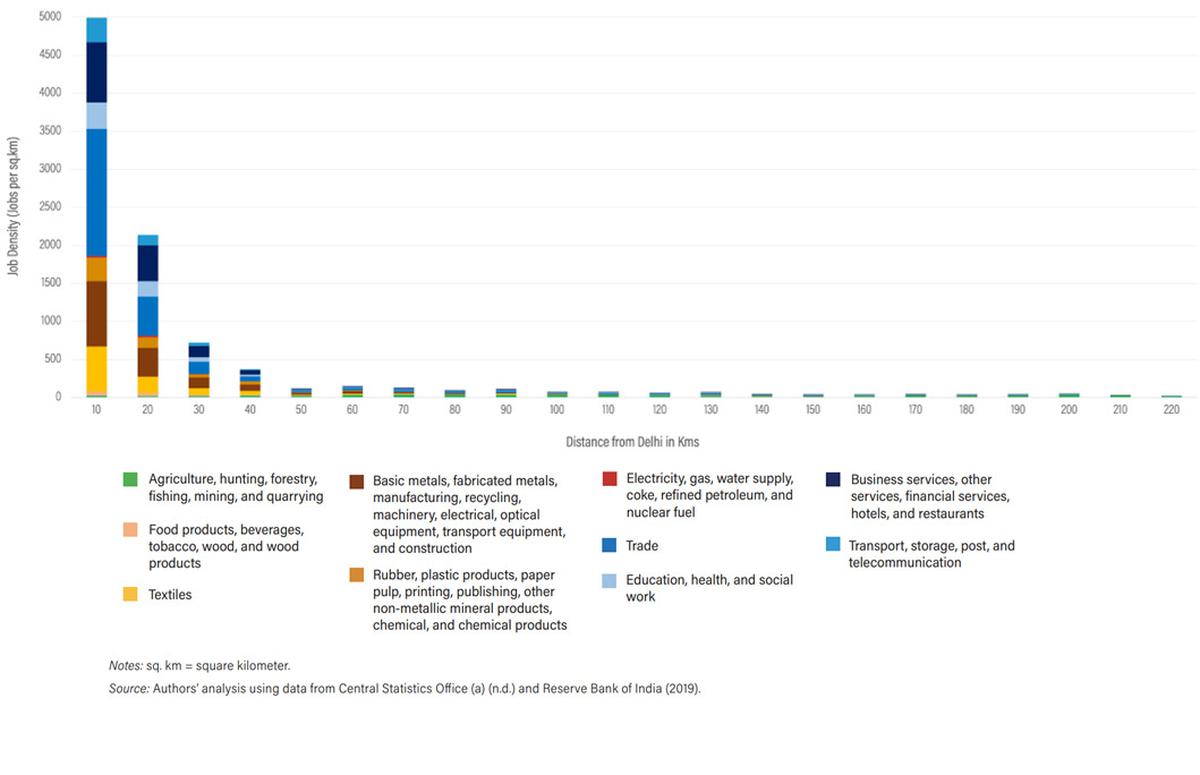
Delhi NCR presents a case of complementarity between its subregions, because the jobs that moved out from the ‘core’ were captured by the periphery and the ‘rest of the region’ without getting expelled from the overall region. The sectors that grew in terms of industrial output generated more employment than those that grew in technical and energy efficiency. Traditional sectors such as trade, textiles and leather still dominate, but despite increasing their employment share, their share to the region’s GDP has declined. On the whole, employment-intensive growth in the secondary, tertiary sectors has been low. A spatial mapping of jobs in terms of distance shows that economic activity peaked within a 10 km radius of Delhi-NCT, and tapered off completely by 40 km.
The CAGR of employment across Delhi NCR’s three subregions from 1990 to 2013-14
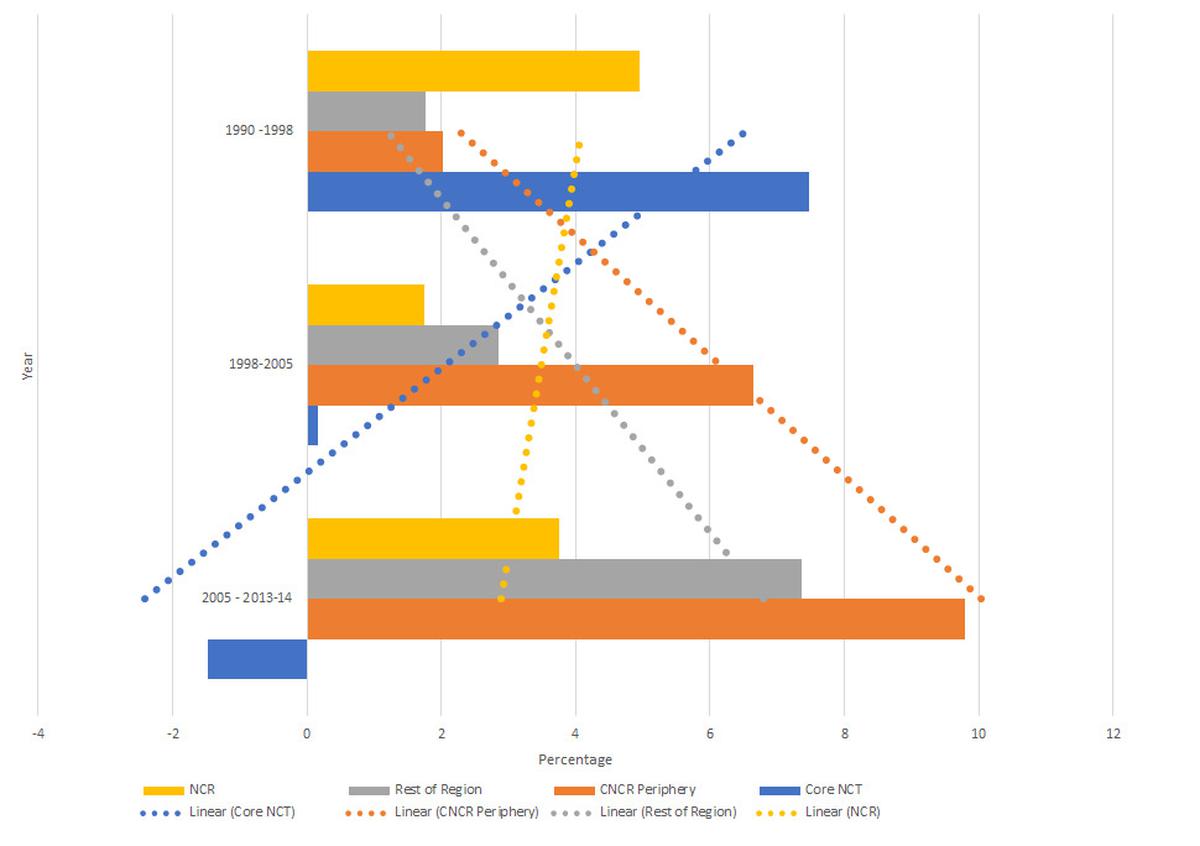
Decentralisation policies, which were emphasised as far back as Delhi’s first master plan in 1962, coupled with land-use and building control restrictions, pollution control norms, and inefficient land acquisition and disposal policies, have contributed to the fragmented development driven by speculation beyond the boundaries of Delhi.
Lessons for the Global South
An economic geography approach can effectively guide the framing of more effective policies, as it provides an interdisciplinary understanding of where and why economic activity occurs, its associated impact on people and that no two places are alike.
In the case of Delhi-NCR, for example, a region-specific economic development corporation could be created to leverage existing interstate frameworks and create place-specific development strategies in a continuously updated process. This corporation could also foster healthy competition between participating cities and States to attract investment. At the same time, a multi-stakeholder platform can be built to bring together the government, private sector, industrial bodies, academia, and civil society representatives, to address development needs. An economic development corporation can also be set up for the revitalisation of the Delhi-NCT core, as cities around the world have done to leverage their full potential.
In Delhi-NCR, as elsewhere, spatio-economic assessments can help target infrastructure investments and foreign direct investments to economically dynamic locations, to ensure better returns and job growth. Strategies, such as safe and accessible work and travel, with child and elder care facilities, can be deployed to enable women to participate in the economy. Spatio-economic assessments can also help improve access to education, healthcare, basic services, and jobs for marginalised groups.
An economic geography-based assessment framework can facilitate better planning and investment decisions in mega city-regions, not just in India but also elsewhere in the Global South. It can inform planning processes at the regional and local levels, guide investment decisions, factor in environmental impacts, and facilitate the inclusion of marginalised groups in the economy. Thus, it can help ensure well-planned, and inclusive economic growth, and support a higher quality of life while also valuing planetary resources.
Madhav Pai is CEO and Rejeet Mathews is Director, Integrated Urban Development at WRI India. Views are personal.