





The story so far: On September 9, the Centre instituted a ban on the export of broken rice. Additionally, it mandated an export duty of 20% on rice in husk (paddy or rough), husked (brown rice) and semi-milled or wholly-milled rice. The measures do not affect export of basmati or parboiled rice. The Secretary at the Department of Food and Public Distribution Sudhanshu Pandey stated that the measures would ensure adequate availability of broken rice for consumption by the domestic poultry industry and for other animal feedstock. Additionally, it would sustain production of ethanol that would further assist the successful implementation of the Union government’s Ethanol Blending Programme (EBP). However, the measures may affect countries dependent on Indian food exports in the face of a lost ‘breadbasket’ in Ukraine owing to the Russian conflict.
What does it have to do with inflation?
The lower the supply of a commodity, the higher would be the price of a product, which results in inflationary pressures. The adequacy of rice stocks in the country would ensure that markets do not experience excess demand and thus, trigger an abrupt price rise. For seven consecutive months, inflation has been above the Reserve Bank of India’s 6% tolerability threshold. The Consumer Price Index (CPI), or retail-based inflation, stood at 7% in August this year with rural and urban inflation scaling 7.15% and 6.72% respectively. This was furthered by an uptick of 7.62% in food prices during the same period.
The COVID-19 pandemic also had an impact on India’s previously held surplus. As a reaction to the distresses caused by the pandemic to the vulnerable sections the Union Cabinet had introduced a food security program, called the Pradhan Mantri Garib Kalyan Anna Yojana (PM-GKAY) in March 2020. The scheme provisions an additional 5kg ration per person each month in addition to their normal quota of foodgrains under the National Food Security Act. In March, the scheme was extended for another six months until September 2022.
The Hindu Businessline had reported this week that foodgrain stocks (including rice, wheat and unmilled paddy) in the Food Corporation of India (FCI)’s central pool had dropped 33.5% on a year-over-year basis to 60.11 million tonnes as of September 1 — prompting doubts on the continuation of the scheme. Research analysts at Nomura observe that on the whole, though rice stocks should remain above buffer levels, the current export restrictions may not necessarily improve the demand-supply situation materially, implying, that there remains an upside risk to the price of rice. “As such, we believe there is a risk that further curbs on rice exports could be imposed, particularly in categories still exempted,” it states.
What happened to rice production?
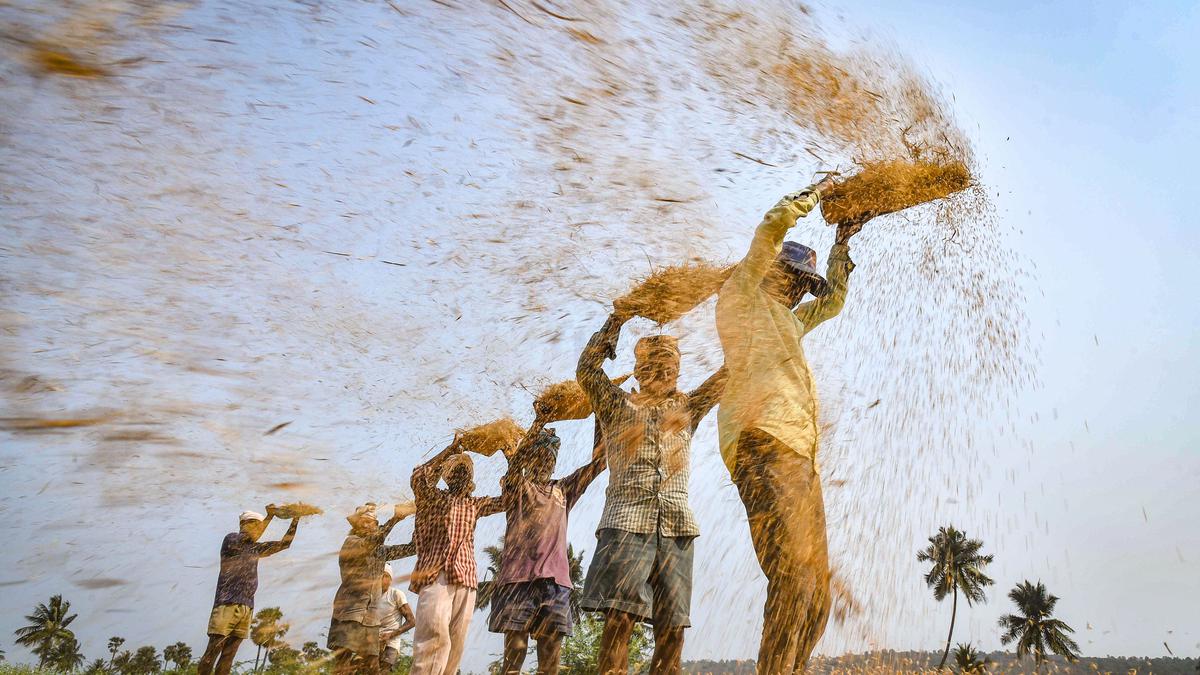
The major rice cultivation season in India is the Kharif season, that entails sowing the crop during June-July and harvesting them in November-December.
It is imperative to note that rice is a water-intensive crop which also requires a hot and humid climate. Thus, it is best suited to regions which have high humidity, prolonged sunshine and an assured supply of water. It is for this reason that the eastern and southern regions of the country, with sustainable humidity and suitable mean temperatures are deemed favourable for the crop. While the two regions are able to grow paddy crops throughout the year, higher rainfall and temperature prompt the northern regions to grow only one crop of rice from May to November. Andhra Pradesh, Telangana, Punjab, Haryana, Chhattisgarh, Odisha, Madhya Pradesh, Tamil Nadu, Maharashtra, Uttar Pradesh and Bihar are among the rice producing States in India.
A perusal of Indian Meteorological Dept’s data, between June 1 and September 14 illustrate that Uttar Pradesh, Jharkhand, Punjab and Bihar have experienced deficient rainfall. The latter refers to rainfall being 20-59% below normal in a particular region. Although West Bengal, the country’s largest producer, has overall experienced a normal rainfall, its major productivity areas such as Nadia, Burdwan and Birbhum have had deficient rainfall. This indicates a potentially lower produce this year.
What are the concerns on ethanol blending?
Ethanol is an agro-based product, mainly produced from molasses, which is a by-product of the sugar industry. The EBP endeavours to blend ethanol with vehicular fuels as a means to combat the use of fossil fuels and in turn, rising pollution. As per the government, sugar-based feed stocks alone would not be able to meet its stipulated target of 20% ethanol blending by 2025.
In the 2018-19 Ethanol Supply Year (ESY), the government had allowed the FCI to sell surplus rice to ethanol plants for fuel production. The idea was to have in place an insurance scheme and an emergency provision for distillers.
However, in the ongoing ESY, because of supply constraints there has been an uptick in the procurement of rice from the FCI. The total ethanol produced from rice lifted from the FCI stood at 26.64 crore litres whereas that from damaged food grains outside the FCI purview stood at 16.36 crore litres. This means that the production accruing from FCI rice has increased 10-fold from the 2.2 crore litres used in a full ESY. At the same time, production from damaged foodgrains stands at half.
Thus, the export ban would endeavour to catch-up with this supply and additionally, unburden the FCI from provisioning to distillers.
What are the likely after-effects of the ban?
Geopolitical tensions between Russia and Ukraine have unsettled global food supply chains. With trade disrupted in the Black Sea region, Bloomberg reported in March that prices of rice are surging because traders are betting it will be an alternative for wheat which is becoming prohibitively expensive.
India accounted for 41% of the total rice exports in the world in 2021 larger than the next four exporters (Thailand, Vietnam, Pakistan and United States) combined.
As for broken rice, the United States Department of Agriculture (USDA) states that India accounted for more than half of the commodity’s global exports in the first half of 2022. As per government figures, between April and August this year, broken rice’s share in the overall rice export mix (of India) was 22.78% compared to 18.89% in FY 2021.
In descending order, China, Senegal, Vietnam, Djibouti and Indonesia are the biggest importers of India’s broken rice.
Senior Executive Director at the All-India Rice Exporters Association Vinod Kumaar Kaul told The Hindu, “Thailand, Vietnam and Pakistan would gain should we happen to lose this market. Once lost, regaining the market would be a task.”
Mr. Kaul pegs the losses to the exporters from the ban to be around ₹5,600 crore for the full year.