



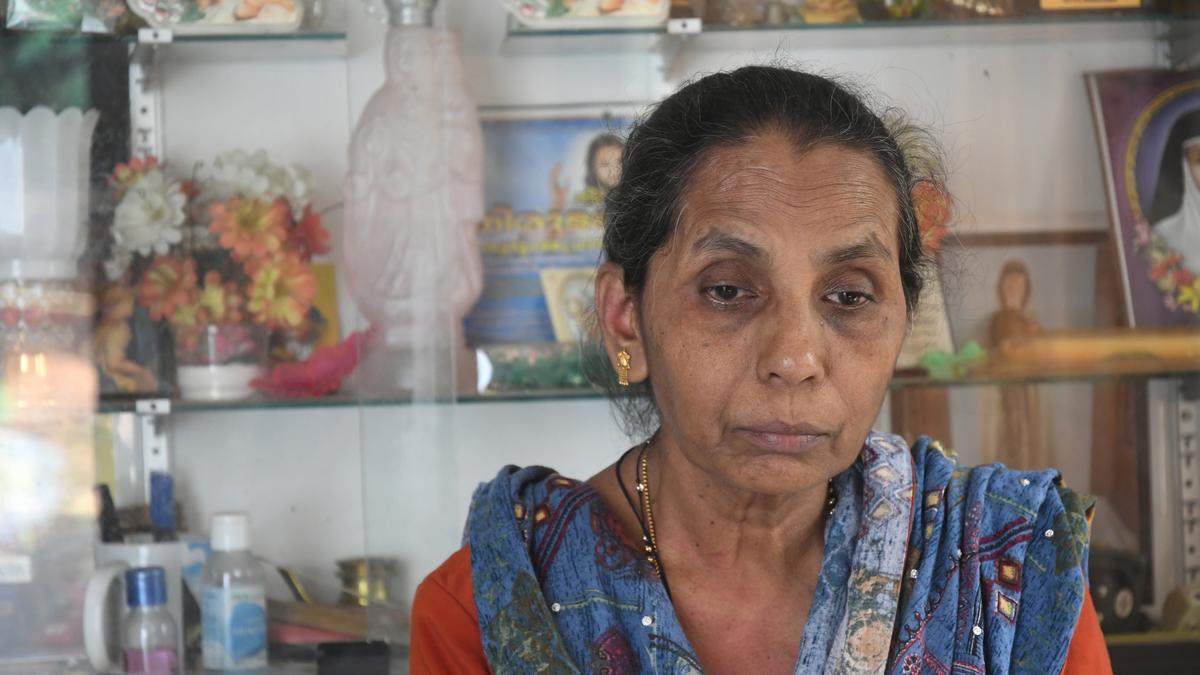
The story so far: The death sentence awarded by a Yemen court to nurse Nimisha Priya from Kerala for murdering her business partner, and the subsequent debates and efforts surrounding her acquittal and repatriation, which involves monetary compensation paid to the victimâs family, have brought the focus back on âblood moneyâ and its implications.
What is âblood moneyâ?
âBlood moneyâ, or âdiyaâ, finds footing in the Islamic Sharia law, and is followed in countries that incorporate these laws in their legislation. Under the rule of âdiyaâ, a select quantity of a valuable asset, primarily monetary, has to be paid by the perpetrator of the crime to the victim, or the victimâs family if the latter has died. The custom is practised predominantly in cases involving unintentional murder and culpable homicide. It is also invoked in murder cases wherein the victimâs kin chooses not to retaliate through âqisasâ (a way of retribution under the Sharia). The end-goal, as the law says, is not to put a price tag on human life, but to alleviate the plight and suffering of the affected family and their potential loss of income. However, it is to be noted that even if the concerned parties reconcile through âblood moneyâ, the community and the state will retain the right to impose a deterrent punishment, including penalties.
In its contemporary applications, âblood moneyâ is upheld in several Islamic countries with factors such as gender, religion and nationality of the victim coming into play. Islamic scholar-researcher Mohammad Hashim Kamali outlines several cases in his book Crime and Punishment in Islamic Law: A Fresh Interpretation. In Saudi Arabia, for instance, the traffic regulations specifically mandate payment of âblood moneyâ to heirs of the victims who die in road accidents. In addition, the perpetrator shall be liable to a prison term. The statutory legislation and the Sharia work hand in hand in such cases. While the police determine the guilty parties, a Sharia court fixes the amount of âblood moneyâ to be paid. As for accidents in workplaces, the rates are fixed by a special committee. In 2022, talks had surfaced that Saudi Arabia was on the course to amend its âblood moneyâ laws, proposing equal monetary payments for men, women, Muslims and non-Muslims alike. However, efforts towards this are yet to come to fruition.
In Iran too, a country where the practice is rigorously upheld, âblood moneyâ varies with respect to religion and gender. A womanâs compensation is fixed at half of that of a manâs. In 2019, the countryâs Supreme Court upheld a law that sought equalisation of âblood moneyâ. However, the country is yet to see its full-fledged implementation. Indiaâs neighbour Pakistan, too, provides a place for âdiyaâ and âqisasâ. Through the Criminal Laws (Amendment) Ordinance, 1991, these provisions were brought into mainstream law. In Yemen, the country in question, the consensus for compensation can be arrived at by the parties, and there might be a judicial oversight over the fairness of the compensation.
Whatâs Indiaâs stand on âdiyaâ?
Provisions for the grant or receiving of âblood moneyâ do not find a place in Indiaâs formal legal system. However, the system does provide a way for the accused to negotiate with the prosecution through âplea bargainingâ.
Though the concept cannot be directly equated with âblood moneyâ, the scheme lays out a procedure whereby the defendant agrees to plead guilty for a particular offence in return for a concession from the prosecutor. The concessions can be offered on a charge or a sentence. In the former, the defendant may plead guilty for one of the several charges or a less severe charge in return for dismissal of other charges, and in the latter, for a reduced sentence than what is prescribed for the concerned offence.
Introduced into legal parlance through the Criminal Law (Amendment) Act, 2005, which added Chapter XXI A to the Code of Criminal Procedure, 1973, plea bargaining comes with an array of limitations unlike âblood moneyâ, which has a broader purview. For instance, plea bargaining can be taken up only for offences that are penalised with imprisonment of less than seven years. It cannot be invoked if the accused has been previously convicted for a similar offence. Besides, the provision is not available for crimes against women or children aged below 14; heinous crimes such as murder or rape; and offences involving socio-economic conditions, including civil rights. Moreover, the accused has to voluntarily come forward to plead guilty, and must not be coerced.
However, on the lines of âblood moneyâ, plea bargaining may also allow for the victim to receive compensation under clause Section 265E. Besides, much like the efforts in Islamic nations towards making âblood moneyâ more inclusive and egalitarian, discussions have been under way to make plea bargaining more refined.

Though its use has been minimal in India, experts have pointed out that owing to judicial delays and prolonged trials, accused persons, even if innocent, may be pushed to a situation to plead guilty under the plea bargaining clause.
What are some historical practices which are similar to âblood moneyâ?
Striking similarities to âdiyaâ can be found in the historical records of several other cultures across the globe.
In the ancient legal system of Ireland, the Brehon law (seventh century AD) provided for the system of âÃraicâ (body price) and âLog nEnechâ (honour price). The law shunned the notion of capital punishment for crimes, and allowed resolution of matters through amicable payment. In Ãraic, the amount was determined by the severity of the offence, while in Log nEnech, the price varied depending upon the victimâs social status.
âGalanasâ was an early Welsh law wherein the compensation was determined according to the status of the victim. Under the ruling, âblood fineâ was always to be paid, especially in cases of murder, barring where the killing was justified or excused owing to circumstances, points out author Thomas Peter Ellis in the book Welsh Tribal Law and Customs in the Middle Ages.
âWergeldâ, a concept that is said to have been formalised in early medieval Germany, greatly resembles âblood moneyâ.
American legal professional Roscoe Poundâs book, The Ideal Element in Law points out that, in fact, several medieval States had set their standards for an appropriate payment to the kin of victims in the event of homicide or grave crimes.
Have there been other Indians who were pardoned with âblood moneyâ?
While Nimisha Priyaâs case is in the spotlight now, there have been several other instances involving Indian nationals where âblood moneyâ had been invoked.
As recently as in 2019, the death sentence of Arjunan Athimuthu, hailing from Thanjavur, in Kuwait was commuted to life imprisonment after his family provided â¹30 lakh in âblood moneyâ. Abdul Rahim, who was sentenced to death for the murder of a Saudi boy in 2006, was pardoned by the court after a âblood moneyâ of â¹34 crore was paid. However, he is yet to be released from prison. Ten Indians in the UAE were âforgivenâ by the victimâs family in 2017 after a âblood moneyâ of 200,000 dirhams was paid. In another case, 17 Indians who were on death row in the UAE for the murder of a Pakistani national in 2009, were pardoned after a âblood moneyâ of nearly â¹4 crore in value equalling dirhams was paid. The Indian consulate had even hired a law firm in the UAE to argue the case.
As for Nimisha, with Iran assuring India of taking up the case, it remains to be seen whether her death sentence would be commuted.
Published – January 16, 2025 08:30 am IST