



Skip to content
  • Facebook
  • X
  • Linkedin
  • WhatsApp
  • Associate Journalism
  • About Us
  • Privacy Policy
  • 033-46046046
  • editor@artifex.news
Artifex.News

Artifex.News

Stay Connected. Stay Informed.

  • Breaking News
  • World
  • Nation
  • Sports
  • Business
  • Science
  • Entertainment
  • Lifestyle
  • Toggle search form
  • Plucky Rawat helps India-A fight back Sports
  • U.S. drone sale to India proceeds to next phase World
  • Who is Heman Bekele? 5 Points On US Teen Who Invented Soap To Treat Skin Cancer World
  • California Sues 5 Major Oil Companies Over Climate Risks Deception World
  • “People Who Talked About Pitch Didn’t Get A Run”: Ravi Shastri’s Explosive Take Sports
  • Amid Gaza War, Palestinians Relaunch Bid To Become UN Member State World
  • Pakistan Presenter Zainab Abbas Covering Cricket World Cup 2023 Leaves India Amid Social Media Backlash: Report Sports
  • Didi Is Lying, Says Amit Shah At Bengal Rally, Explains Citizenship Law Nation

Did Venus ever have oceans? Scientists have an answer

Posted on December 3, 2024 By admin


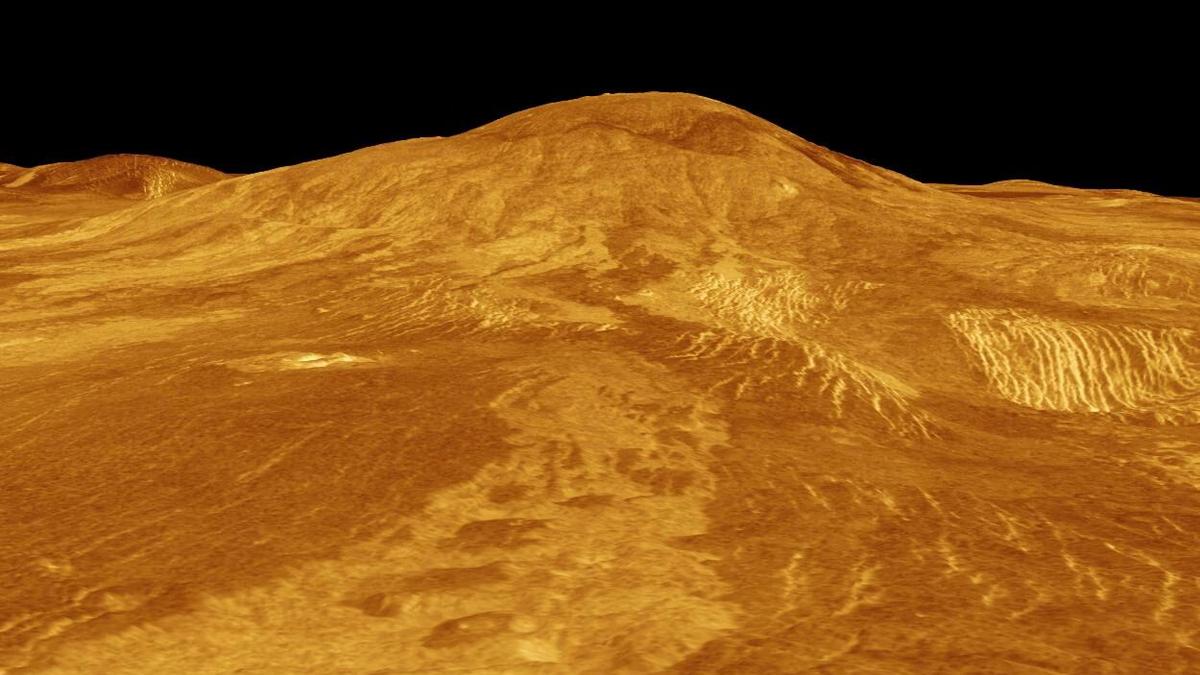
A computer-generated 3D model of Venus’s surface provided by NASA’s Jet Propulsion Laboratory shows the volcano Sif Mons exhibiting signs of ongoing activity, in this undated handout image.
| Photo Credit: NASA/JPL/Reuters

Earth is an ocean world, with water covering about 71% of its surface. Venus, our closest planetary neighbor, is sometimes called Earth’s twin based on their similar size and rocky composition. While its surface is baked and barren today, might Venus once also have been covered by oceans?

The answer is no, according to new research that inferred the water content of the planet’s interior – a key indicator for whether or not Venus once had oceans – based on the chemical composition of its atmosphere. The researchers concluded that the planet currently has a substantially dry interior that is consistent with the idea that Venus was left desiccated after the epoch early in its history when its surface was comprised of molten rock – magma – and thereafter has had a parched surface.

Water is considered an indispensable ingredient for life, so the study’s conclusions suggest Venus was never habitable. The findings offer no support for a previous hypothesis that Venus may have a reservoir of water beneath its surface, a vestige of a lost ocean.

Volcanism, by injecting gases into a planet’s atmosphere, provides clues about the interior of rocky planets. As magma ascends from an intermediate planetary layer called the mantle to the surface, it unleashes gases from deeper parts of the interior.

Volcanic gases on Earth are more than 60% water vapor, evidence of a water-rich interior. The researchers calculated that gases in Venusian eruptions are no more than 6% water vapor, indicative of a desiccated interior.

“We suggest that a habitable past would be associated with Venus’ present interior being water-rich, and a dry past with Venus’ present interior being dry,” said Tereza Constantinou, a doctoral student at the University of Cambridge’s Institute of Astronomy and lead author of the study published on Monday in the journal Nature Astronomy.

“The atmospheric chemistry suggests that volcanic eruptions on Venus release very little water, implying that the planet’s interior – the source of volcanism – is equally dry. This is consistent with Venus having had a long-lasting dry surface and never having been habitable,” Constantinou added.

Venus is the second planet from the sun, and Earth the third.

“Two very different histories of water on Venus have been proposed: one where Venus had a temperate climate for billions of years, with surface liquid water, and the other where a hot early Venus was never able to condense surface liquid water,” Constantinou said.

The Venusian diameter of about 7,500 miles (12,000 km) is just a tad smaller than Earth’s 7,900 miles (12,750 km).

“Venus and Earth are often called sister planets because of their similarities in mass, radius, density and distance from the sun. However, their evolutionary paths diverged dramatically,” Constantinou said.

“Venus now has surface conditions that are extreme compared to Earth, with an atmospheric pressure 90 times greater, surface temperatures soaring to around 465°C (869°F), and a toxic atmosphere with sulfuric acid clouds. These stark contrasts underscore the unique challenges of understanding Venus as more than just Earth’s counterpart,” Constantinou said.

The story appears to have been different on Mars, the fourth planet from the sun.

Surface features on Mars indicate it had an ocean of liquid water billions of years ago. No such features have been detected on Venus. Mars, according to research published in August based on seismic data obtained by NASA’s robotic InSight lander, may harbor a large reservoir of liquid water deep under its surface within fractured igneous rocks, holding enough to fill an ocean that would cover its entire surface.

While Venus has been studied less than Mars, new explorations are planned. NASA’s planned DAVINCI mission will examine Venus during the 2030s from its clouds down to its surface using both flybys and a descent probe. Also during the 2030s, the European Space Agency’s EnVision orbital mission is due to conduct radar mapping and atmospheric studies.

“Venus provides a natural laboratory for studying how habitability – or the lack of it – evolves,” Constantinou said.

Published – December 03, 2024 08:34 am IST


Source link

Science

Post navigation

Previous Post: India’s ‘One Nation, One Subscription’ plan | Explained
Next Post: “One 5-for In 10 Years”: R Ashwin, Ravindra Jadeja Sent Blunt Message As India Ponder 2nd Test XI

Related Posts

  • With no central brain, can jellyfish learn from past experiences? Science
  •  Future Skills at Monash College and Microsoft partner to transform tech education with AI Science
  • The Science Quiz: AI in science, from neurons to nodes Science
  • Why NASA astronauts Butch Wilmore and Sunita Williams may be stuck in space until next year Science
  • How genetics is revealing skin colour biology is more than skin-deep Science
  • What will ‘cosmic detective’ OSIRIS-Rex bring back on September 24? | Explained Science

More Related Articles

What are carbon credits? – The Hindu Science
Bumrah’s ball to Rizwan shows energy conservation law in action Science
Smoking leaves a lasting adverse impact on immune responses Science
Why do popcorns pop? Science
Sanofi gets approval for alternative inactivated polio vaccine Science
Prevalence of NCDs tripled, infectious diseases doubled since 1995 Science
SiteLock

Archives

  • December 2024
  • November 2024
  • October 2024
  • September 2024
  • August 2024
  • July 2024
  • June 2024
  • May 2024
  • April 2024
  • March 2024
  • February 2024
  • January 2024
  • December 2023
  • November 2023
  • October 2023
  • September 2023
  • August 2023
  • July 2023
  • June 2023
  • May 2023
  • April 2023
  • March 2023
  • February 2023
  • January 2023
  • December 2022
  • November 2022
  • October 2022
  • September 2022
  • August 2022
  • July 2022
  • June 2022
  • May 2022

Categories

  • Business
  • Nation
  • Science
  • Sports
  • World

Recent Posts

  • ISRO successfully launches PSLV-C59 rocket with European Space Agency’s Proba-3 satellites
  • Sensex, Nifty surge on buying in IT stocks, foreign fund inflows
  • Rupee recovers from all-time low, rises 3 paise to close at 84.72 against U.S. dollar
  • United States Senators introduce Bill to reunite immigrant families, raise per-country, family-based immigration cap
  • Can science’s peer-review system guarantee academic rigour?

Recent Comments

  1. dfb{{98991*97996}}xca on UP Teacher Who Asked Students To Slap Muslim Classmate
  2. "dfbzzzzzzzzbbbccccdddeeexca".replace("z","o") on UP Teacher Who Asked Students To Slap Muslim Classmate
  3. 1}}"}}'}}1%>"%>'%> on UP Teacher Who Asked Students To Slap Muslim Classmate
  4. bfg6520<s1﹥s2ʺs3ʹhjl6520 on UP Teacher Who Asked Students To Slap Muslim Classmate
  5. pHqghUme9356321 on UP Teacher Who Asked Students To Slap Muslim Classmate
  • India, Canada Expel Diplomats In Tit-For-Tat Move Amid Deepening Rift Nation
  • Gangster Lawrence Bishnoi Gets Relief In Mohali Student Assault Case Nation
  • Cricket World Cup: Sachin Tendulkar ‘Surprised’ By This Decision Of Australia vs India, Underlines What They Missed Sports
  • Boy, 15, Drowns In Water Pit At Under-Construction Site In Haryana: Cops Nation
  • “Big Mistake, Lost 9 Years”: Pakistan Star, Targetting T20 World Cup Return, On Spot-Fixing Saga Sports
  • “Moment Of Immense Pride”: Harmanpreet Singh After Being Named Among India’s Flag-Bearers For Asian Games Opening Ceremony Sports
  • Rescuers search for dozens buried in an Indonesian landslide that killed at least 17 people World
  • Putin praises ‘unprecedented’ energy ties with China World

Editor-in-Chief:
Mohammad Ariff,
MSW, MAJMC, BSW, DTL, CTS, CNM, CCR, CAL, RSL, ASOC.
editor@artifex.news

Associate Editors:
1. Zenellis R. Tuba,
zenelis@artifex.news
2. Haris Daniyel
daniyel@artifex.news

Photograher:
Rohan Das
rohan@artifex.news

Artifex.News offers Online Paid Internships to college students from India and Abroad. Interns will get a PRESS CARD and other online offers.
Send your CV (Subjectline: Paid Internship) to internship@artifex.news

Links:
Associate Journalism
About Us
Privacy Policy

News Links:
Breaking News
World
Nation
Sports
Business
Entertainment
Lifestyle

Registered Office:
72/A, Elliot Road, Kolkata - 700016
Tel: 033-22277777, 033-22172217
Email: office@artifex.news

Editorial Office / News Desk:
No. 13, Mezzanine Floor, Esplanade Metro Rail Station,
12 J. L. Nehru Road, Kolkata - 700069.
(Entry from Gate No. 5)
Tel: 033-46011099, 033-46046046
Email: editor@artifex.news

Copyright © 2023 Artifex.News Newsportal designed by Artifex Infotech.