




The story so far: Endeavouring to address issues related to coverage and quality inside buildings and civic facilities (such as airports and bus stations), the Telecom Regulatory Authority of India (TRAI) floated a consultation paper on September 27, proposing a rating system to assess network operability in the premises, to nudge property owners to “come forward and implement solutions to provide seamless digital connectivity in buildings.”
The regulator is seeking comments on the proposal until November 10 and counter-comments until November 24.
What are objectives of the proposed move?
The chief objective is to improve connectivity inside enclosed quarters. To attain this, TRAI recognises the need for an ecosystem that would create a “competitive environment” among property managers to provide the best quality of digital connectivity. According to the regulator, ratings would impact the commercial decisions of prospective buyers and tenants, allowing them to make an informed choice— thereby bettering connectivity in these spaces.
The regulator also observes that unlike street level wireless coverage, thorough connectivity in buildings entails the collaboration of service providers with local administrators and/or property managers. Thus, a TSP would not be able to deliver the desired quality all alone. “Apart from the permissions, the property managers and TSPs need to collaborate right from the design stage to co-design and co-create digital connectivity infrastructure in new buildings or buildings under renovation,” the paper reads. Thus, the regulator notes the necessity to combine these entities, tools and marketplaces under one platform, to aid in speeding up the roll-out of digital connectivity infrastructure and carry out capacity augmentation whenever required. Further, this will also serve to identify and remove obstacles to facilitate smooth functioning of the market for benefit of all end users and stakeholders.
As TRAI notes, the exponential rise in demand for digital services requires frequent augmentation of network capacity. Even though issues related to digital connectivity infrastructure can be addressed when the infrastructure is initially laid, however, they reappear at each instance of expansion, upgradation or any related activity. Thus, issues have to be dealt with during the entire lifecycle and not only at the initial phase. Hence ratings, once accorded, would require renewal.
What does the rating framework look like?
A star rating, between 1 to 5, would be accorded, ascertaining the scope and level of digital connectivity in the premises. The certification may be used for all further legal and marketing purposes. TRAI recommends that the rating be made mandatory for all existing and newer buildings of public importance within two years of the framework’s formalisation, or two years from obtaining occupancy certificate, whichever is later.
Buildings of public importance which would mandatorily fall under its purview include airports, ports, railway stations, metro stations, bus stations, industrial estates (including industrial parks, SEZs, multi-modal logistic parks), large commercial shopping complexes, higher education institutes and multi-speciality hospitals, among other places.
The assessment would combine objective and subjective considerations with suitable weightage. Objective metrics for assessment would include key-performance indicators like digital connectivity infrastructure availability, network performance and service performance. The subjective component would involve surveying end users about perceptions of quality.
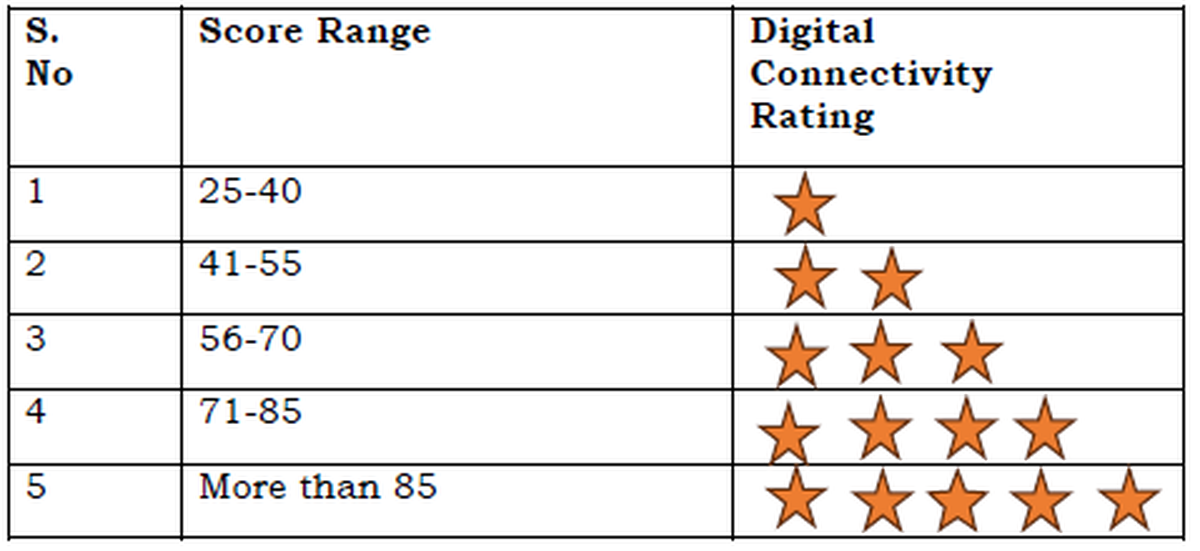
TRAI’s proposed rating scale
For public places, like airports and railway stations, TRAI has sought that the requisite infrastructure be “agile enough to cater to a dynamic number of users such that quality of services is not affected during traffic peaks.” The demand for connectivity and quality network at these places fluctuates as per season or traffic during different times of the day, thus resulting in short periods of demand but in potentially greater volumes— as in the case of people riding the train during rush hour.
This is unlike businesses and residential complexes which have a more predictable pattern of consumption varying only according to their payment capacity and type of digital connectivity.
Further, the certification issued would be valid for a specified period. It would also provide conditions under which they may be withdrawn or require to be renewed. For example, performance quality during a certain period might degrade because of increase in average traffic or the availability of new technology networks or spectrum bands. Should an additional capability be introduced, an incremental assessment would determine the new rating.
How will the rating be done?
The process would be voluntary. After registering, due diligence would be carried out in two stages — initially offsite and then onsite. Following this, a rating would be awarded and if required, a renewal or review of the rating.
During the initial onsite process, the regulatory authority would provide the applicant with action points, classifying them into mandatory, recommended and optional. ‘Mandatory’ action points, if not addressed, would halt progress to the next stage, while not following recommended action points would result in lowered ratings, even though they can otherwise be ignored. Optional action points are entirely suggestive measures.
The second stage— the onsite verification— needs to be completed within sixty days from the date on which the on-site verification is requested, provided the applicant has complied with the requirements in the earlier stage.
After this stage, the scores are updated as necessary and finalised. Should the applicant not be happy with their score, an online appeal may be filed within 30 days.
The emphasis is on collaborative efforts to improve the quality of services for 847.31 million wireless internet subscribers. In a related context, TRAI said that wireless coverage “has become the main access technology for digital connectivity in India,” accounting for almost 98.5% of broadband connections in the country.