



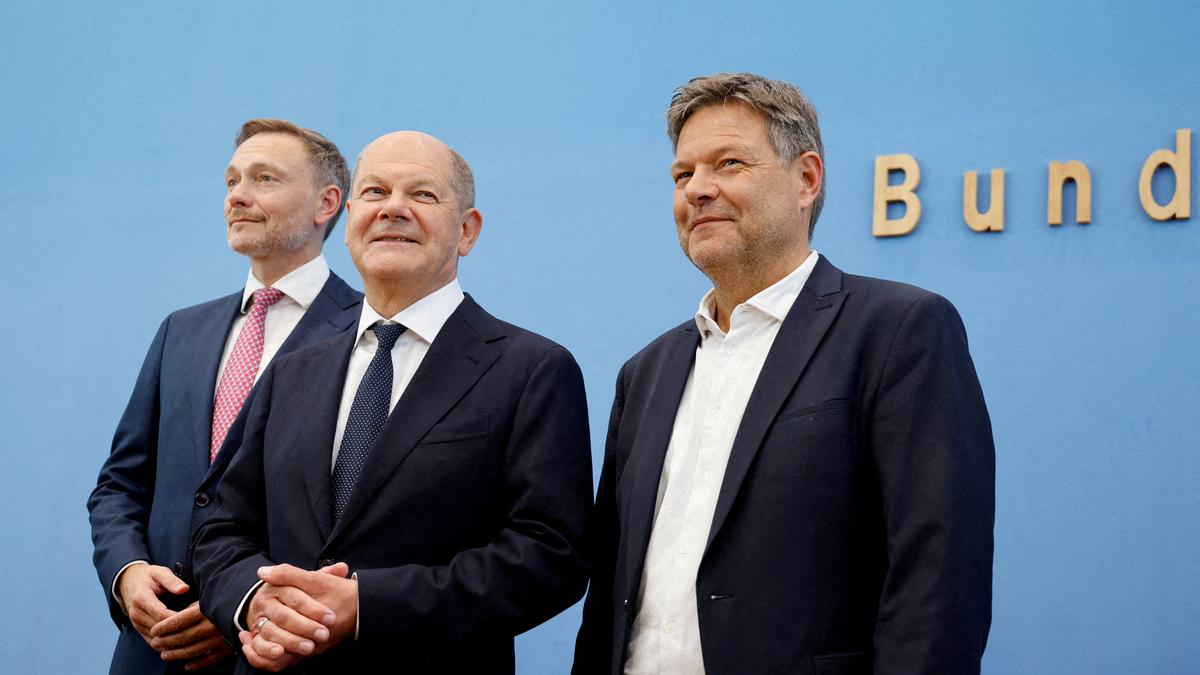
On the day the U.S. elected Donald Trump as its 47th President, Germany’s ruling coalition of the centre-left Social Democrats (SPD), environmentalist Greens, and neo-liberal Free Democrats (FDP) dissolved after three years.
Chancellor Olaf Scholz sacked the Finance Minister Christian Lindner late in the evening on November 6 over budget-related disagreements that have riddled this 3-way coalition since last November. While the SPD and Greens are in favour of taking on more debt, FDP was insistent on increased taxes and spending cuts. Mr. Scholz called out Mr. Lindner for his ‘petty political tactics’.
“Finance Minister Lindner showed no willingness to implement any of our proposals,” said Mr. Scholz in a speech following the dismissal. He will now lead a minority government with the Greens as FDP has withdrawn all its leaders from the coalition.
The ruling government in Europe’s largest economy could not be collapsing at a more critical juncture – both geopolitically and economically.
The German economy has not been performing well and is looking at a second consecutive year of contraction. German Economy Minister Robert Habeck (Greens), announced on October 9 that the economy was expected to shrink by 0.2% this year. This is a downgrade from the 0.3% growth that was expected in April 2024, making Germany the only G-7 country to contract in 2024. This follows the predictions from major economic institutions in Germany.
The only positive news was that in Q3 of 2024, the German economy showed a 0.2% increase in GDP after a 0.3% contraction in the preceding quarter.
“The economy is proving more robust than previously forecast and the technical recession expected by many has failed to materialise,” noted Mr. Habeck.
The German government is predicting a return to growth from 2025 onwards. Mr. Habeck is counting on the successful implementation of a growth package involving 49 measures to revitalise the economy, including higher productivity, encouraging investments, and addressing long-term structural issues that he blames for the contracting economy. On October 23 , Mr. Habeck also proposed a “Deutschland Fund” to stimulate the German economy.
But Mr. Scholz’s decision to fire the Finance Minister puts a question mark on whether these measures could be implemented in time. While Mr. Scholz has called for a vote of confidence on January 15, the Leader of Opposition Friedrich Merz from the conservative Christian Democrats (CDU/CSU) has called for the vote to be taken sooner. The CDU/CSU currently lead the polls in Germany.
Structural issues
The war in Ukraine, which forced Germany to cut off its supply of cheap Russian gas, hit the economy, which was recovering from the global trends experienced during the COVID-19 pandemic. However, structural issues were noted by Mr. Habeck as the main drivers of a slowing economy.
According to Dr. Thomas Obst, senior economist at the German Economic Institute (IW), the structural issues referred to are chronic public underinvestment and an aging society with detrimental demographics that have also existed during earlier governments.
The International Monetary Fund has also cited the lack of public investment in Germany as one of the structural issues holding Germany back. “Money that has been budgeted for investment is routinely underspent, often because of staff shortages in municipalities,” noted the report.
Germany puts 2.6% of its GDP in public investments compared with almost 5% in Sweden. One prime example of a lack of investment is the Deutsche Bahn (German national railways), which has caused unending delays, overcrowding, and cancellations for more than a few years now. The investments have not kept up with the amount of passenger traffic and rail freight. In September 2024, a bridge collapse in the eastern city of Dresden further underlined the chronic underinvestment in public utilities.
“Under the current government, the competitiveness of German companies is increasingly deteriorating. This is also due to bad decisions of the current administration,” said Mr. Obst, calling for tax reforms to reduce the overall tax burden.
Dr. Klaus Wohlrabe, senior economist at the ifo Institute concurs. In addition to the structural issues mentioned above, Mr. Wohlrabe mentioned over-reliance on traditional industries, energy dependence on imports, and bureaucracy as other structural issues.
“(Former Chancellor Angela) Merkel’s tenure saw Germany’s economy rely heavily on automotive and manufacturing industries. These sectors, though vital, face growing competition and disruption, especially as the world shifts towards green technologies. Late adoption of electric vehicles has impacted Germany’s global competitiveness,” said Mr. Wohlrabe.
While the Russia-Ukraine war did raise gas prices in 2022, that situation is under control now. However, German energy policies in the Merkel government have ensured that it relies on fossil fuel imports.
“The decision to phase out nuclear (energy) made Germany more dependent on fossil fuel imports. The dependence on imported energy sources has impacted energy costs, stability, and manufacturing competitiveness,” said Mr. Wohlrabe.
Volkswagen shutting auto-plants?
The auto industry is one of the major revenue earners for Germany making up almost 5% of the economy. Auto giant Volkswagen is one of the largest industrial groups in the country. On October 28, Volkswagen’s works council head, Daniela Cavallo, told employees that the auto giant was planning to shut down three plants in Germany, which would affect tens of thousands of jobs. On October 31, Volkswagen requested its employees to take a 10% pay cut, according to Reuters.
Although Volkswagen did not officially announce anything about plant shutdowns, statements by its CEO, Thomas Schäfer, do not elicit much hope among employees.
“We are not productive enough at our German sites, and our factory costs are currently 25% to 50% higher than planned. This means that individual German plants are twice as expensive as the competition,” said Mr. Schäfer.
Mr. Obst notes that Chinese competitiveness in the electric car segment is a huge challenge to the German auto industry.
“The green transformation has brought the German car makers into a predicament. European demand for electric cars has been below expectations. Increased energy and labour costs render some auto production lines unprofitable,” said Mr. Obst.
Another home-grown chemical industry giant, BASF, is also planning to increase its investments in China following the energy price shock it experienced in 2022.
“Production in energy-intensive sectors, such as glass, chemicals, and metals, is almost 15% below the pre-pandemic level of Q4 2019. The energy price difference between the EU and the U.S. is simply too large for these sectors to compete with foreign companies in global markets”, said Mr. Obst.
The point for large structural shifts is ripe, according to Mr. Wohlrabe. “I think the energy-intensive industry will produce where the energy costs are lower. I do not see Germany becoming a country where energy is cheap in the near term. New industry structures could emerge,” said Mr. Wohlrabe, pointing out that the German population is not used to such changes.
Service industry preventing recession
The IW Economic Forecast Autumn 2024 noted that the services industry is the only shining light in the current German economy and the only sector preventing recession. However, the report notes that it is not enough to stimulate the economy.
According to Mr. Obst, there are three challenges preventing services from stimulating the economy. “Firstly, we have seen large wage increases in the service sector and hence an increase in labour costs leading to a loss of competitiveness in this industry. Secondly, labour productivity has decreased since 2022, adding to the competitiveness issue. Finally, demographic changes lead to a lack of skilled workforce,” said Mr. Obst.
Germany perennially suffers from a worker shortage in sectors such as engineering, IT, sciences, and healthcare. According to estimates, around 4,00,000 skilled workers are needed in Germany.
Towards the end of October, during the Intergovernmental Consultations between India and Germany, Berlin decided to increase the visas for skilled Indian workers from 20,000 to 90,000.
China factor
Another factor that could impact Germany’s export-oriented economy is the drop in demand from China, its largest trading partner.
“We saw a decline in exports to China not only this year, but also years before. This could be because China also produces high-technology products and exports them. It is also a serious competitor in the automobile segment. This impacts Germany’s growth model,” said Mr. Wohlrabe.
The recently announced EU tariffs on electric vehicles made in China and sold in Europe could lead to possible trade wars. Mr. Wohlrabe notes that Germany wants to prevent these tariffs, as they could lead to counter-tariffs from China as well, which could hit Germany the most.
“The big three automakers, BMW, Mercedes, and Volkswagen, make substantial revenue in China – between 30-40%. Hence a lower demand for their products affects these automakers significantly,” noted Mr. Obst.
German auto sales figures in China are not impressive if one looks at Q2 of 2024. BMW’s China sales dropped by 30%, Volkswagen by 15%, and Mercedes by 13%. German car sales, which had a 25% share in Chinese market before the pandemic, now account for just 15%, with most of the competition coming from home-grown Chinese electric car brands such as BYD.
Deutschland Fund to the rescue?
Mr. Habeck recently proposed a “Deutschland Fund” to stimulate the German economy. According to his 14-page proposal paper, the fund would focus on small and medium enterprises, large corporations, and startups that could receive a 10% government investment bonus in the form of tax credits. This would be in addition to the benefits already present for businesses.
Mr. Wohlrabe calls the proposal ambitious and one that targets critical bottlenecks such as infrastructure investment and digital modernisation, but practical and political hurdles are immense.
“The ‘Deutschland Fund’ would need a clear, transparent, and efficient allocation process to avoid bottlenecks. If not, it would set just another brick to the bureaucracy wall. It is important that all investment projects are supported, so that there is no selection by some authority. Another issue is the anticipation effect, if firms expect the Fund to be realised in practice, they will postpone their investments, knowing they will get some grants for it. This worsens the problem of the weak private investment that we currently have in Germany,” said Mr. Wohlrabe.
Chip giant Intel recently postponed its plans to set up its fab plant in Magdeburg, Germany. Intel had received a €10 billion subsidy for this plant from Berlin. More recently, another chipmaker, Wolfspeed, scrapped its plans to open a chipmaking facility for the auto industry, citing slower adoption of electric vehicles in Europe.
Germany’s ‘debt-brake rule’ could be another roadblock for initiatives such as the “Deutschland Fund”. According to the debt-brake or balanced budget rule, there is an upper limit on how much governments can borrow to finance public projects. The fiscal deficit cannot exceed 0.35% of the GDP.
The debt brake was the major bone of contention between the SPD and the outgoing FDP. Mr. Scholz was in favour of suspending the limit on the debt brake to allow more spending. Mr. Lindner was not in favour of it.
“For the ‘Deutschland Fund’ to gain traction, it might need to be financed creatively, such as through public-private partnerships or green bonds specifically earmarked for sustainability and digital projects,” said Mr. Wohlrabe, noting that this would require political negotiations but could appeal to parties more reluctant about new debt.
Political chaos
While Mr. Habeck’s Green Party found support for this proposal with one of its partners, the SPD, the FDP was not in favour of it. The just dismissed Finance Minister, Mr. Lindner, stated that the proposal called for a “fundamentally different economic policy for Germany” that will need to be discussed. Mr. Lindner had drafted his own proposal.
Political chaos has been the operating principle of the current ruling coalitionin Germany. Following the announcement of the economic outlook for the year, Chancellor Scholz called for a meeting with industry leaders to discuss issues. As his then coalition partners – Mr. Habeck and Mr. Lindner – were not part of this “industry summit,” Mr. Lindner decided to hold his own meeting with small and medium enterprise leaders.
The lack of unity among the ruling coalition partners eventually reached its breaking point on the evening of November 6 when Mr. Scholz fired his Finance Minister.
The German national election which was scheduled to happen in September 2025, will most likely be pre-poned to March or April next year if Mr. Scholz loses the confidence vote in January. If the confidence vote takes place earlier, the election could also happen before March.
(Nimish Sawant is an independent journalist based in Berlin)
Published – November 12, 2024 06:00 am IST