


Skip to content
  • Facebook
  • X
  • Linkedin
  • WhatsApp
  • Associate Journalism
  • About Us
  • Privacy Policy
  • 033-46046046
  • editor@artifex.news
Artifex.News

Artifex.News

Stay Connected. Stay Informed.

  • Breaking News
  • World
  • Nation
  • Sports
  • Business
  • Science
  • Entertainment
  • Lifestyle
  • Toggle search form
  • India vs Bangladesh “Attention-Seeker” – Report Makes Big Claim On Bangladesh Super Fan Amid Kanpur Test Row Sports
  • Amazon, Flipkart Violated Competition Laws, Says Anti-Trust Body: Report Nation
  • Swearing-In Ceremony Of New BJP Government To Be Held In Panchkula On 15 October Nation
  • Sports Ministry Okays Vinesh Phogat’s Request To Include Strength and Conditioning Coach in Hungary Training Camp Sports
  • Quinton De Kock Out Or Not Out? SA Star’s Controversial Call In T20 World Cup Divides Cricket World Sports
  • History Of The Amethi Lok Sabha Seat In Uttar Pradesh Nation
  • No Abnormal Rise In Seasonal Flu Cases In Country So Far: Health Ministry Nation
  • 3 Budding Hockey Players Killed, 5 Injured In Lightning Strike In Jharkhand: Cops Nation

How do lightning rods prevent lightning strikes from reaching people?

Posted on November 11, 2024 By admin


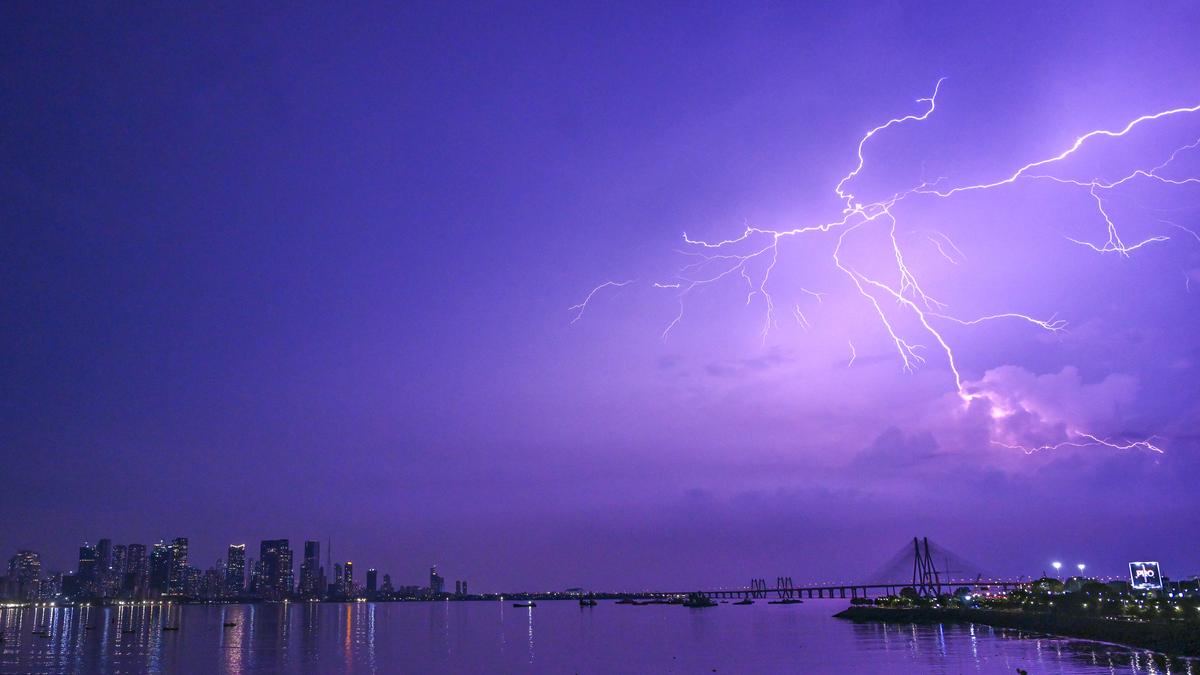
Lightning strikes above the city skyline in Mumbai.
| Photo Credit: EMMANUAL YOGINI

Climate change is making lightning strikes around the world more common and deadlier. Every year, around 24,000 people around the world are killed by such strikes; in India, lightning strikes killed 2,887 people in 2022. There have been petitions to declare this phenomenon a natural disaster in India so that its survivors can access institutional mechanisms for protection and rehabilitation. Against this backdrop, lightning rods are important for their ability to keep lightning away from people.

What is lightning?

Lightning is an electrical discharge between charged particles in a cloud and the ground. Objects can be classified as electrical conductors or insulators, but this depends on the electrical energy acting on the object. For example, the air around us is an electrical insulator: it doesn’t transport electric charges. But if it is subjected to a high voltage of around 3 million V/m, its insulating properties break down and it can transport a current.

Lightning strikes are possible because electrical charges can build up in a cloud beyond the ability of air to keep resisting their movement.

What is a lightning rod?

While a lightning strike occurs between a cloud and an object on or near the ground, it takes the path of least resistance, which means it moves towards the closest object with the highest electric potential.

“The reason lightning strikes the rod has to do with its shape. Lightning rods are pointy and pointed things create stronger electric fields near them,” IIT Kanpur assistant professor of physics Adhip Agarwala said. “It’s like saying the flow of water speeds up near a nozzle. The electric field is the force that acts on molecules of air, so it becomes strongest near the lightning rod. This force ionises the air near the rod first and provides a route for the current to flow.”

Think of a lightning strike as the extended hand of someone who wants to be pulled out of a pool. If there are many hands offering to help, the lightning’s hand will reach for the strongest one. A lightning rod is an electrical conductor that takes advantage of this fact with one addition: engineers install it on building-tops in a way that it’s the first hand the lightning encounters on its way down. This is also why it’s risky to stand under trees in an otherwise open field, like a farm.

Where does the current in a lightning rod go?

Heat energy always flows from a warmer object to a cooler object. Liquid water flows from a place with a higher gravitational potential to a lower one. Similarly, an electric current flows from a place with higher electric potential to a place with lower electric potential.

Fortunately, we have an abundant source of lower electric potential: the earth. The lightning rod is connected to a wire that drops through the length of the building into the ground, where it dissipates its electric charges into its surroundings. The idea here is that electrifying the earth will need virtually infinite amount of charges, so it’s treated as a bucket that will never fill up.

However, some parts of the bucket may still be better at receiving the charges than others.

If a strike induces a large current in a grid-connected electrical system, engineers connect the wire to a line that allows only high currents, thus diverting them away from devices that can handle only low currents. Such setups are called lightning arresters.

Can lightning evade a lightning rod?

A lightning strike may evade a lightning rod if the rod is installed at the wrong height or angle or too close to another structure, isn’t properly grounded, if there are multiple thunderstorms in an area, if it has a flawed design, or if it has become misshapen and/or corroded due to lack of maintenance.

It can also fail if an electrical discharge ascends from the ground to meet a descending strike, risking bypassing the rod, or if a strike is more attracted to the side of a tall building than to the top.

Over the years engineers have devised new incentives for lightning to prefer a lightning rod over other structures nearby. Among others, they make sure a lightning rod is available for lightning to strike within the minimum distance the strike travels in each step it takes towards the ground.

What dangers does a lightning rod pose?

The lightning rod and the components connected to it are designed to carry a lightning strike into the ground. This means catching the strike and safely transporting it. If the wire bends in a U shape at any point, the two arms of the U should be far apart to prevent the current from arcing across and shorting the conductor. The charges should also not be able to arc through any other objects nearby. Engineers also bury the grounding wire in a part of the crust with higher electrical conductivity so that the wire dissipates charges faster. In the 1960s, a U.S. engineer named Herbert Ufer developed a system later called a concrete encased electrode: it has the properties of a good grounding material, including better electrical conductivity than soil.

The International Electrotechnical Commission publishes standards that specify the design limits and points of failure engineers can consider when installing lightning rods, and the priorities that planners and policymakers should adopt — informed by technical considerations — when estimating risk and liability.

Published – November 11, 2024 08:30 am IST


Source link

Science

Post navigation

Previous Post: Gautam Gambhir Press Conference Live Streaming, Border-Gavaskar Trophy Live Telecast: When And Where To Watch
Next Post: COP16: Will financial roadblocks continue to hinder conservation efforts? | Explained

Related Posts

  • Constipation increases your risk of a heart attack, new study finds Science
  • Does cash take away the cachet of science awards? Science
  • Managing our resources with AI Science
  • Copper becomes unexpectedly hard under extreme strain rate Science
  • Watch | How climate change is affecting monsoon forecast and disaster management Science
  • inStem’s fabric offers protection from pesticides Science

More Related Articles

Astronomers find the small, hot helium stars they had been looking for Science
Egypt is racing to eliminate hepatitis C Science
Mummified American climber found 22 years later in Peru as glaciers retreat Science
India’s ambitious plans on space station on track, says Chandrayaan-3 project director Science
What is ‘Net Zero’, anyway? A short history of a monumental concept Science
The Science Quiz: The stuff semiconductors are made of Science
SiteLock

Archives

  • November 2024
  • October 2024
  • September 2024
  • August 2024
  • July 2024
  • June 2024
  • May 2024
  • April 2024
  • March 2024
  • February 2024
  • January 2024
  • December 2023
  • November 2023
  • October 2023
  • September 2023
  • August 2023
  • July 2023
  • June 2023
  • May 2023
  • April 2023
  • March 2023
  • February 2023
  • January 2023
  • December 2022
  • November 2022
  • October 2022
  • September 2022
  • August 2022
  • July 2022
  • June 2022
  • May 2022

Categories

  • Business
  • Nation
  • Science
  • Sports
  • World

Recent Posts

  • Chinese booksellers thrive abroad as China tightens control at home
  • Team India Drops Big Selection Hint In Practice, Slip Cordon Pictures Say It All
  • Rupee rises 2 paise to 84.40 against U.S. dollar in early trade
  • India, China Review Disengagement Process; Discuss Next Steps In Ties
  • 15 Arrested For Death Of 1st Year MBBS Student Due To Ragging In Gujarat

Recent Comments

  1. dfb{{98991*97996}}xca on UP Teacher Who Asked Students To Slap Muslim Classmate
  2. "dfbzzzzzzzzbbbccccdddeeexca".replace("z","o") on UP Teacher Who Asked Students To Slap Muslim Classmate
  3. 1}}"}}'}}1%>"%>'%> on UP Teacher Who Asked Students To Slap Muslim Classmate
  4. bfg6520<s1﹥s2ʺs3ʹhjl6520 on UP Teacher Who Asked Students To Slap Muslim Classmate
  5. pHqghUme9356321 on UP Teacher Who Asked Students To Slap Muslim Classmate
  • Karnataka MLA HD Revanna, Accused Of Kidnapping Woman, Taken Into Custody: 10 Points Nation
  • India vs South Africa: “Want To Win T20 World Cup Because…”: Rahul Dravid On #DoItForDravid Campaign Sports
  • Doughty South Africa Eke Out Seven-Run Win Over England, Get Closer To T20 World Cup Semi-Finals Sports
  • Sheikh Hasina to stay in Delhi ‘for a little while’, says her son Sajeeb Wazed Joy World
  • 12 Coaches Of Chandigarh-Dibrugarh Express Derail In UP, 4 Killed Nation
  • Team Eknath Shinde Workers Burn Omar Abdullah Photo Over Maharashtra Bhavan Remark Nation
  • Daily Quiz: On H2 fuel and batteries Science
  • ‘Union Budget must provide tax relief to those in lowest income slab, focus on employment’ Business

Editor-in-Chief:
Mohammad Ariff,
MSW, MAJMC, BSW, DTL, CTS, CNM, CCR, CAL, RSL, ASOC.
editor@artifex.news

Associate Editors:
1. Zenellis R. Tuba,
zenelis@artifex.news
2. Haris Daniyel
daniyel@artifex.news

Photograher:
Rohan Das
rohan@artifex.news

Artifex.News offers Online Paid Internships to college students from India and Abroad. Interns will get a PRESS CARD and other online offers.
Send your CV (Subjectline: Paid Internship) to internship@artifex.news

Links:
Associate Journalism
About Us
Privacy Policy

News Links:
Breaking News
World
Nation
Sports
Business
Entertainment
Lifestyle

Registered Office:
72/A, Elliot Road, Kolkata - 700016
Tel: 033-22277777, 033-22172217
Email: office@artifex.news

Editorial Office / News Desk:
No. 13, Mezzanine Floor, Esplanade Metro Rail Station,
12 J. L. Nehru Road, Kolkata - 700069.
(Entry from Gate No. 5)
Tel: 033-46011099, 033-46046046
Email: editor@artifex.news

Copyright © 2023 Artifex.News Newsportal designed by Artifex Infotech.