





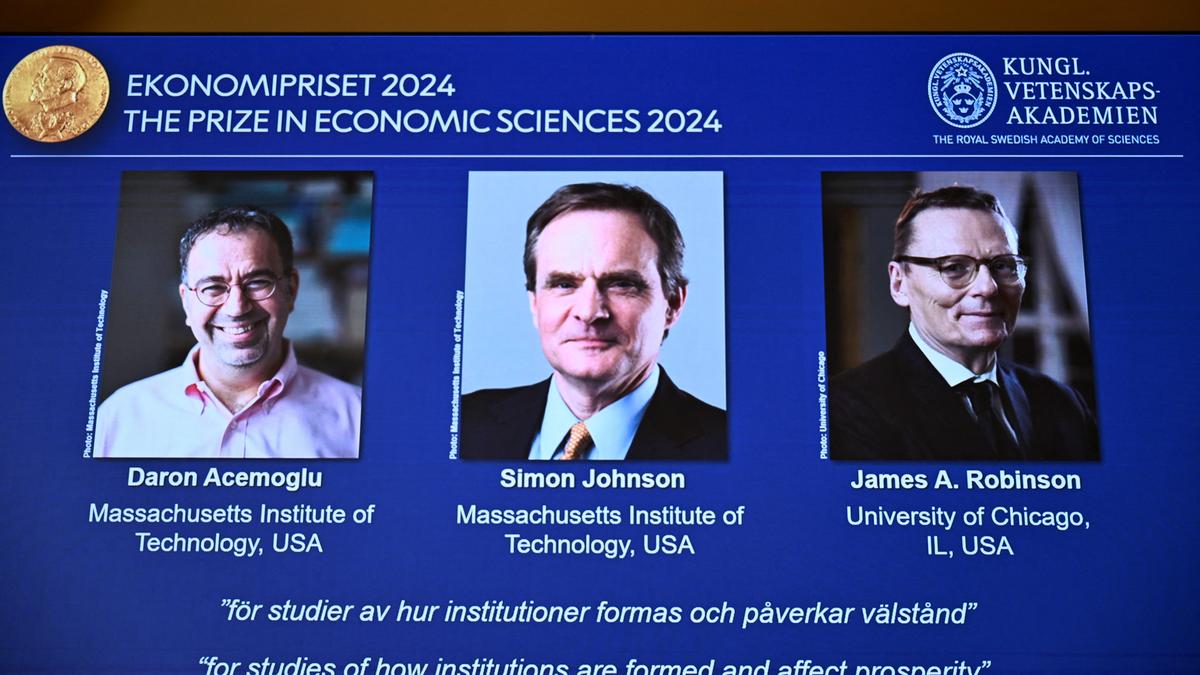
Economics Nobel winners Daron Acemoglu, Simon Johnson and James A Robinson being announced at the Royal Swedish Academy of Sciences in Stockholm, Sweden, on October 14, 2024.
| Photo Credit: Reuters
The Royal Swedish Academy of Sciences on Monday (October 14, 2024) awarded the Nobel Prize in Economics to Daron Acemoglu, Simon Johnson and James A. Robinson for “studies of how institutions are formed and affect prosperity”. The trio demonstrated how societies with a poor rule of law and institutions that capitalise on its population with an exploitative intent neither generate growth nor change for the better. In fact, a similar theme was explored by Mr. Acemoglu and Mr. Robinson in an earlier book Why Nations Fail: The Origins of Power, Prosperity and Poverty (2012).
Explore this year’s Nobel winners, and their achievements with this interactive guide
The co-authors tracing political and economic divergence
Why Nations Fail was the second of the three books authored by Mr. Robinson and Mr. Acemoglu together. Each of them traced the prevailing political scenarios of a region to their economic histories. Their first, Economic Origins of Dictatorship and Democracy (2005) proposed “a theory of the emergence and stability of democracy and dictatorship”. The third book, titled The Narrow Corridor: States, Society and the Fate of Liberty, examines “the incessant and inevitable struggle between states and society. Its purpose was to throw light on the deep historical process that have helped shape the modern world.
One of the fundamental principles of the duo’s research has been demonstrating the exploitative role of “extractive economic institutions” — that do not create incentives needed for people to save, invest and innovate. “Extractive political instructions support these economic institutions by cementing the power of those who benefit from the extraction,” an excerpt from Why Nations Fail reads, elaborating, “Extractive economic and political institutions, though their details, vary under different circumstances, are always at the root of this failure.”

Robinson’s interest in sub-Saharan Africa and Latin America
The MIT professor holds a particular interest in issues relating to sub-Saharan Africa and Latin America. During his career, Mr. Robinson has conducted fieldwork and collected data in Bolivia, Colombia, Haiti, the Democratic Republic of Congo, Nigeria, Sierra Leone, South Africa and Zimbabwe. In fact, the Nobel laurate is a Fellow at the Institute of African Studies at the University of Nigeria at Nsukka. Furthermore, he taught a summer school at the University of the Andes in Bogota between 1994 and 2002.
To lend perspective into his reading: a 2008 paper titled ‘Governance and Political Economy Constraints to World Bank’s Country Assistance Strategy Priorities in Sierra Leone’ – having described the developing political scenario in the West African nation, held, “Though political institutions are not the whole story, they do heavily influence political incentives and the history of Sierra Leone makes clear that they have first order-effects”. He stated that whilst the financial institution correctly fostered decentralisation (back then), the reform process had to be “deepened” and “complemented by the reduction of executive autonomy, the strengthening of Parliament and the introduction of greater democracy into the institution of chieftaincy”.
Presently, Mr. Robinson is the Reverend Dr. Richard L. Pearson Professor of Global Conflict Studies and a University Professor at the Harris School of Public Policy and Department of Political Science at the University of Chicago. The scholar becomes the 101st recipient associated with the University to have won the Nobel.
He completed his Ph.D. from Yale University in 1993, after having attended University of Warwick (1985-86) and the London School of Economics and Political Science (1979-82).
Daron Acemoglu: The tryst with the political and economics
The Institute Professor of Economics of Turkish-descent at MIT’s research extends to cover a wide array within economics. They include political economy, economic development and growth, human capital theory and network economics, among others.
An IMF publication (March 2010) had described how potentially a night in jail underscored (to him) the importance of regulation in the market system. Then a teenager and an unlicensed driver, Mr. Acemoglu had been careening around a deserted highway in Istanbul (Turkiye) – typically used for practice by such drivers. However, it was on a day that Police intervened leading to him and other being arrested and bundled into cells downtown “pending a stern dressing down the next morning”. “A few hours’ perusal of his cell’s cement decor, and the administrative chastisement that followed, left a lasting recognition of the importance of importance of impartially adjudicated rules, even in overtly free markets,” the profile read.
Mr. Acemoglu completed his bachelor’s degree in 1989 from the University of York (England). Thereafter, he attended the London School of Economics for his Masters’ and Ph.D. He joined the MIT in 1993 and has been at the institute ever since.
Other than the mentioned areas of research, Mr. Acemoglu has also made notable contributions in research relating to labour economics — examining the relationship between skill and wages, and the effects of automation on employment and growth.
Though presently revered for his political economics’ research, the MIT professor, notwithstanding the positive overall feedback, was warned against pursuing the same when he was up for tenure. Thus, he hid the work for the next two years until he got his tenure. However, as noted in the IMF profile, “By the time Acemoglu secured a tenured position at MIT in 1998, his political economy approach had become almost mainstream.”

Simon Johnson: The academic with policy experience
Mr. Johnson is the Ronald A. Kurtz Professor of Entrepreneurship at the MIT Sloan School of Management. The academic’s 20-year long career in policy making has primarily focussed on crisis prevention and mitigation (in financial markets and economy), alongside issues relating to economic growth. In other words, how policymakers can limit the impact of shocks and manage the risks faced by their countries. The MIT professor borrows his expertise from previous engagements as the Chief Economist of the IMF (March 2007 to August 2008) and as a member of the U.S. Securities and Exchange Commission’s Advisory Committee on Market Information (2000-01). In fact, his observations relating to the need for continued strong market regulation were published as part of the final report from the committee.
Other than regulatory policies, Mr Johnson has also delved focus on developmental economics, including fiscal policy and the ways technology can either enhance or restrict broad prosperity.
He completed his Ph.D. at the MIT itself. This was after having attended the University of Manchester for his Masters and the University of Oxford for Bachelor’s.
Published – October 14, 2024 09:15 pm IST