


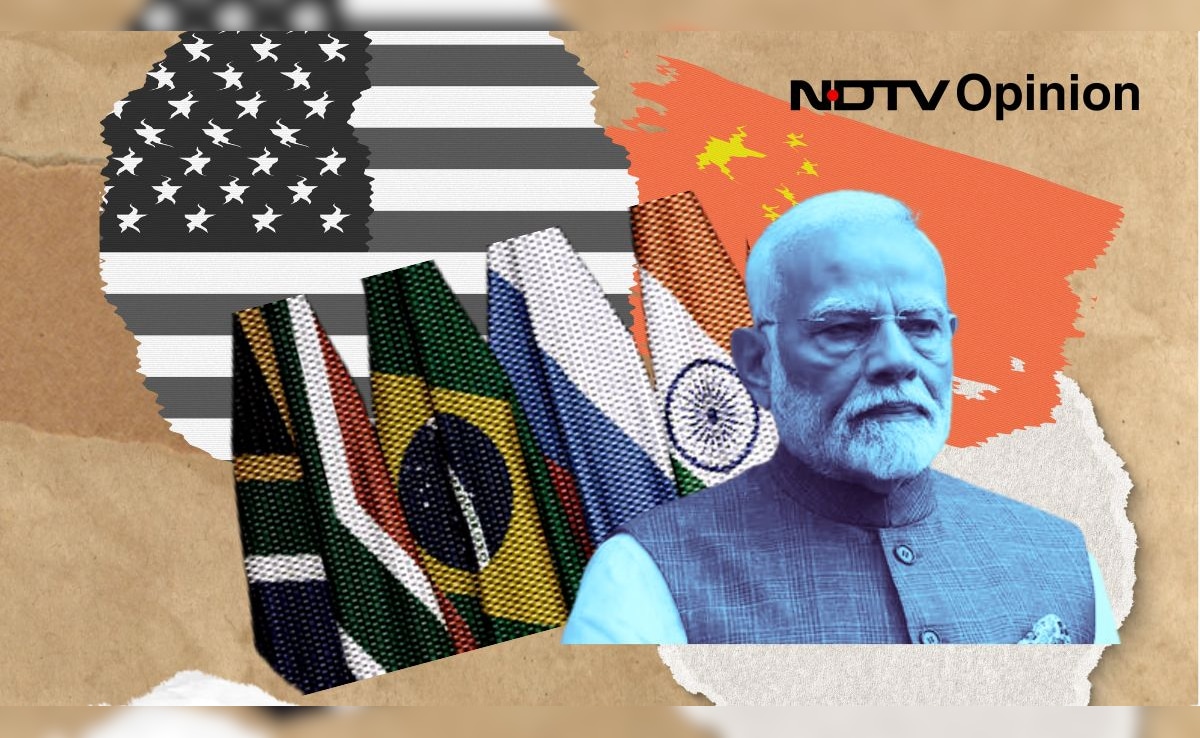
Among all BRICS leaders, it’s perhaps Russian President Vladimir Putin who is waiting for this year’s summit, scheduled to be held on October 22-24 in Kazan, most eagerly.
Last year, he skipped the summit in South Africa for fear of being arrested. In March 2023, the International Criminal Court (ICC) issued an arrest warrant for Putin over alleged war crimes committed during Russia’s full-scale invasion of Ukraine. South Africa, as a signatory to the Rome Statute, would have been obligated to arrest him had he entered the country. And so, Putin had to make do with virtual participation.
But this year’s BRICS summit will be a significant moment for him as he will not only host the event on his own turf but he will also be keen to show to the Western world that despite their sanctions on Russia and attempts to diplomatically isolate him, he is still playing host to some of the world’s most influential leaders, such as Prime Minister Narendra Modi and Chinese President Xi Jinping. As a host, Putin’s effort will be to highlight Russia’s successful outreach to non-Western countries.
It is true that despite Western sanctions, Russia remains a pivotal member of this dynamic group, which represents 24% of the global nominal GDP and 41% of the world’s population. Despite attempts to isolate Russia following its invasion of Ukraine, Putin may also claim that Moscow remains a key player in reshaping the world order, drawing strength from its BRICS alliances. These ties illustrate how countries outside the G7 are increasingly seeking alternatives to Western-dominated institutions like the International Monetary Fund (IMF) and the World Bank
BRICS Is Here To Stay
BRICS, the economic and political alliance comprising Brazil, Russia, India, China and South Africa, has gained a lot of prominence since its inception 15 years ago. Political analysts, economists and academics in the West had long predicted its demise. For instance, Eurasia Group, a political risk consultancy, questioned BRICS’ relevance in 2013, saying, “BRICS is a term that has lost its relevance… It’s a grouping that doesn’t have a lot of coherence, and it’s not clear what they are trying to achieve together.”
But it has not just endured but is expanding, defying initial Western scepticism. Its latest members are Iran, Saudi Arabia, Egypt, Ethiopia and the United Arab Emirates. The bloc has attracted interest from nearly 40 other countries, including NATO member Turkey, which has now formally applied for its membership. Indonesia has been invited to join too, but it seems to be reluctant to become a part of the group, which, it views as anti-West.
India Should Carve Out Its Own Playing Field
Many years after the Indian National Congress was founded in 1885, it remained a petitioner to the British Raj. The assertion of its right to self-determination was weak until Mahatma Gandhi arrived on the national landscape.
Today, India should not be seen to be petitioning for a permanent seat on the United Nations Security Council (UNSC). The UN and UNSC, formed after the Second World War, are relics of the 20th century. The global landscape has dramatically changed since then, with emerging economies like India yearning to play a far more significant role in global affairs.
As the world’s most populous country, the fifth-largest economy and a robust democracy to boot, Indians believe they should have a permanent voice in the decision-making processes that affect global peace and security. But the US, often in collaboration with its Western allies, has considerable sway within the UN system, which allows it to exert influence over its priorities and decision-making. The US is so powerful that it has managed to restrict BRICS’s progress too. For example, many Chinese banks have ceased transactions with Russia to avoid US penalties, and BRICS’s New Development Bank (NDB) has frozen its projects in Russia due to US sanctions.
The Indian government is not necessarily in favour of dismantling the existing US-led world order. It argues that the system has to be more inclusive; it wants what it believes are its rights in the existing system. It urges reforms in global financial institutions, such as the International Monetary Fund (IMF) and the World Bank, which further highlights its desire for a more equitable distribution of power in the global system.
West ‘Protecting’ The Existing Order
The US, France and the UK, all three permanent members of the UNSC, have often openly supported India’s stance on the reform of international bodies. But it’s unclear how genuine their intentions are. With the war raging in Ukraine, West Asia engulfed in violence and China’s rise as their global challenger, the US and its Western allies appear to have become more assertive to protect their dominance of the world order.
For India, the time for petitioning or expecting favours from the West without a quid pro quo is over. India should use BRICS as a platform for amplifying its voice in global governance. It should value BRICS as a platform to advocate for a multipolar world. This is not to suggest that New Delhi should allow BRICS to become an overtly anti-West group. But it should use the platform to its advantage. Prime Minister Narendra Modi has often talked about India’s ambition to be a leading voice of the Global South. Global bodies, such as BRICS and G20, provide a means to achieve such goals.
Why Does China Have The Upper Hand
India has benefited economically from the group, particularly through discounted Russian energy imports amid Western sanctions. Being a founding member of BRICS, India should realise that global fora such as BRICS and the G20 are credible products of a new, multipolar international order. If you do not get your rightful place in the existing order, you help create a new one, a more just order, without disengaging yourself with the existing one. India’s increasing engagement in BRICS and the G20 demonstrates its willingness to work within the existing global order while advocating for change
India should go a step further and be an agent of change. It should not allow China to control the BRICS agenda. But sadly, even though India is a founding member, it does not wield as much direct influence as China, mostly due to the latter’s economic and geopolitical clout. Russia, despite sanctions, remains a key BRICS player, especially because it sees the group as a way to counterbalance Western influence. But India’s importance within the group is undisputed in some areas. For example, it brings credibility to the bloc because of its democratic credentials. It is an established global player in the IT sector and a huge market for investment.
What The West Thinks Of BRICS
Many in the West now appear to take BRICS quite seriously as a counterbalance to the Western hegemony. But they suspect that the inherent division within the group could hamper its progress into a true alternative to the West-dominated world order. China and Russia are pushing BRICS to become a decidedly anti-West bloc. The recent inclusion of anti-West Iran, at their behest, is a case in point. Indeed, experts in the West believe that the alliance seeks alternative centres of power, frustrated with Western domination.
Under President Xi Jinping, China has been trying to create an alternative global financial and technological system to circumvent the US dollar dominance. Projects such as the Belt and Road Initiative (BRI), the creation of the New Development Bank (NDB) and efforts to internationalise the Yuan align with Chinese goals of establishing an alternative multipolar world order.
On the other hand, India, South Africa and Brazil do not fully share China’s ambitions. They favour reforming the existing global system rather than dismantling it. They aim for a multipolar world where they can balance relations between the US and China, without fully aligning with either.
The question of whether BRICS can maintain its cohesion amid internal divisions looms large over the Kazan summit. I will be keenly observing how the summit navigates its members’ competing national interests. But what one can say with confidence is that the group’s relevance as a counterweight to Western power is indisputable.
(Syed Zubair Ahmed is a London-based senior Indian journalist with three decades of experience with the Western media)
Disclaimer: These are the personal opinions of the author
Waiting for response to load…