



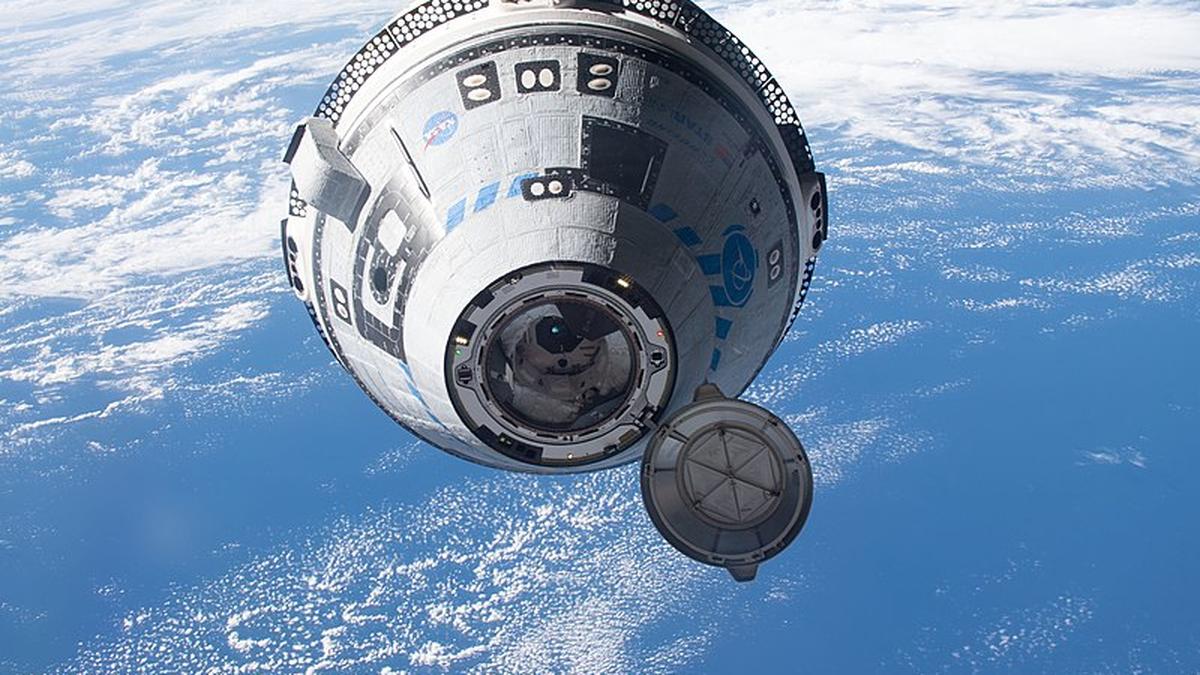
Boeing’s crew transport space capsule, the Starliner, returned to the earth without its two-person crew right after midnight Eastern time on Sept. 7, 2024. Its remotely piloted return marked the end of a fraught test flight to the International Space Station which left two astronauts, Butch Wilmore and Sunita “Suni” Williams, on the station for months longer than intended after thruster failures led NASA to deem the capsule unsafe to pilot back.
Wilmore and Williams will stay on the International Space Station until February 2025, when they’ll return to the earth on a SpaceX Dragon capsule.
Former commander of the International Space Station (ISS) Michael Fossum answers questions about NASA’s decision to return the craft uncrewed, the future of the Starliner program and its crew’s extended stay at the space station.
What does this decision mean for NASA?
NASA awarded contracts to both Boeing and SpaceX in 2014 to provide crew transport vehicles to the International Space Station via the Commercial Crew Program. At the start of the program, most bets were on Boeing to take the lead, because of its extensive aerospace experience.
However, SpaceX moved very quickly with its new rocket, the Falcon 9, and its cargo ship, Dragon. While they suffered some early failures during testing, they aggressively built, tested and learned from each failure. In 2020, SpaceX successfully launched its first test crew to the International Space Station.
Meanwhile, Boeing struggled through some development setbacks. The outcome of this first test flight is a huge disappointment for Boeing and NASA. But NASA leadership has expressed its support for Boeing, and many experts, including me, believe it remains in the agency’s best interest to have more than one American crew launch system to support continued human space operations.
NASA is also continuing its exchange partnership with Russia. This partnership provides the agency with multiple ways to get crew members to and from the space station.
As space station operations continue, NASA and its partners have enough options to get people to and from the station that they’ll always have the essential crew on the station – even if there are launch disruptions for any one of the capable crewed vehicles. Having Starliner as an option will help with that redundancy.
What does this decision mean for Boeing?
I do think Boeing’s reputation is going to ultimately suffer. The company is going head-to-head with SpaceX. Now, the SpaceX Dragon crew spacecraft has several flights under its belt. It has proven a reliable way to get to and from the space station.
It’s important to remember that this was a test flight for Starliner. Of course, the program managers want each test flight to run perfectly, but you can’t anticipate every potential problem through ground testing. Unsurprisingly, some problems cropped up – you expect them in a test flight.
The space environment is unforgiving. A small problem can become catastrophic in zero gravity. It’s hard to replicate these situations on the ground.
The technology SpaceX and Boeing use is also radically different from the kind of capsule technology used in the early days of the Mercury, Gemini and Apollo programs.
NASA has evolved and made strategic moves to advance its mission over the past two decades. The agency has leaned into its legacy of thinking outside the box. It was an innovative move to break from tradition and leverage commercial competitors to advance the program. NASA gave the companies a set of requirements and left it up to them to figure out how they would meet them.
What does this decision mean for Starliner’s crew?
I know Butch Wilmore and Suni Williams as rock-solid professionals, and I believe their first thoughts are about completing their mission safely. They are both highly experienced astronauts with previous long-duration space station experience. I’m sure they are taking this in stride.
Prior to joining NASA, Williams was a Naval aviator and Wilmore a combat veteran, so these two know how to face risk and accomplish their missions. This kind of unfavorable outcome is always a possibility in a test mission. I am sure they are leaning forward with a positive attitude and using their bonus time in space to advance science, technology and space exploration.
Their families shoulder the bigger impact. They were prepared to welcome the crew home in less than two weeks and now must adjust to unexpectedly being apart for eight months.
Right now, NASA is dealing with a ripple effect, with more astronauts than expected on the space station. More people means more consumables – like food and clothing – required. The space station has supported a large crew for short periods in the past, but with nine crew members on board today, the systems have to work harder to purify recycled drinking water, generate oxygen and remove carbon dioxide from their atmosphere.
Wilmore and Williams are also consuming food, and they didn’t arrive with the clothes and other personal supplies they needed for an eight-month stay, so NASA has already started increasing those deliveries on cargo ships.
What does this decision mean for the future?
Human spaceflight is excruciatingly hard and relentlessly unforgiving. A million things must go right to have a successful mission. It’s impossible to fully understand the performance of systems in a microgravity environment until they’re tested in space.
NASA has had numerous failures and near-misses in the quest to put Americans on the Moon. They lost the Apollo 1 crew in a fire during a preflight test. They launched the first space shuttle in 1981, and dealt with problems throughout that program’s 30-year life, including the terrible losses of Challenger and Columbia.
After having no other U.S. options for over 30 years, three different human spacecraft programs are now underway. In addition to the SpaceX Crew Dragon and the Boeing Starliner, NASA’s Orion spacecraft for the Artemis II mission, is planned to fly four astronauts around the Moon in the next couple of years.
These programs have had setbacks and bumps along the way – and there will be more – but I haven’t been this excited about human spaceflight since I was an 11-year-old cheering for Apollo and dreaming about putting the first human footprints on Mars.
Michael E. Fossum is vice-president, Texas A&M University. This article is republished from The Conversation.

Published – September 10, 2024 03:01 pm IST