



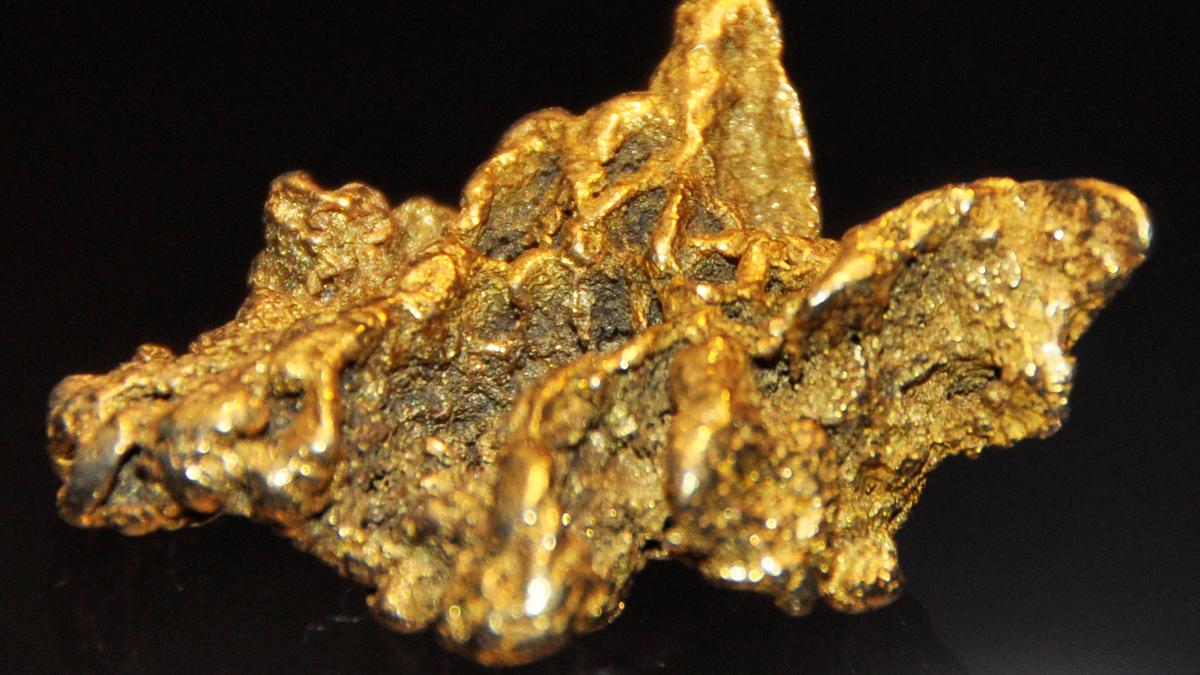
A nugget of gold on public display at the Carnegie Museum of Natural History, Pittsburgh, U.S., November 17, 2012.
| Photo Credit: James St. John
Sometimes a scientific study comes along that reminds us not all the natural mysteries of this world demand highly specialised knowledge or million-dollar experiments to solve. Instead, they reveal something new by using ideas we were familiar with by high school. Doing this science in this day and age is still limited by access to specific instruments and locations and of course time. Not everyone can do it — but that shouldn’t stop us from being wowed by it.
One such study was published in Nature Geoscience on September 2. It opens thus: “Ore deposits represent natural enrichments of elements compared with their normal distribution in Earth’s crust. Gold deposits stand out by having the highest degree of enrichment, by factors of 1,000 to 10,000 required to make economic deposits … compared with base metals, such as copper, that require ~200x enrichment. Gold nuggets represent the most extreme examples of this gold enrichment. Most nuggets originate from the quartz veins formed in orogenic gold systems found around the world. These systems have had exceptional economic importance throughout human history, representing up to 75% of all gold ever mined.”
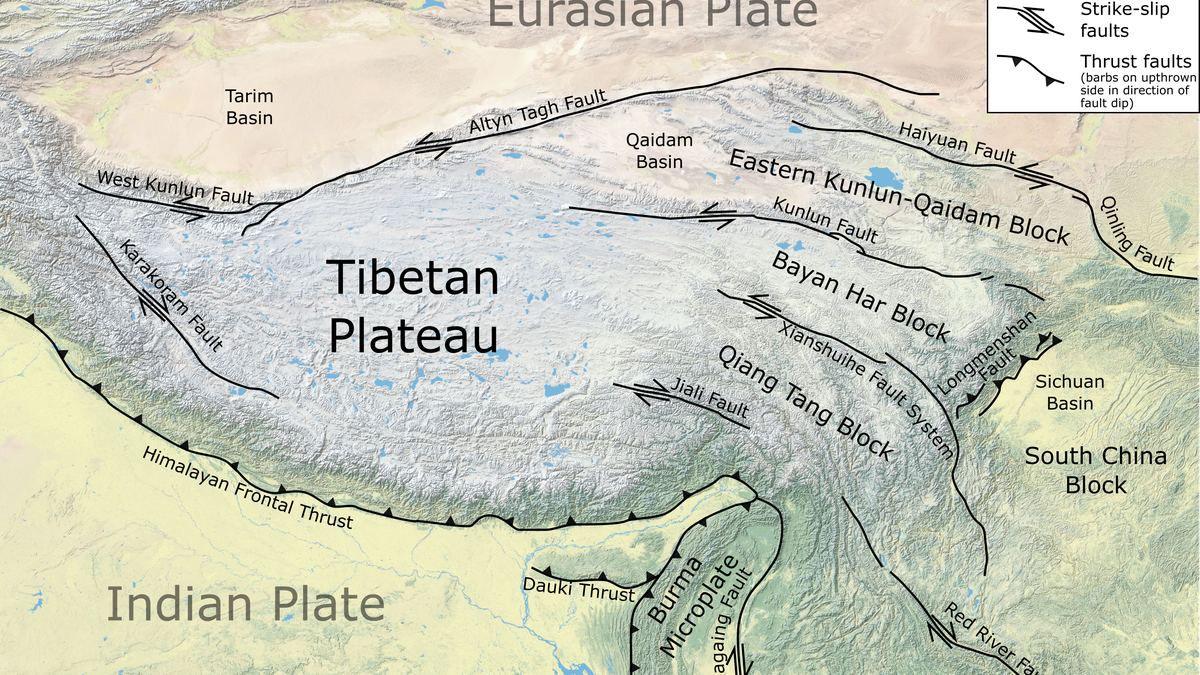
(‘Orogenic’ means a large-scale geological process that creates mountains, such as the interaction of the Indian tectonic plate with the Eurasian plate to create the Himalaya.)
For the study, the researchers — all from research institutes in Australia — were curious why most gold nuggets mined in human history were found in orogenic quartz veins.
Scientists know gold isn’t very soluble in fluids. If gold deposits form when the metal condenses out of water in certain locations, we’d need 10 million litres of water just to have 10 kg of gold. So this theory doesn’t present the full picture. Another idea scientists have had is that water could contain more dissolved gold if the gold is present as nanoparticles, but yet others have said there’s no way to explain why a very large quantity of nanoparticles would get out of water at the specific places where miners have found nuggets. Even others have wondered whether the orogenic nugget veins could be formed the same way epithermal vein deposits — which occur up to 1.5 km underground — are formed: when hot, mineral-rich fluids cool, depositing gold, silver, copper, and/or some other metals on the rocks around them. There’s a problem here, too, per the paper: “This mechanism leaves a clear textural and geochemical signature that cannot be applied to most orogenic deposits”.
Where are the large nuggets coming from, then?
It seems the quartz itself might be the answer. Quartz is a piezoelectric crystal: when it is squeezed or its shape is mechanically distorted in some way, it develops a voltage. Since quartz is also an insulator, electrons can’t flow within the crystal in response to this voltage. Instead, the electric field created distorts the electronic properties of the crystal such that charged particles — like electrons — flow from the crystal to an aqueous solution on its surface or vice versa. And if the quartz crystal is continuously distorted back and forth, these charged particles can also keep flowing back and forth.
“This exchange is referred to as piezocatalysis and can drive electrochemical reactions at the material-solution interface,” the paper read.
So the researchers cut and prepared six slabs of quartz, placed them inside fluids containing small amounts of dissolved gold, and switched on a linear actuator that strained the slabs at a frequency of 20 Hz. (Small earthquakes produce seismic waves in the 5-60 Hz range.) They also prepared six other slabs the same way but didn’t strain them; they formed the control group against which the team could compare the effects of the strain. The team’s goal: to check if piezocatalytic chemical reactions could cause gold to be deposited from the solution to the slabs’ surface.
The solution consisted of chloroauric acid dissolved in a water-salt solvent, where the gold is present as the AuCl4– anion. According to the researchers, while the “dominant” gold-bearing species in orogenic quartz-vein fluids are Au(HS)2– and Au(HS)0, a reaction that causes AuCl4– to gain electrons will also cause the hydrosulphide ions to gain electrons because AuCl4– is the keenest of all three gold-bearing species to lose electrons.
Et voila! An hour after they turned on the actuator, they spotted several small gold deposits on the quartz slabs and none on the control slabs. The chemical reaction they expected was:
AuCl4– + 3e → Au + 4Cl–
The corresponding reactions with the hydrosulphide compounds would’ve been:
Au(HS)0 + H+ + e → Au + H2S
Au(HS)2 + H+ + e → Au + H2S + HS
Thus they had an answer to the question about the origins of orogenic quartz-vein gold nuggets: a seismic wave released during an earthquake and/or its aftershock squeezes natural quartz crystals, leads to piezocatalytic reactions with gold-bearing solutions nearby, and some gold is deposited on the crystals’ surfaces. As this happens thousands and thousands of times, more and more gold finds itself in the quartz veins until, one day, there are large gold nuggets.
According to the researchers, their hypothesis idea is held in good stead by two other details. One: Gold is also a very good conductor of electricity, which means if some gold is deposited in some place for the first time, piezocatalysis will cause even more gold to be deposited there in future, which the researchers have written could explain why nuggets are so highly localised. And two, according to the paper:
Additionally, this provides interpretation for highly interconnected networks of gold along fractures within quartz veins; the fractures are repeatedly reactivated as fluid pathways, and since piezoelectric voltages are coupled with stress, the maximum achievable voltages occur during brittle failure. Since piezoelectric voltages are instantaneous and leave behind no visible tracer, this can rationalise why gold nuggets commonly appear to be ‘floating’ in quartz veins with no obvious chemical or physical trap.
Take quartz, dip in aqueous solutions of gold, and hit them with earthquakes for millennia. Making big gold deposits is almost like microwaving cup noodles. Almost. And understanding how only demanded knowledge of high-school physics and chemistry.